From scientist to silk farmer: India's silk industry renewal

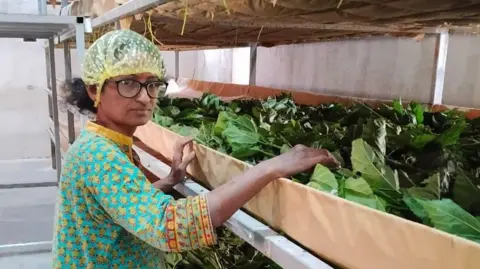 Umamaheswari
Six years ago Dr Jolapuram Umamaheswari walked away from her career as a scientist in Singapore.
"When I came back to India, I was jobless but I wanted to be my own boss," she says.
After some research she hit on silk farming, or sericulture. It involves feeding mulberry leaves to silkworms, harvesting their cocoons and extracting the silk fibres.
"Silk farming sits at a rare intersection of biology, precision, and business. It didn't feel like I was leaving science, it felt like I was applying it differently," she says.
However, raising silkworms on her farm in the eastern state of Andhra Pradesh proved to be a challenge.
"The early days were not easy. There were disease outbreaks, inconsistent yields, and the steep learning curve that comes with managing living systems," she remembers.
Her scientific background helped to keep her going.
"Over time, small improvements in hygiene, feeding practices, and environmental control began to compound into better survival rates and higher-quality cocoons."
The work paid off, today Umamaheswari produces 10 crops of raw silk a year, with the growth cycle of each batch of silkworms taking 25 to 30 days.
She makes around $1,000 (£760) a month.
"The result is like a steady, almost salary-like income. That's what makes sericulture unique, If managed well, it gives you regular returns, not just seasonal income," Umamaheswari says.
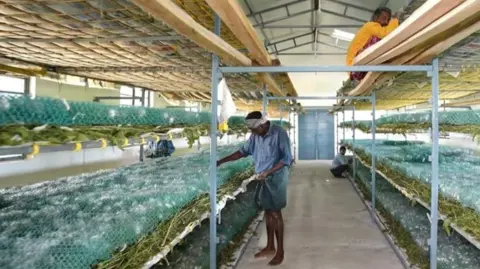 Asho Farms
"Modern sericulture is currently undergoing a massive digital and biotechnological shift," says Krishna Tomala, the founder of Asho Farms.
From producing silkworm eggs to supplying larvae and rearing cocoons, Asho Farms has integrated the latest technology.
"A silkworm grows nearly a thousand times in just 25 days. But its success depends completely on temperature, humidity and good-quality leaves," Tomala says.
Silkworms are "extremely sensitive" to changes in their environment, he points out. Temperature and humidity used to be monitored manually, but today sensors and automated systems automatically adjust an array of fans, heaters, and humidifiers.
At Asho, AI is used to identify any problems with the crops.
"I use computer vision and machine learning. Cameras can detect early signs of diseases in silkworm larvae with over 99% accuracy, which helps remove the infected worm immediately below the entire lot is infected," Tomala says.
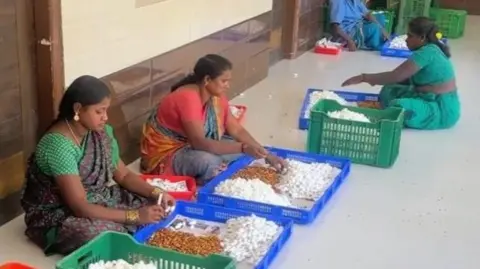 Asho Farms
India is the world's second-biggest silk producer, behind China which dominates the market.
But India can boast an unrivalled range of products, as well as some unique silk.
"India is the only country in the world where all four commercial varieties of silk - Mulberry, Tasar, Eri, and Muga - are available.
"Muga silk, in particular, is unique to India, primarily found in Assam and Meghalaya," says Manthira Moorthy, a director at the government's Central Silk Board.
So what's next for India's industry?
Manipulating the DNA of silkworm gene is helping create more robust varieties.
"We have entered a new era of research focusing on genome editing. In collaboration with international partners like Japan, we have developed disease-resistant silkworm varieties," says Moorthy.
The Central Silk Board is also looking at how to use the by-products of silk making.
For example, for every kilo of raw silk produced around 2kg of dried silkworm pupae are left over.
Comprising more than 50% protein, it's a nutrient dense foodstuff, and is being used as food for poultry and fish.
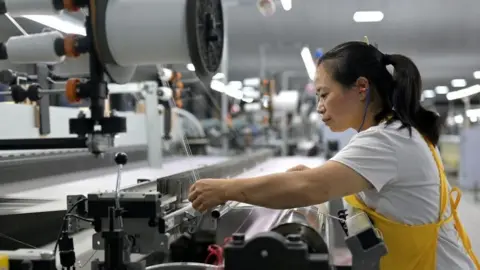 Getty Images
Satheesh Kannur runs a company in the final stage of sericulture - turning cocoons into raw silk yarn - a process known as reeling.
Most of the work is done by machines, which tease out silk fibres from the cocoons and then combine the fibres to make one strong thread.
One machine can produce between 50kg and 60kg of raw silk a day.
"Technology is transforming silk reeling from a slow, manual craft into a fast, precision-driven industry, while solar power is quietly making it more sustainable," says Kannur.
But he is worried about the outlook for the industry. He thinks Indian farmers will not be able to produce sufficient silk cocoons to meet the demand from reelers like him.
"Without cocoons, there is no silk. The entire industry depends on farmers. Many second-generation farmers are not willing to continue silk framing and the landholdings are spread in small sections. For this industry to grow we need huge lands," Kannur says.
However, the Silk Board does not see this as a problem. Although the numbers of farmers are falling, production of cocoons is rising due to more modern techniques.
"With advancements in rearing techniques, disease control, and scientific support to farmers, yield per acre has gone up significantly," the Silk Board said in a statement.
Back in Andhra Pradesh, Umamaheswari is planning a low tech addition to her farm.
She is building a cow shed and when that's populated there will be an extra stream of income from milk plus the cows' manure will be used to fertilise the mulberry plants.
"Even small improvements in technique can significantly increase yield and quality, making it a rewarding field for someone who likes to apply knowledge practically."
More Technology of BusinessAre domes and spheres the future of entertainment?
The spiky cactus fruit giving Indian farmers a cash boost
Is it possible to build a plastic-free home?
International BusinessIndiaTechnology of BusinessСхожі новини

Вплив війни на Близькому Сході: Ціни на житло в Дубаї знизилися вперше з часів пандемії

Кількість IT-компаній в податковому «Клубі білого бізнесу» зросла до 7%