France’s Jean-Luc Mélenchon announces 2027 presidential bid
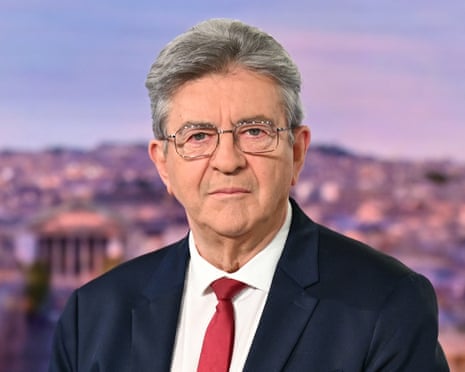
The radical left leader will seek presidency for the fourth time – despite previously vowing to stand aside
Jean-Luc Mélenchon, France’s radical left leader, has confirmed he will run again for president next spring, saying it was urgent for the country to stand up against war being waged by the US and Israel in the Middle East.
The 74-year-old veteran leader of La France Insoumise (LFI), announced in an interview with the French broadcaster TF1 that he would run for the presidency for the fourth time in 2027.
“We are threatened by a widespread war, we are threatened by a spectacular change in the climate, and now we have an economic and social crisis approaching,” he said. He called for a common front with Spain against war in the Middle East.
A one-time Trotskyist and former teacher, Mélenchon spent 30 years in the traditional left party of government, the Socialists, where he served as a minister and was once the youngest ever Socialist senator. He quit in 2008, arguing the party wasn’t properly leftwing.
He ran for president on a radical left ticket in 2012, 2017 and 2022 – coming third that year behind the far-right leader Marine Le Pen and the president, Emmanuel Macron.
After the last presidential election, Mélenchon had vowed to stand aside to let a younger generation take the lead but now said he would run again next year because he had the most experience.
There are a large number of would-be candidates on the rest of the broader French left, from Greens to Social Democrats, which could split the vote. Mélenchon said his radical left economic programme could counter the National Rally, the far right party that will be represented by either Le Pen or Jordan Bardella, and is polling high.
But in a polarised French political landscape, Mélenchon is seen by opponents as an increasingly divisive and provocative figure. Several polls at the end of 2025 found he was the political figure in France who attracted the most hatred from voters.
Political commentators and pollsters have said the wider electorate’s high feeling of antipathy towards him would prevent him from winning, even if divisions on the centre and the left allowed him to reach the final round.
Last month, the Socialist party national bureau accused Mélenchon of “intolerable antisemitic comments” and “caricature conspiracy theories” after public rallies in which he questioned the pronunciation of the name of the late sex offender Jeffrey Epstein and then appeared to deliberately stumble over Raphaël Glucksmann’s name, the French centre-left member of the European parliament , who is Jewish.
Glucksmann said that Mélenchon, by mocking Jewish or foreign-sounding names, had become the “Jean-Marie Le Pen of our times” and was “playing with the worst codes of the French far-right and antisemitism”.
Mélenchon then posted on social media saying he was sorry and that he had accidentally mangled Glucksmann’s name with others during a speech in Perpignan, in southern France. He denied any antisemitism, saying: “I’m the first one who is sorry, thinking about those it hurt.”
Announcing his candidacy on TF1 at the weekend, Mélenchon said there was too much division and social inequality in France and his main adversary was the far-right. “What most divides the unity of the French people is privilege and racism,” he said.
Under the French constitution, Macron cannot seek a third consecutive mandate as president next year.
Edouard Philippe, Macron’s first prime minister in 2017, has also announced he intends to stand in 2027, representing a centre-right ticket. Scores of other figures from the centre, left and right have said they are keen to run, amid a lack of clarity on how candidates will be chosen.
Explore more on these topicsShareReuse this contentСхожі новини
Cooler, Variable Week Ahead: Met Office says northerly winds will cut UK warmth; frosts and showers follow

'Can a neighbor hear a gunshot?': Chilling forensic details emerge in murders of two Bangladeshi students in US

Meto Komori and Yuhi Chito suspension shocks fans as VSPO! hides details behind contract violation claims