Forza Horizon 6 PC performance analysis: Heavy on your CPU, with uninspiring ray tracing, but at least it all runs very nicely
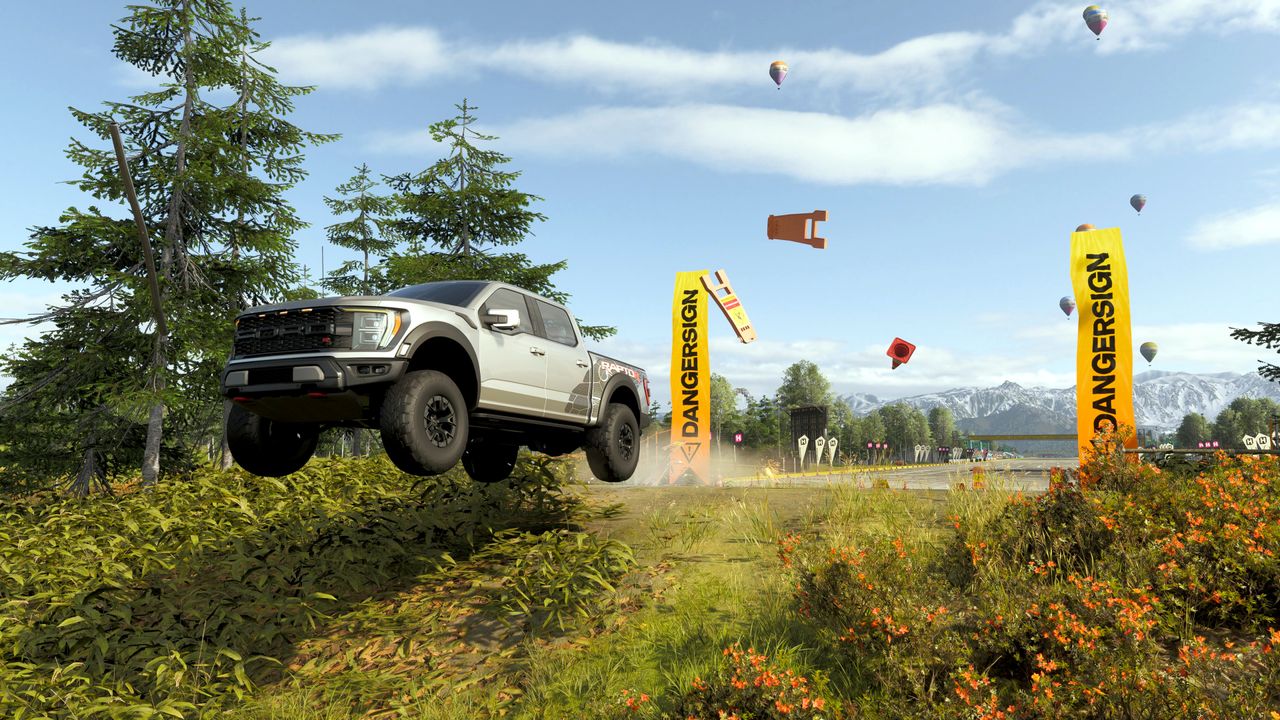
It's been five years since Xbox Game Studios launched Forza Horizon 5, and now it's back again, and in Forza Horizon 6, you'll be burning rubber, smashing through fences, and generally causing four-wheeled mayhem in and around Tokyo, Japan.
The Forza Horizon games have all been very much 'arcade driving' in nature, and number six doesn't aim to change things in that sense. If truth be told, this new version isn't a whole heap different to its predecessor, at least on face value. But that's okay, because FH5 looked great, ran well on most PCs, and is a blast to play.
If that's all up your alley, then you'll be pleased to know that Forza Horizon 6 is very much more of the same thing. Except this time, you can use ray tracing everywhere, if you want the very best visual experience. And the rendering workload is scalable across a ridiculously broad range of gaming PCs: from the Steam Deck, all the way through to a 3D V-Cached chip paired with a high-end GPU.
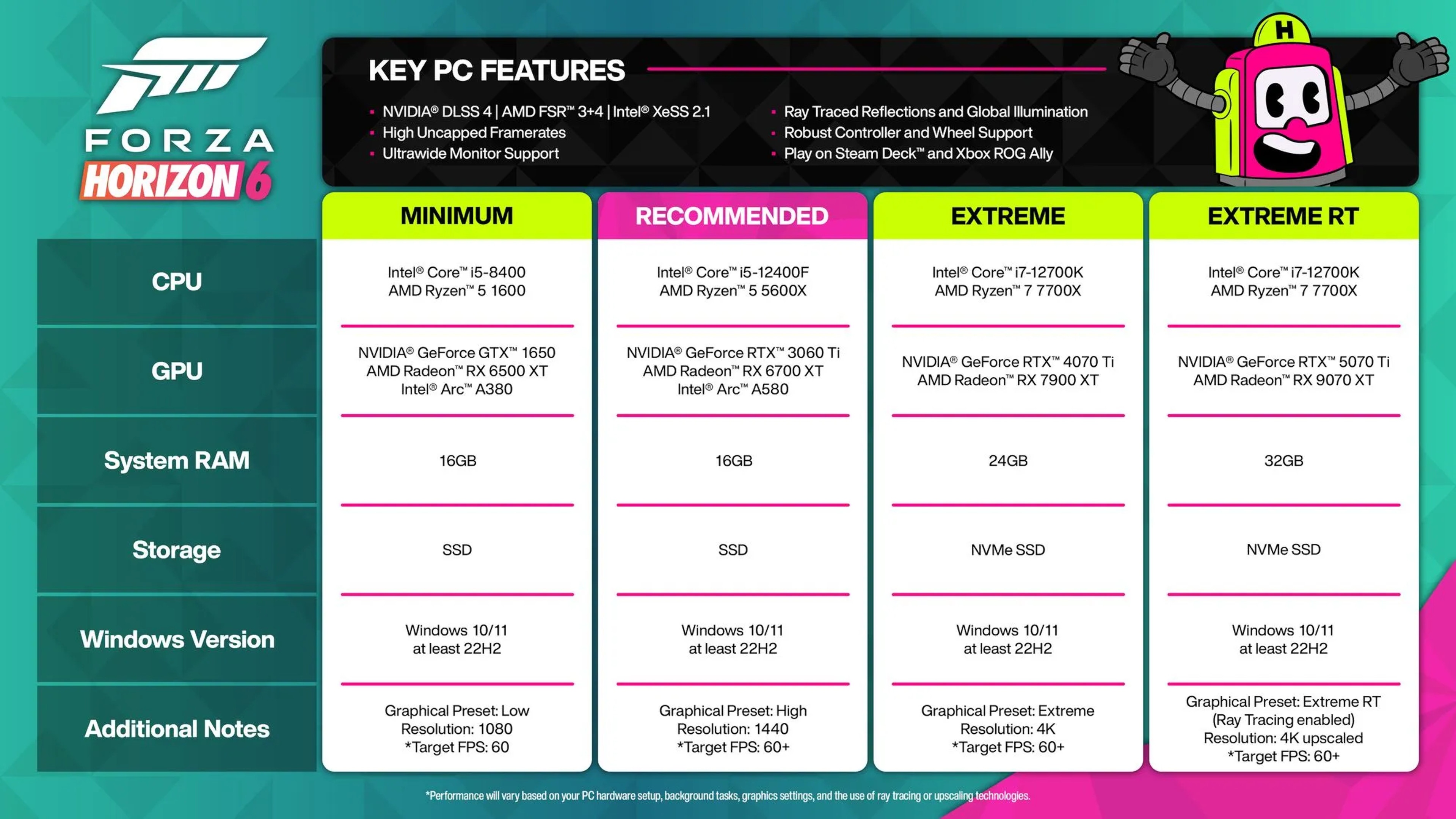
Just as all publishers do these days, Xbox Game Studios released a system requirement breakdown, indicating what kind of hardware is required to achieve the stated performance at a given resolution and graphics preset. So with that all in mind, I set off to see just how well reality matches Microsoft's claims.
Test PC specs
- Asus ROG Ally, 15 W power mode
- Ryzen 5 5600X (65 W), 16 GB DDR4-3200, GeForce RTX 3060 Ti
- Ryzen 7 7700X (105 W), 32 GB DDR5-6000, Radeon RX 7900 XT
- Core Ultra 5 245K (125 W), 32 GB DDR5-6000, GeForce RTX 5060
- Ryzen 9 9950X3D (170 W), 32 GB DDR5-6000, GeForce RTX 5090
- Monitor: Acer Nitro XV282K KV
- Operating System: Windows 11 25H2
- Drivers: Adrenalin Edition 26.5.1 / GeForce Game Ready 596.36
As I didn't have PC hardware close enough in age or performance to that listed under the Minimum requirements, I started things off with a direct clone of the Recommended specs. From there, I moved to an Extreme spec setup, before putting together a modern 'mainstream' build and a wallet-bursting top-end system. To round things off, I dusted off my Asus ROG Ally to see how things were on a handheld device.
And you know what? Microsoft's claims are mostly spot on.
FH6 'Recommended spec' PC
1440p TAA | High preset | Ryzen 5 5600X, GeForce RTX 3060 Ti | Benchmark
Forza Horizon 6 has a built-in benchmark, which performs half a lap of a simulated race. While it is all 'on rails', the CPU workload is actually quite indicative of what you can expect to see in the game itself.
With the race being in Tokyo city, and the weather being somewhat on the wet side of things, you've got an awful lot of reflections going on, including a reasonable amount of lighting sources to handle.
As you can see in the above video, the 'recommended spec' gaming PC copes pretty well, getting an overall frame rate in line with Microsoft's claims. For the most part, the 1% low frame rate remains steadily above 60 fps, too.
Benchmarks are one thing, of course, so let's take a gander at how things fare once you're in the game itself.
Other that the fact that I can't drive for toffee (a tad worrying, given a drive a real car on a daily basis), the performance in-game is very good indeed for such a PC configuration. The overall graphics are very respectable, too, although there is a noticeable degree of pop-in with reflections on buildings.
The one thing that I noticed almost immediately was the level of CPU utilisation, typically bouncing around between the high 70% and 80% mark, with the odd bump into the 90s. As you'll soon see, CPU usage in this game is way higher than you probably expect it to be.
FH6 'Extreme spec' PC
4K FSR Quality | Extreme preset | Ryzen 7 7700X, Radeon RX 7900 XT
Xbox Game Studios doesn't list anything especially 'mid-range', instead jumping from Recommended to a PC that uses the Extreme graphics preset, at 4K with upscaling enabled. I put together a rig with a Ryzen 7 7700X and Radeon RX 7900 XT, so the upscaling in question here is FSR 3.1 Quality.
If you have a Radeon RX 9000-series graphics card, you'll be able to use FSR 4. Though having explored the quality of the implementation of DLSS, FSR, and XeSS in Forza Horizon 6, I reckon you probably won't notice any difference between using FSR 3 and FSR 4.
The one thing you won't be able to enable, however, is FSR frame generation. For whatever reason, it's simply not an option for both FSR variants, nor XeSS for that matter. While the game doesn't really need frame gen, if you're aiming to get the highest possible frame rate, then you're going to be limited as to what you can achieve with an AMD or Intel GPU.
At least all three upscaler implementations are very solid, and I didn't see any glitches or oddities when using any of them. It's just very odd that the developers didn't go the whole way of adding the full feature set of FSR and XeSS.
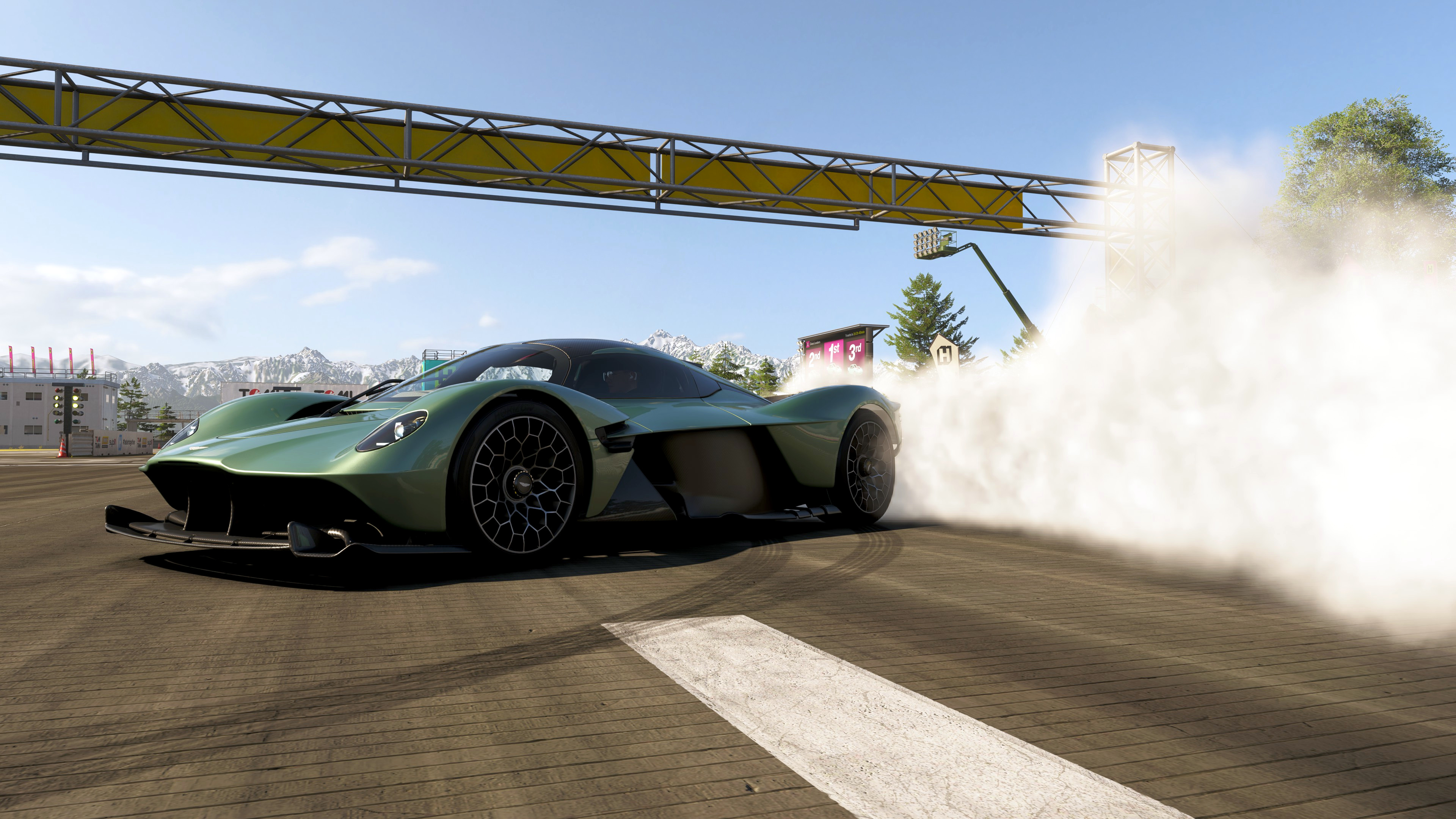
Anyway, at 4K with FSR Quality, and using the game's Extreme quality preset, the Radeon RX 7900 XT easily copes with the rendering workload, and produces very acceptable average and 1% low frame rates. The Ryzen 7 7700X's utilisation isn't as high as the 5600X's, generally hovering around the 30% mark.
That said, if you drive through scenery with a lot more detail, especially at night time or when the road is wet (i.e. with lots of reflections), the utilisation can jump to around 45% to 50%. I tracked the workload distribution using Microsoft's PIX on Windows and found that the game generates a lot of threads, with every core being hit pretty frequently.
Hence why you can see the Ryzen 7 7700X consistently pulling over 140 W of power in the above video. That's right at the top of that CPU's limit, so don't be surprised if you hear a lot more cooling noise from your gaming PC when playing FH6.
Modern mainstream PC
1440p DLSS Quality | High+RT preset | Core Ultra 5 245K, GeForce RTX 5060
Most system requirements tend to ignore the latest generation 'mainstream' hardware. The lower specs generally refer to older components, leaving the new stuff for 'maximum graphics' scenarios. To address that point, I put together the kind of system that you can find around the $1,200 mark (i.e. an RTX 5060-powered system).
As it turned out, it was an interesting experiment, as I initially began using the same settings as I did for the 'Recommended' setup. Naturally, I got considerably better frame rates, so I tried using the Extreme graphics preset. The game immediately threw out a caution about VRAM usage, so I switched to High with ray tracing to stay within the 8 GB budget.
Forza Horizon 6 ray tracing is entirely optional, and it's used to replace screen space reflections and global illumination. We'll take a closer look at this later on, but for now, you can see that if you do have a modern mainstream gaming PC, you'll have no problems playing FH6 at well over 60 fps.
Should that not be high enough for your tastes, and you have an RTX 40- or 50-series graphics card, then you add frame generation to lift things very nicely. The above video show a comparison between no FG on the left and 3x Multi FG on the right (Nvidia Reflex is enabled in both).
As you can see, there are no drawbacks to using DLSS FG in Forza Horizon 6, as you get the same kind of performance lift in the game itself, as well as barely any increase to the system latency (this is also true for using FG on RTX 40 cards).
Ultra high-end PC
4K DLSS Quality | Extreme+RT preset | Ryzen 9 9950X3D, GeForce RTX 5090
Although I didn't have an RTX 5070 Ti or RX 9070 XT to hand, to examine what Forza Horizon 6 is like at 4K with upscaling and the Extreme+RT preset enabled, I presumed an RTX 5090 would be more than up to the job, given how much more powerful it is than either of the two aforementioned graphics cards.
If you take a look at the frame rates in the above video, you'll see that when Xbox Game Studios says '4K upscaled' for Extreme+RT, it doesn't mean DLSS Quality. Sure, 100+ fps is extremely playable, but don't forget that this is with an RTX 5090 (and a Ryzen 9 9950X3D).
Going all-out with the graphics options at this resolution with less capable GPUs will almost certainly require the use of Balanced or Performance upscaling. Frame generation can help, too, but you only want to be using that if the baseline frame rate (especially the 1% low frame rate) is at least 60 fps.
I have to say that I felt somewhat disappointed by how Extreme+RT looked. It was never bad, as such, and reflections on buildings were all pixel-perfect, but I was expecting something a little...more. Precisely what I can't quite put my finger on, but the image at the very top of this article was taken with every single graphics setting maxed out (basically Extreme+RT with reflections one notch higher).
Night City in Cyberpunk 2077, it is not.
Handheld gaming PC
720p TAA | Low preset | Asus ROG Ally (15 W mode)
For the review build of Forza Horizon 6, Xbox Game Studios noted that there were improvements to come for handheld gaming PC owners. Watch the above video, captured from an Asus ROG Ally, running at 720p with the Low preset, and you'll see that there are some occasional...umm....rendering problems.
I hasten to add that they are occasional. Sometimes, everything ran fine on the Ally, though every now and then, the handheld just stopped producing a video output signal altogether. In part, this isn't a problem with Forza Horizon 6, as the game spits out a warning about drivers when you start off.
Basically, you need to be using Radeon 26.3.1 or newer with FH6, but the latest offered by Asus is only 25.30.27. This might be the cause of the problems seen above, but since you can't upgrade the Ally's drivers until Asus gives you a new set, one can't rule them out.
You might be wondering why I didn't test at 1080p with FSR Balanced, or similar. That's because FSR 3.1 upscaling adds a non-trivial shader load to a game, and with most handhelds only packing a smattering of shader cores, you're better off just dropping the native resolution instead.
Now, 720p looks very fuzzy on a big screen, but on a typical seven-incher as used by many handheld gaming PCs, it's actually fine. The performance is too, for the most part, though some heavy stutters do spoil the fun at times.
CPU usage
As I've already mentioned, Forza Horizon 6 is pretty heavy on the CPU, throwing out lots of threads and pretty much working every core you have in your processor. However, there are some exceptions to this and one thing I noticed is that dual CCD Ryzen chips, especially those with 3D V-Cache, aren't distributing the threads correctly.
To show you what I mean, I used Task Manager to track CPU core usage with a Ryzen 9 9950X3D (on the left in the video) and a Core Ultra 7 270K Plus (right-hand side). In the case of the AMD processor, the first two top rows of graphs are for the 16 logical processors (i.e. eight cores, two threads each) in CCD0.
That's the one that has the extra L3 cache, and threads must be scheduled to be handled by that CCD and not the other one. Except that you can clearly see this is not happening. The cores in CCD1 are being more heavily used than those in CCD0, and I confirmed this using PIX on Windows.
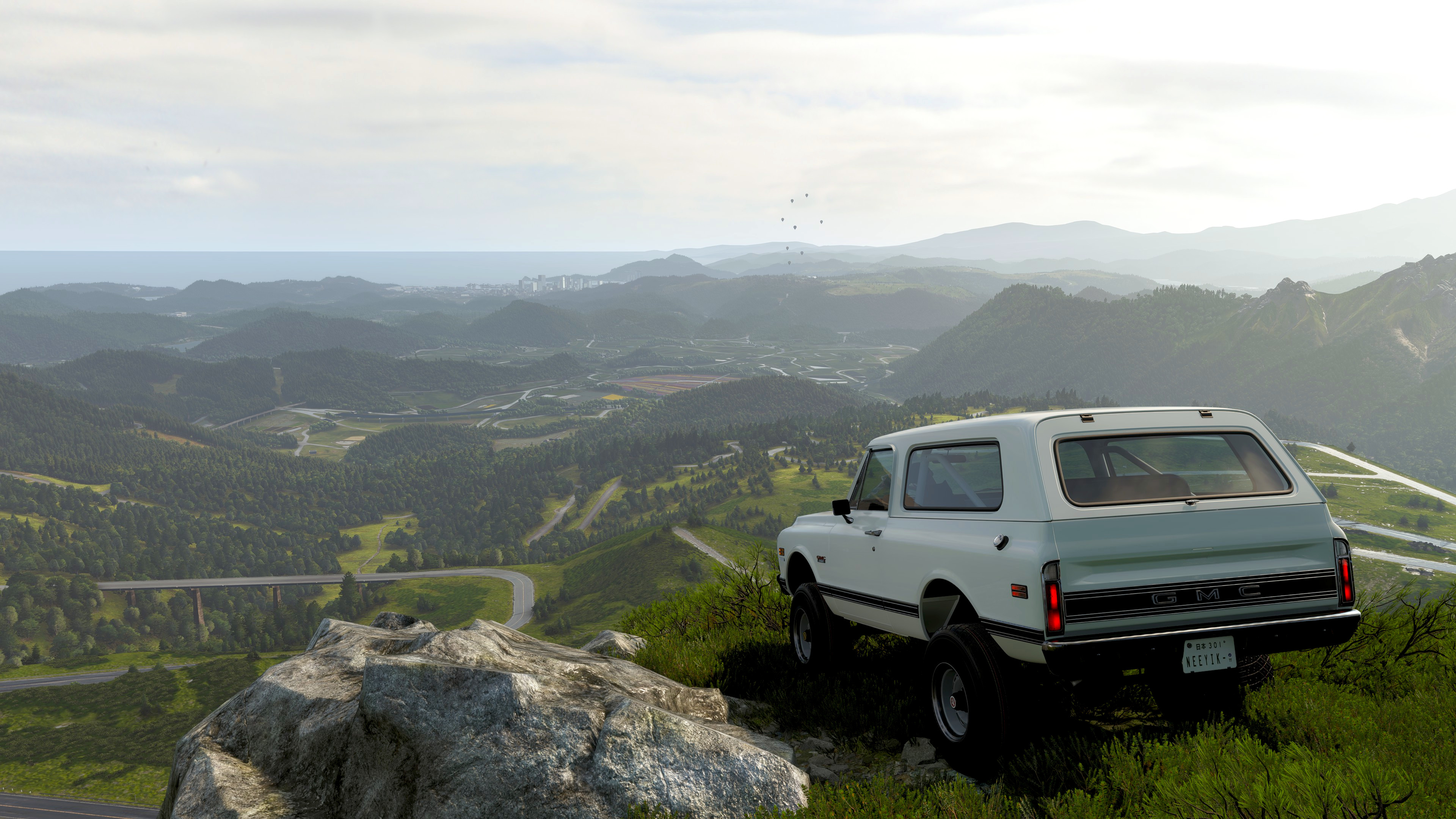
I wasn't able to determine precisely what thread workloads are being done on the 3D V-Cached core chiplet, but apart from core 0 in CCD0, the rest aren't doing a whole lot of work, just brief bursts now and then. The cores in CCD1, on the other hand, are being absolutely hammered.
Now look at the core usage in the 270K Plus. In Task Manager, the P cores are clearly marked by the high utilisation, rather than the E-cores, which is precisely what you want to happen with an Intel hybrid architecture chip. I'm confident that this will be resolved with game patches or new drivers in the future, and it really only affects a very small selection of CPUs, but given how CPU-heavy Forza Horizon 6 is, I hope this is resolved sooner rather than later.
Is ray tracing worth using?
After testing Forza Horizon 6 with the Extreme and Extreme+RT presets, and coming away somewhat disappointed by the impact of ray tracing in the game, I went back and used the built-in benchmark to do a direct visual comparison between the two modes.
In the above video, taken using the RTX 5090 setup, every graphics setting is maxed out on both sides, but ray tracing is disabled on the left. Reflections are clearly more accurate when using RT, but while the global illumination is technically more correct, I actually prefer the non-RT look and feel.
In fact, if you delve a little closer into how the game's RTGI implementation affects the visuals, you'll see that it does a poor job at preserving fine details.
At least, you can avoid this by just using RT reflections alongside screen space global illumination, and there's a decent array of graphics options for you to tweak until your heart's content. Personally, though, I recommend not bothering with ray tracing in this game, despite the better reflections.
The performance hit isn't exactly small (roughly 36% in the RTX 5090 benchmark, at 4K with DLSS Quality) and I'd much rather have a very smooth running game, than staring at building and going 'ooh, gosh, wow' as I plough headlong into a pile of vehicles.
Final thoughts
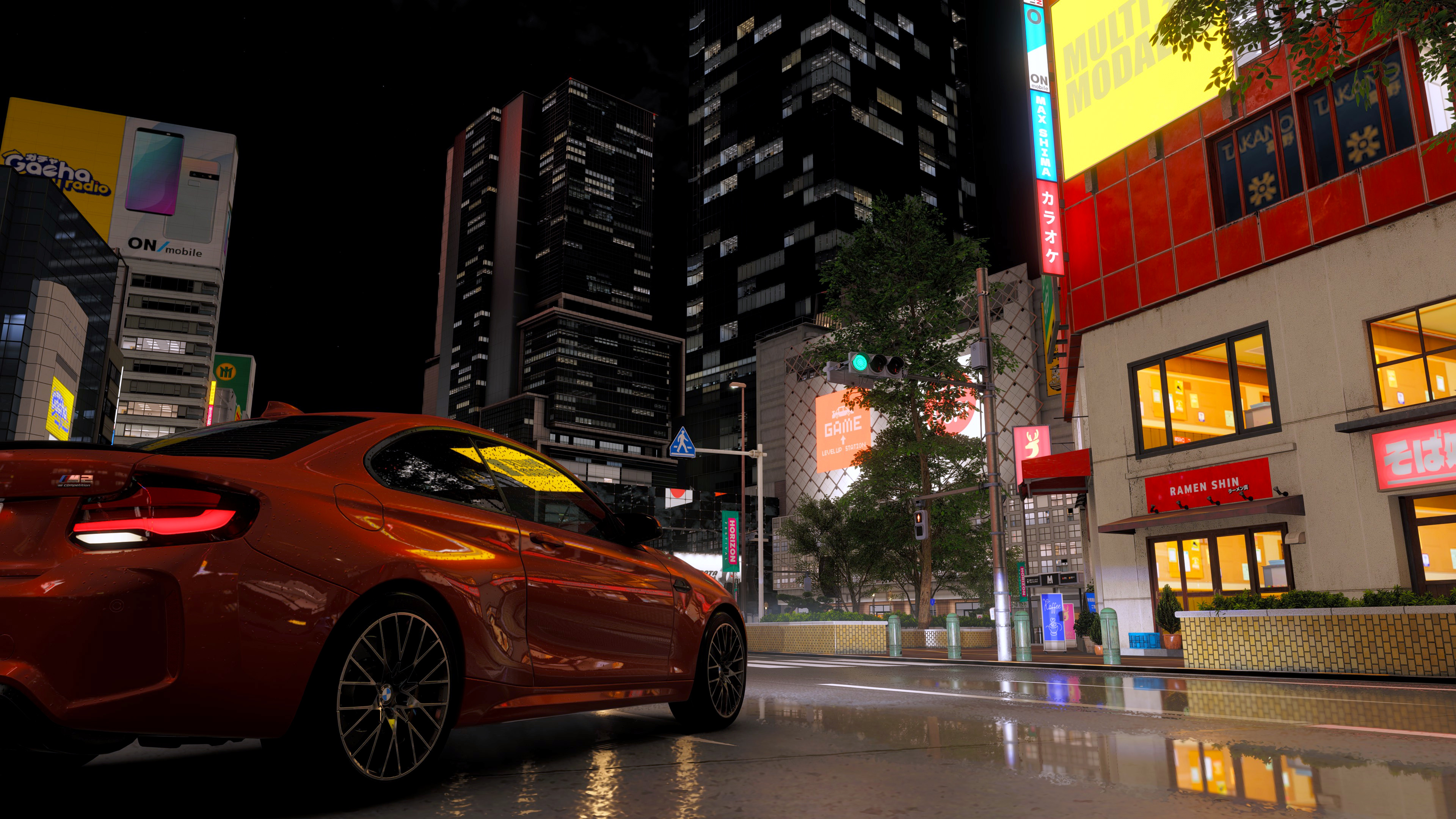
Graphics grumbles aside, the main thing to take away from all of this is that Forza Horizon 6 runs well on the PCs I've tested, and for Xbox Game Studios' Recommended and Extreme system requirement claims, the performance figures do tally. That's good news for all PC gamers wanting to jump into the new game and hoon around at max speed, exploring every nook and cranny to bag hot-snottin' rides.
While the latest entry in the 14-year-old franchise might not be making any bold steps forward in terms of rendering technology, especially compared to Forza Horizon 5, the game fundamentally looks fine and, more importantly, runs fine—even without upscaling and frame generation.
And that's especially encouraging in this day and age, when PC upgrades cost a small fortune. It doesn't matter if your GPU is a few years old, because it should be more than happy to give you many hours of fun in the new Forza.
Схожі новини
Procrastination, productivity and inspiration: how research is like designing video games

Ахметова подвел курс гривни. Энергохолдинг ДТЭК ВИЭ сменил миллиардную прибыль на «зеркальные» убытки

Pokemon's 151 Hershey's Kisses Are Back With A Team Rocket Expansion