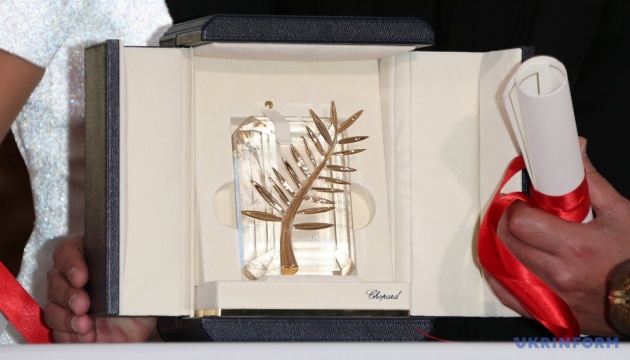
'Fjord' by Romania's Cristian Mungiu wins Palme d'Or at Cannes Film Festival
The Norway-set drama "Fjord" by Romanian director Cristian Mungiu was awarded the Palme d'Or at the closing ceremony of the 79th Cannes Film Festival as critics hailed a strong field of contenders directed by auteurs from Russia, Iran, Japan and beyond.
Issued on: 23/05/2026 - 20:11Modified: 23/05/2026 - 22:07
4 min Reading time Share By: FRANCE 24
Cristian Mungiu’s Norway-set drama about political polarisation “Fjord” has won the Palme d’Or, the Cannes Film Festival’s top honour that on Saturday went for the second time to the Romanian director of “4 Months, 3 Weeks and 2 Days”.
This year's edition of the festival saw few films breakout but “Fjord” found wide admiration for its engrossing tale of what Mungiu called “left-wing fundamentalism”.
The film stars Sebastian Stan and Renate Reinsve as Romanian Evangelicals who move to Norway, but soon after have their children taken from them by child services for spanking them.

Mungiu becomes just the 10th filmmaker to win the Palme d’Or twice. His “4 Months, 3 Weeks and 2 Days”, a Romanian abortion drama, won the award in 2007.
The win also extended Neon’s unprecedented streak of Palme d’Or winners. The specialty label has been attached to the last seven Palme winners.
With Hollywood studios largely absent, this year's Cannes Film Festival leaned into its indie roots with a strong field of arthouse directors.
The nine-member jury led by South Korean director Park Chan-wook were tasked with choosing one of 22 films from Cannes veterans, including Spain's Pedro Almodovar, Iran's Asghar Farhadi and Romania's Cristian Mungiu, for the festival's top award.

The Grand Prix, or second prize, went to “Minotaur”, Andrey Zvyagintsev’s domestic thriller set against Russia’s war with Ukraine. Loosely based on Claude Chabrol’s 1969 film “The Unfaithful Wife”, “Minotaur” is about a Russian businessman suspicious of his wife’s indiscretions. At the same time, he’s tasked with conscripting 150 of his workers for Vladimir Putin’s war machine.
During his acceptance speech, Zvyagintsev appealed to President Vladimir Putin to end the invasion of Ukraine.
"Millions of people on both sides of the line of contact now dream of only one thing: that the massacres finally stop," he said.
"And the only person who can put an end to this meat grinder is you ... put a stop to this carnage, the whole world is waiting for this."
Two films won for best director: the Polish filmmaker Pawel Pawlikowski, for his postwar drama “Fatherland”; and the Spanish creative duo Javier Ambrossi and Javier Calvo for “The Black Ball”, a generation-spanning queer epic.
Virginie Efira and Tao Okamoto, the two stars of Ryusuke Hamaguchi’s “All of a Sudden” shared the best actress award. In the elegantly empathetic drama, the two play women brought together in friendship out of their mutual sense of care for others.

The jury also split the best actor prize. They chose Emmanuel Macchia and Valentin Campagne, the two stars of “ Coward”, Lukas Dhont’s drama about young Belgian men sent to the frontlines of World War II.
The prize for best screenplay was awarded to Emmanuel Marre for “A Man of His Time”, a French drama about a Nazi collaborator in Vichy France. Marre based it on the experiences of his own great-grandfather.
The jury prize, or third place, went to German filmmaker Valeska Grisebach’s “The Dreamed Adventure”, a crime drama set in a Bulgarian border town.
The Camera d’Or, Cannes’ award for best first film, went to Marie Clémentine Dusabejambo’ post-genocide drama “Ben’Imana,” the first Rwandian film to be officially selected for the festival.
Winning an award at Cannes typically transforms careers, shapes the awards season that follows and cements directors in the canon.
Recent examples include last year's second-place winner, "Sentimental Value" starring Renate Reinsve, which later took the Oscar for best international feature film, as well as 2024 winner "Anora", which went on to sweep the Oscars with five wins.

(FRANCE 24 with AP, AFP and Reuters)
Advertising Keywords for this articleСхожі новини