First Impressions: A Quick Drive Aboard VinFast’s VF6 Proves More Than Satisfying
 The VinFast VF6. Torino-designed. (Photo for Cleantechnica by author)
May 4, 20263 hours
Raymond Tribdino
0 Comments
Support CleanTechnica's work through a Substack subscription or on Stripe.
The VinFast VF6. Torino-designed. (Photo for Cleantechnica by author)
May 4, 20263 hours
Raymond Tribdino
0 Comments
Support CleanTechnica's work through a Substack subscription or on Stripe.
This Is Not A Test Drive
I had myself listed to participate in the 63-plus kilometer drive from the north of Manila at the VinFast Caloocan dealership to a place called Nene’s Sanctuary hidden in a popular golf course in Laguna just 30 kilometers from my home. But the evening’s heavy writing and summaries of the Bangkok Motor Show prevented me from waking up at 4:30 am to take the bus to Manila.
Now that an excuse has been laid out, let me say that the VF6 is a vehicle that commands attention even when your introduction to it is a condensed loop through the manicured lanes of an exclusive golf club.
Catching the tail end of the media convoy at Lakehall was a localized introduction to a car that carries significant global weight. In the automotive world, first impressions are usually forged on the open road, but my experience was a distilled version of that reality.
With a speed cap of 40 kilometers per hour, I could not tell you how the car handles a sweeping curve at triple digits, but I can tell you exactly how it feels to live with it in the environment where most electric vehicles will spend their lives, which is the quiet and low speed crawl of daily life.
I drove with Monch Henares of Monchster Chronicles & Motourismo riding shotgun and Ron delos Reyes and Davien Madrid of Auto Review taking the flank. We had an additional hour or so with the VF6 moving in places so guarded that every turn we take had a security guard on a motorcycle tailing us. It was like an overbearing homeowners’ president watching to see if we’d let the tires squeal on the sidewalk.
Even at a walking pace, the importance of this car to VinFast cannot be overstated. Globally the VF6 is the strategic heavy hitter for the brand. It recently clinched the Value for Money Car of the Year at the 2026 Auto Excellence Awards in India and it has been a primary engine for VinFast becoming the top automotive brand by market share in Vietnam. In the Philippines it arrives as the bridge between the entry level VF5 and the more premium VF7. It carries the burden of proving that an electric vehicle can be both a high technology showcase and a practical daily driver for the professional class.
Visually, the VF6 is an exercise in athletic minimalism. It possesses a certain European flair that feels more sophisticated and grounded than some of its more cluttered competitors in the compact crossover segment. Inside that design language continues with a cabin that manages to feel futuristic without being alienating to those transitioning from internal combustion.
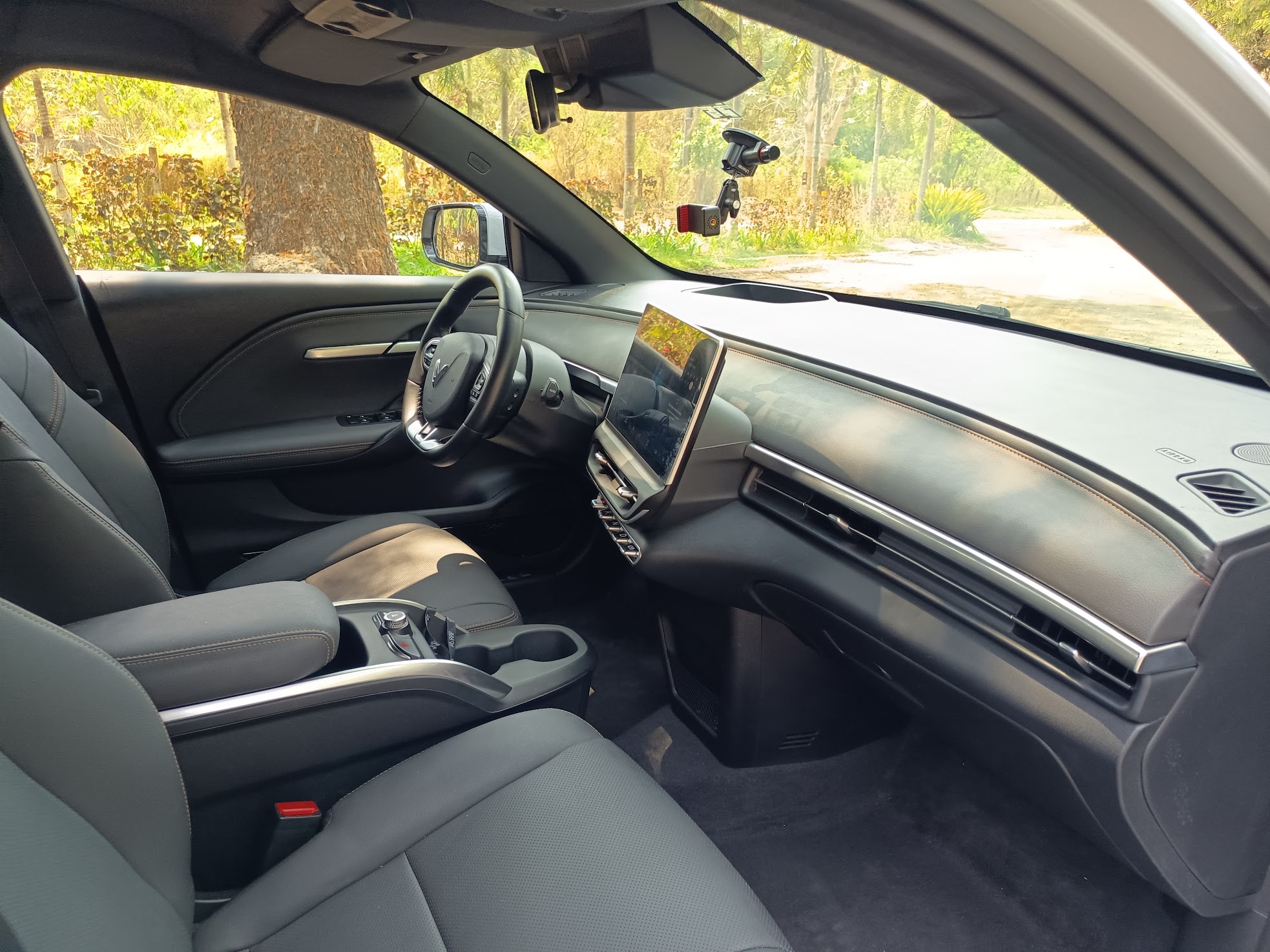
One of the most satisfying elements of the interior is the row of control switches. In an era where every manufacturer is obsessed with burying every single function inside a submenu of a touchscreen, VinFast has opted for tactile and cassette button style switches for the gear selectors and essential functions. There is a weight and a satisfying click to them that feels wonderfully analog in an otherwise digital space.
That physical tactility is balanced by a massive 12.9-inch infotainment screen. While the screen in the Philippine specification models does not rotate as seen in some early global concepts, it remains the command center of the vehicle. It is crisp and responsive and it is oriented toward the driver. This is supplemented by a head-up display that makes the traditional instrument cluster feel like a relic of the past. By moving the vital statistics to the windshield VinFast allows the dashboard to remain low and the visibility to remain high.
However the commitment to a seamless digital experience leads to a primary point of contention, which is the total absence of a start stop switch. In the VF6 the car is essentially on the moment you board with the key fob in your possession. To drive you simply press the brake and shift into gear. To turn it off you put it in park and walk away. While proponents call this seamless, I find the lack of a definitive physical off button a bit unnerving.
There is a loss of agency when the car decides its own state of readiness. As a driver, I prefer a clear and tactile confirmation that the machine has been put to bed. In the VF6 you are left trusting the software to shut down once you lock the doors. It is a minor ergonomic hurdle but one that requires a shift in the mental model of what it means to park a car.
Other reports from the full media run from Caloocan to Laguna suggest that the VF6 is quite the highway performer. Colleagues mentioned that despite carrying four passengers and running the air conditioning at full tilt, the battery consumption was remarkably lean. The car arrived in Laguna having used only about 12% of its charge for the 80-kilometer journey.
They also noted a firm and stable ride on the Skyway, which is a characteristic I could only sense in small doses as I navigated the smooth asphalt of Santa Elena. The motor provides 201 horsepower in the Plus variant, which is more than enough to make the crossover feel light on its feet despite the weight of the battery pack.
The VF6 is a car designed for a world that is still being built. In the Philippines where the electric vehicle infrastructure is growing but not yet ubiquitous, the VF6 makes a strong case for itself through efficiency and a high technology safety suite. The Plus variant comes loaded with Level 2 advanced driver assistance systems which are essential for the chaos of the South Luzon Expressway.
Prices for the VF6 start at P1,249,000 (~$21,000) with the battery subscription, which significantly lowers the barrier to entry for first time adopters.
Is it a success? Globally the numbers say yes.
In the Philippines, the verdict will depend on how many drivers are willing to trade the traditional engine rumble and the familiar click of a key for a silent and always ready computer on wheels. For now, my short loop around the golf course leaves me with a sense of a car that is immensely polished and aesthetically confident even if I am still looking for a button to tell it when it is time to sleep.
Note to VinFast Philippines: I am waiting for an actual test drive.

CleanTechnica's Comment Policy