Fiji Was Made For Island Hopping. These 3 Marriott Resorts Prove It.
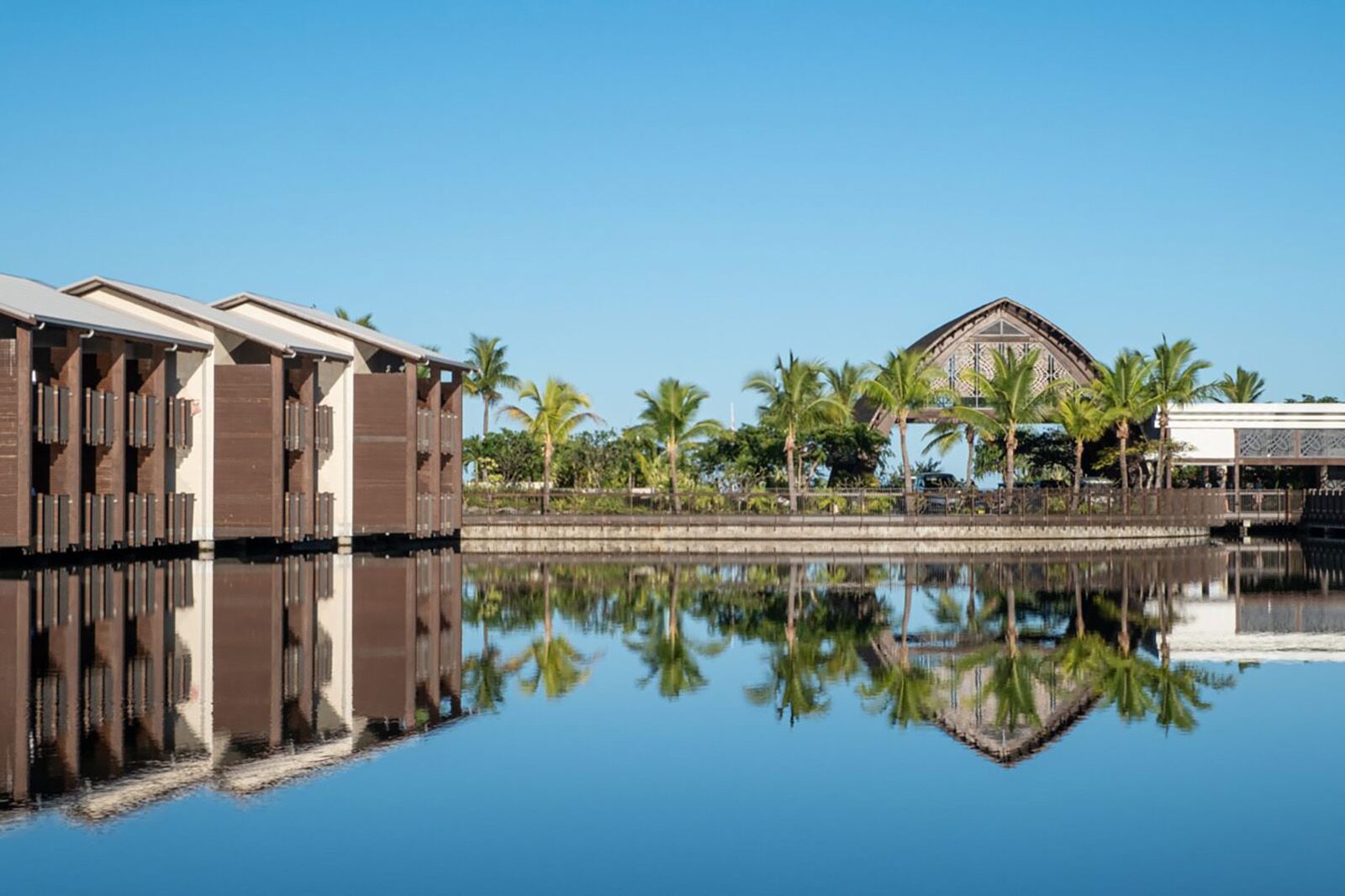
There’s nothing better than pulling up to a hotel lobby where even the staff look like they’re on vacation. They’re walking around barefoot, playing ukuleles, wearing flowers in their hair, and flashing the biggest ear-to-ear smiles as they welcome you to the paradise that they call home.
Before coming to Fiji, I hadn’t heard much about the country outside of its famous turquoise waters and being home to “Survivor Island.” (The long-running reality TV show has been filming in the Mamanuca Islands since 2016.) I quickly learned that Fiji is a place where island hopping is highly encouraged — after all, it’s an archipelago comprising more than 330 islands.
Sure, you could spend a week or two soaking up the sun in the same spot. But it’s worth moving around to see some of Fiji’s more remote beauty, and this group of Marriott properties is the perfect start. Here’s what to expect at each one.
Laid-back luxury at Fiji Marriott Resort Momi Bay
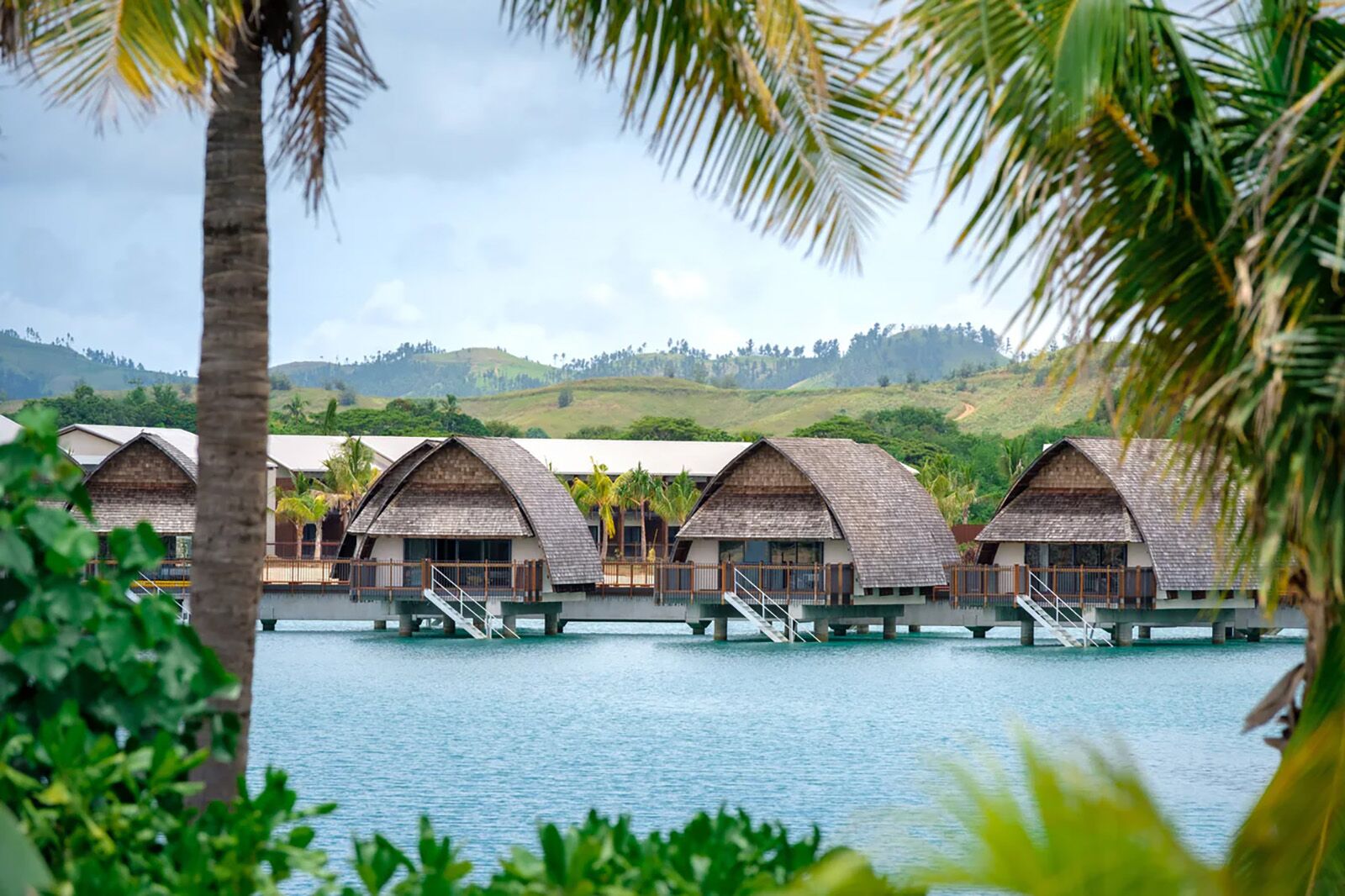
Photo: Fiji Marriott Resort Momi Bay
The group of journalists I was traveling with arrived on a direct flight from LAX bright and early before driving through the rolling hills of inactive volcanoes to our first stop: Momi Bay. But it wasn’t just the 7 AM sunshine perfectly glistening off the overwater bungalows that welcomed us. It was the warmth of the locals, which we later learned is unofficially coined “just that Fijian hospitality.”
Fiji Marriott Resort Momi Bay is one of the most sought-after properties for couples to stay at in Fiji, and I understand why. Being home to what the resort bills as Fiji’s only overwater bungalows, as well as the official location partner and venue for the Lexus World Surf League Finals Fiji 2025, it’s a resort where you can be as secluded or as central as you’d like. Even being a stone’s throw from your neighbor, the way that the Fijian bures are designed makes it feel like you’re overlooking your own private lagoon (or ocean). (Bures are traditional village houses made from natural materials, and the style has since been used as a model for bungalow-style resort villas.)
Given that Fijians operate on a level of chill I aspire to have coming from my busy lifestyle in Los Angeles, I wanted to get a glimpse into why everyone was so stress-free here. My findings led me to kava, a root native to the South Pacific that’s ground and strained (similar to tea) and drunk for a sense of calm and relaxation. So I visited a local village and took part in a traditional kava ceremony.
My group was welcomed into a large bure alongside the village’s elders, children, and teens. We sat down cross-legged as our local host, Maraia, told us about the village as some of the boys prepared the kava. Once it was my turn for a sip, I took a low tide (a small sip) while most of the elders helped us finish the kava by taking a high tide (a big gulp). After we finished the entire bowl (which is required for the ceremony), we ended the afternoon singing and dancing a traditional meke with the locals. I’m probably not going to be running to the store to switch out my coffee with kava anytime soon, but this resort-offered experience was one of my biggest highlights while in Fiji.
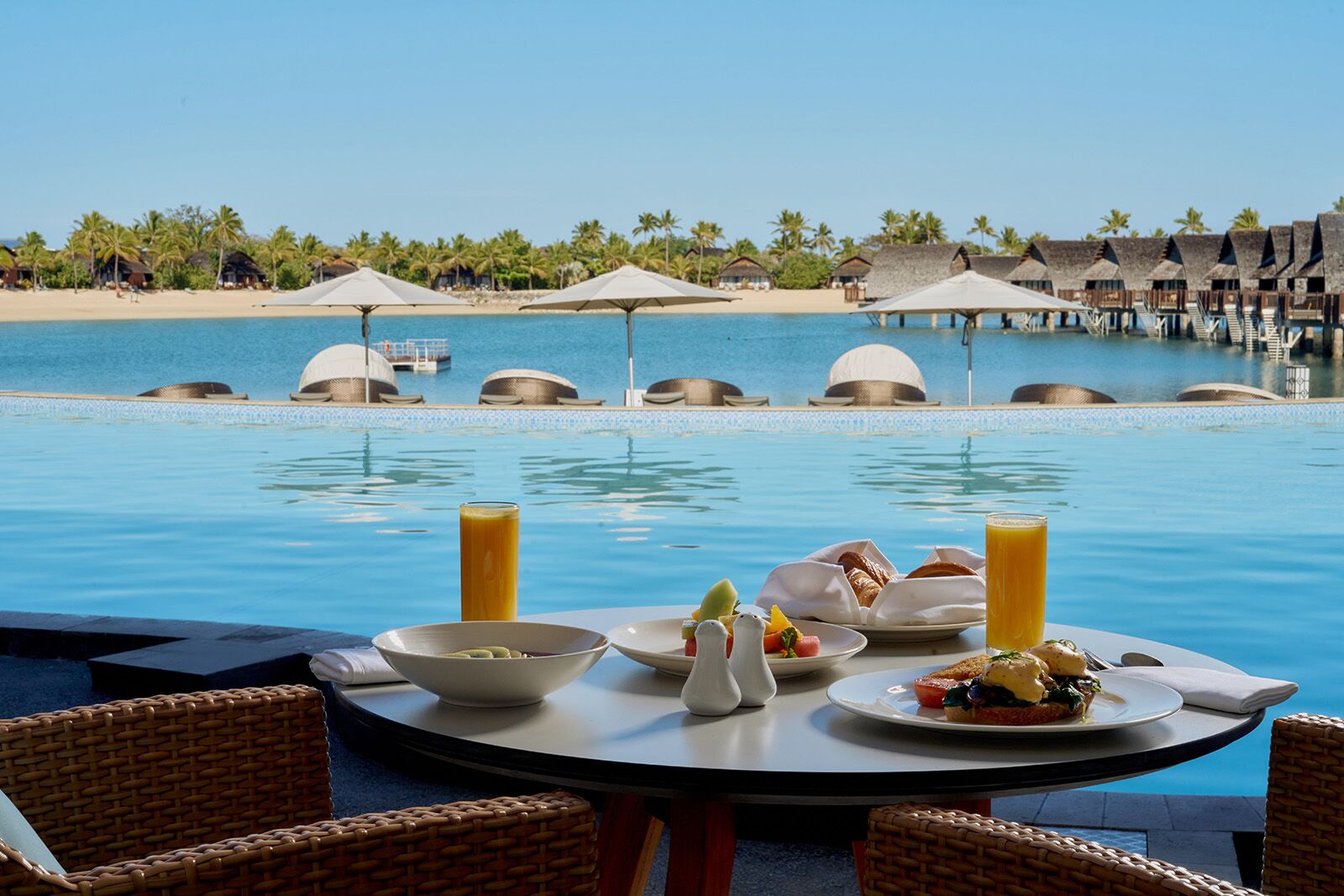
Photo: Fiji Marriott Resort Momi Bay
In addition to cultural experiences, Momi Bay facilitates a wide range of outdoor activities that are perfect for experiencing with a partner: sunrise yoga, kayaking, surfing, boating, snorkeling, and fishing, to name a few. Momi Bay is also part of the Good Travel with Marriott Bonvoy program, which organizes experiences where you can give back and care for the land that you’re visiting. I took part in a fish-habitat-building project to nurture marine life, but you can also plant mangroves along the bay and partake in coral regeneration. On the other hand, if you’re looking to just kick back and relax, one of my favorite places to enjoy a mojito was the adults-only infinity pool.
Fiji’s history layers Melanesian, Polynesian, Indian, Chinese, and European cultures, and nowhere is that more apparent than the kitchen. Goji Kitchen & Bar has some of the most incredible Fijian-Indian fusion (as well as a delicious pad thai), plus a morning buffet with breakfast options from every corner of the globe — India, Asia, the US, you name it.
The biggest standout for me was Fish Bar’s Salt Menu, a four-course prix fixe menu where every dish is paired with a speciality salt based on the dish: lime, chili, coconut, wild hibiscus, and luxe sea salt. Fish Bar is also one of the best spots at the resort to watch the sunset. If you want to dive deeper into Fijian cuisine, Voi Voi Bar is the perfect spot. The kokoda, a Fijian ceviche-like dish made with raw mahi-mahi or snapper marinated in citrus and coconut cream, was one of my favorite dishes on the trip.
As I gathered my things to depart for my next location, I couldn’t help but notice the obvious connections that the other guests had made with the staff. Guests were calling the staff by their first names while their kids were running into their arms to hug them goodbye. Though Momi Bay is an obvious choice for a romantic getaway, in those moments, guests and staff felt like one big family saying not goodbye but sota sale (“see you again” in Fijian).
Relaxation meets adventure at Sheraton Resort & Spa, Tokoriki Island
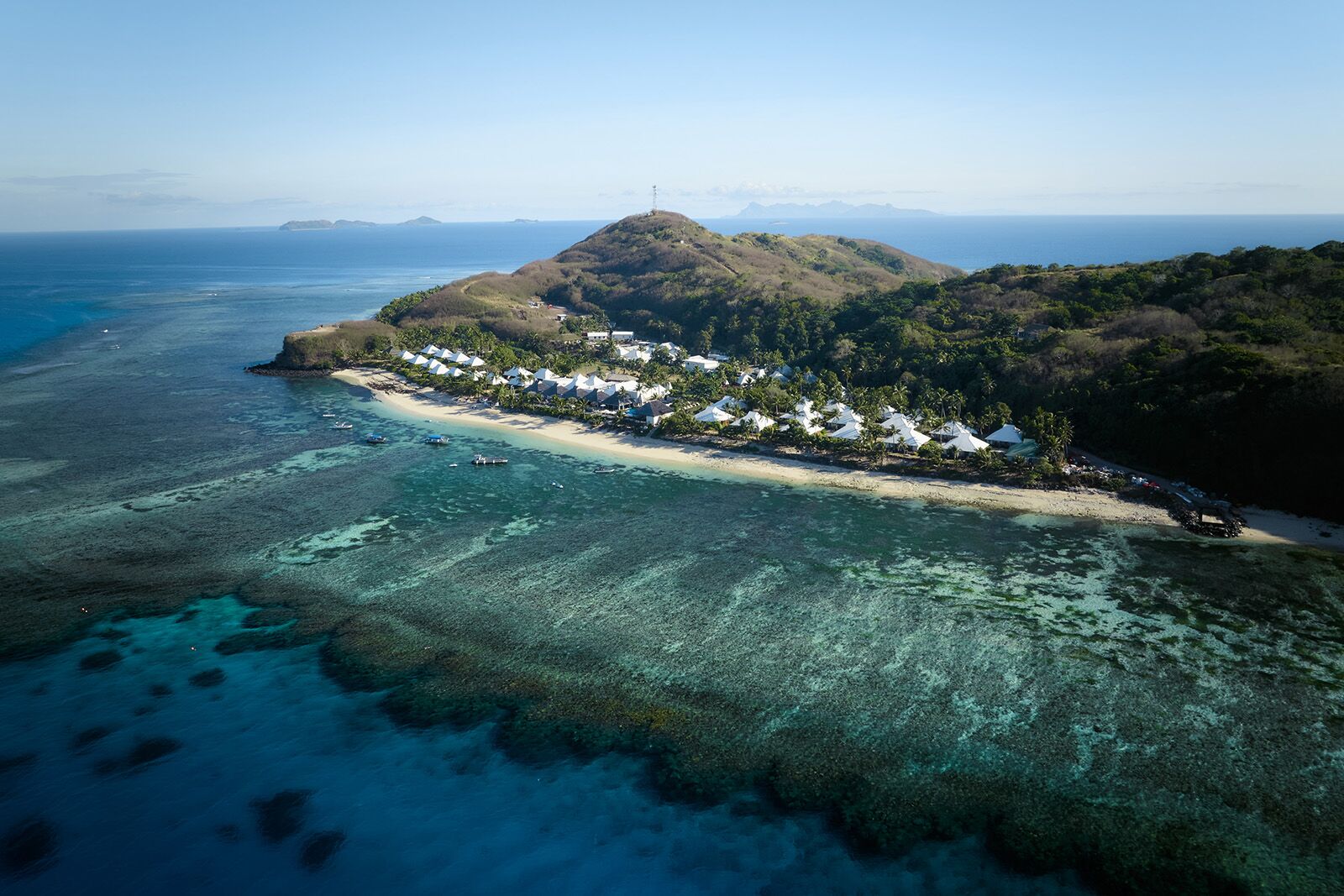
Photo: Sheraton Resort & Spa, Tokoriki Island
You know how people say, “It’s not the destination, it’s the journey”? That’s how it felt traveling to our next hotel via a private boat transfer. As Momi Bay faded into the distance, a warm, coastal breeze washed over me as we passed dozens of lush islands. Our captain pointed out the islands where they filmed Survivor and Castaway, as well as his favorite floating restaurants and bars that you can visit via boat. I couldn’t help but think that if we hadn’t planned to visit a second hotel, we would have never seen all of this remote beauty in the middle of the South Pacific.
The turquoise waters turned 10 shades of blue as we approached the Sheraton Resort & Spa, Tokoriki Island. (Tokoriki is an island in the Mamanuca archipelago.) I didn’t see a dock, which had me questioning exactly how we were going to get on land. Sure enough, our boat coasted straight up to the shore, and we all got a good laugh jumping off the back of the boat onto the staircase entry in front of us. Unlike Momi Bay, which is situated at sea level in a lagoon, the Sheraton Tokoriki sits a bit higher, offering a lovely vantage point of the Mamanuca Islands.
As I walked to my bungalow, I noticed a variety of travelers: some were enjoying their books in the warm sun at the beachside infinity pool; others put on life jackets to go on a jet-ski tour of the surrounding islands. Sheraton Tokoriki feels like a choose-your-own-adventure type of retreat, and honestly, you can’t go wrong with any choice.
I knew I wanted to tap into my adventurous side once we arrived, so I rented some snorkel gear (fins and a mask) and walked to the resort’s main beach, where the reef is easily accessible from the shore. The only other place I’ve snorkeled in is the Maldives, so I had high expectations. When I went underwater, I immediately understood why Fiji is referred to as “the soft coral capital of the world.”
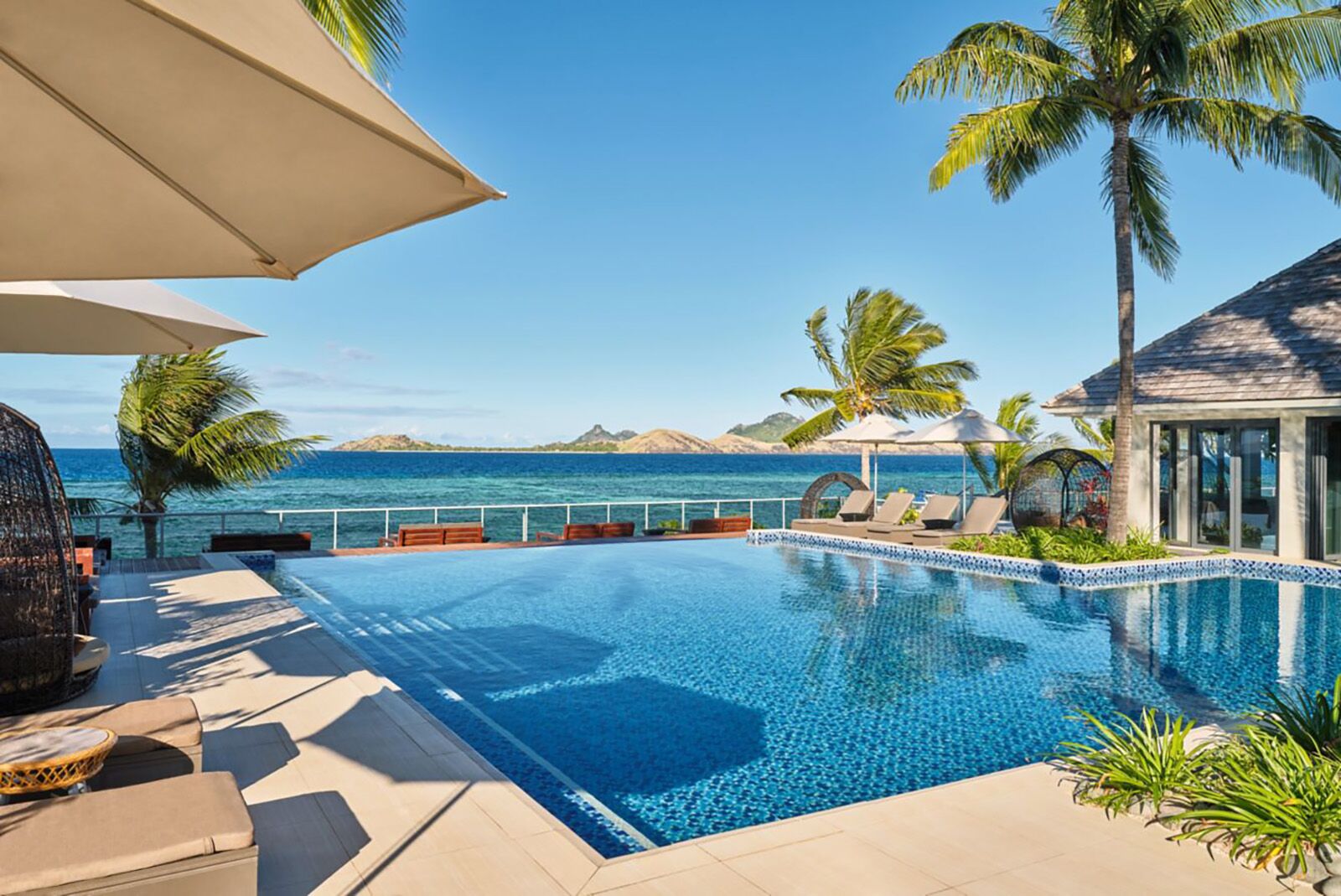
Sheraton Resort & Spa, Tokoriki Island
The house reef is filled with vibrant colors, thriving marine life, and healthy coral. It gave me so much hope to see such a flourishing ecosystem within this archipelago (let alone an inhabited resort-island), which is directly linked to the connection that Fijians have to their land. The resort staff told us it was because they worked on prioritizing safeguards for coral reef conservation over the years, and that they’re now seeing the remarkable recovery of those efforts.
I also joined in on a few other activities the hotel offered while I was there that I’d recommend checking out: a guide-led jetski tour around the island, another kava ceremony (where I did a high tide this time), and a local-led medicine walk where our guide took us around the island to learn about native plants and ancient healing traditions.
On my first night, I had dinner at Curcuma, Sheraton Tokoriki’s Indian-fusion al fresco restaurant. As a pescatarian, I had little trouble eating well in Fiji, given that Indian restaurants usually have great vegetarian options. The paneer butter masala was one of the best I’ve had outside of India. There were plenty of things to choose from at lunch and dinner, even some options for my vegan friends.
The morning buffet also had a range of semi-healthy, vegetarian-friendly options, ranging from omelets-to-order and waffles to cut fruits and a juicing station. One thing you shouldn’t miss is grabbing a coffee (or tea) and heading out to the breakfast patio overlooking the water. I swear I could’ve sat there for hours watching waves hit the shore, jet skis fly by, and people snorkeling.
Upon our departure, the resort staff sang a few Fijian songs, including “Isa Lei,” a farewell song that the staff traditionally shares with departing guests. You could see some of the staff getting visibly emotional as they sang it, almost as if they were leaving us with a piece of Fiji’s spirit.
Something for everyone at Sheraton Fiji Golf & Beach Resort
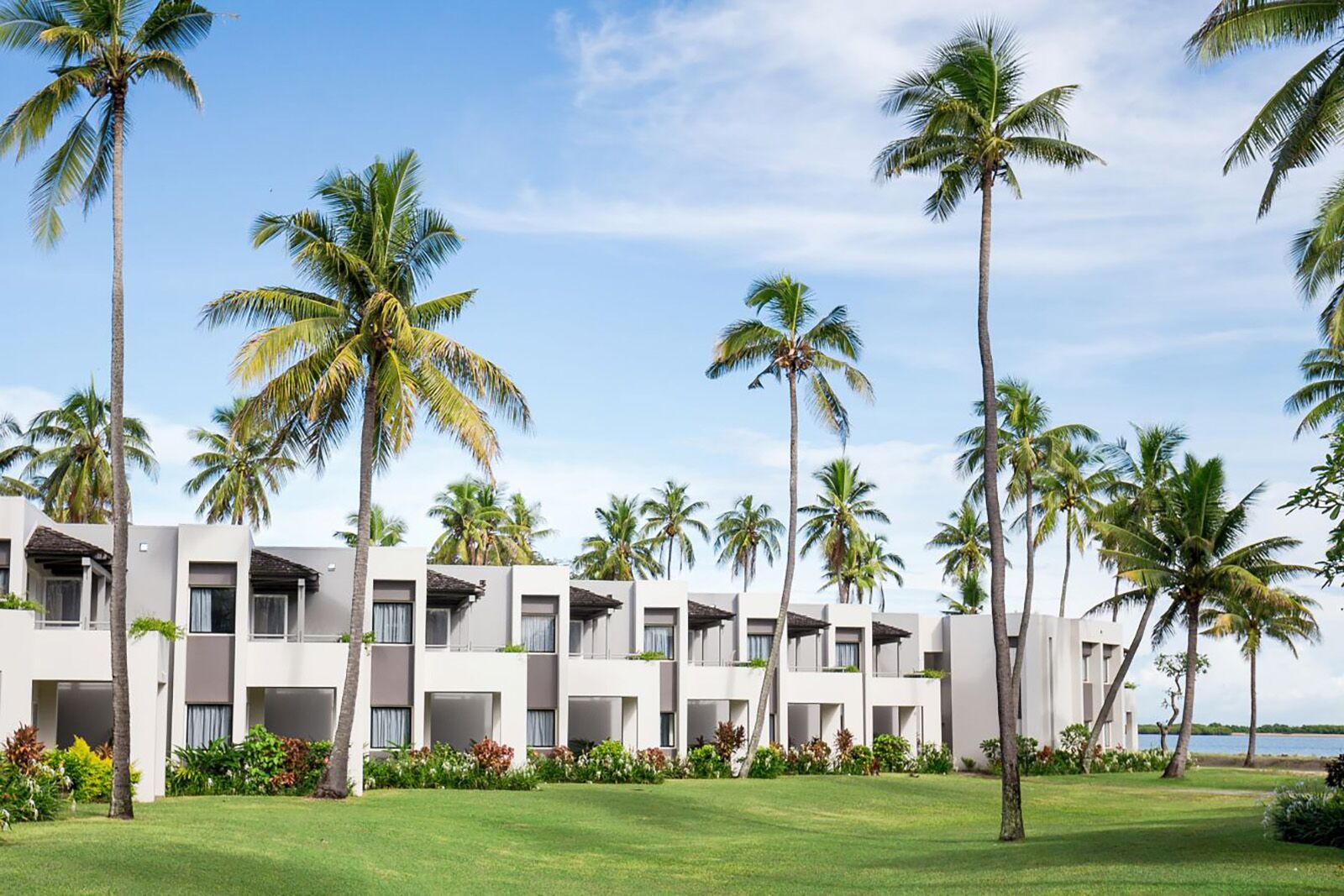
Photo: Sheraton Fiji Golf & Beach Resort
To make it to our next location, we hopped a catamaran ferry filled with both guests and locals to head back from Tokoriki to the mainland of Viti Levu. I knew we’d arrived at Port Denarau, Fiji’s premier marina, when we started approaching the mangrove-lined bay and saw dozens of ships in the marina. The port was bustling: a mix of travelers like us headed to their next destinations, Fijian salesmen trying to sell us guided tours and trips, souvenir shops (Jack’s was a favorite), and locals commuting back home after work.
Soon after a private shuttle transfer picked us up, we arrived at Sheraton Fiji Golf & Beach Resort. This resort felt huge compared to the other two, with a large reception area filled with shops, restaurants, a coffee shop/bakery, and a bar. This seemed like the perfect location to bring your whole family, from the grandparents to the little ones, and hang out at the beachfront pool all day to enjoy the slow bula (lifestyle) that Fiji is all about. Everything you need is easily accessible within a short walk from your room. The resort is also part of Fiji’s only integrated five-star resort complex, so guests have access to facilities at the adjacent Sheraton Denarau Villas, The Westin Denarau Island Resort, and the Denarau Golf & Racquet Club.
As the sun was setting over the horizon on my first night, I heard some Polynesian music start blaring, and I knew that meant the fire show was about to start. A crowd of about 100 people formed around the young performers who gave the fire show their all, blending traditional dancing and fire routines. The performance paired with the orange sunset hues made for a gorgeous welcome to the resort.
After the show was over and the sun had set, my group went next door to Tatavu Grill & Bar, the resort’s Latin American-inspired restaurant where your toes are literally in the sand in your seat. Tatavu means “open fire grill” in Fijian, which is a perfect name for this restaurant given that it has an open-style kitchen.
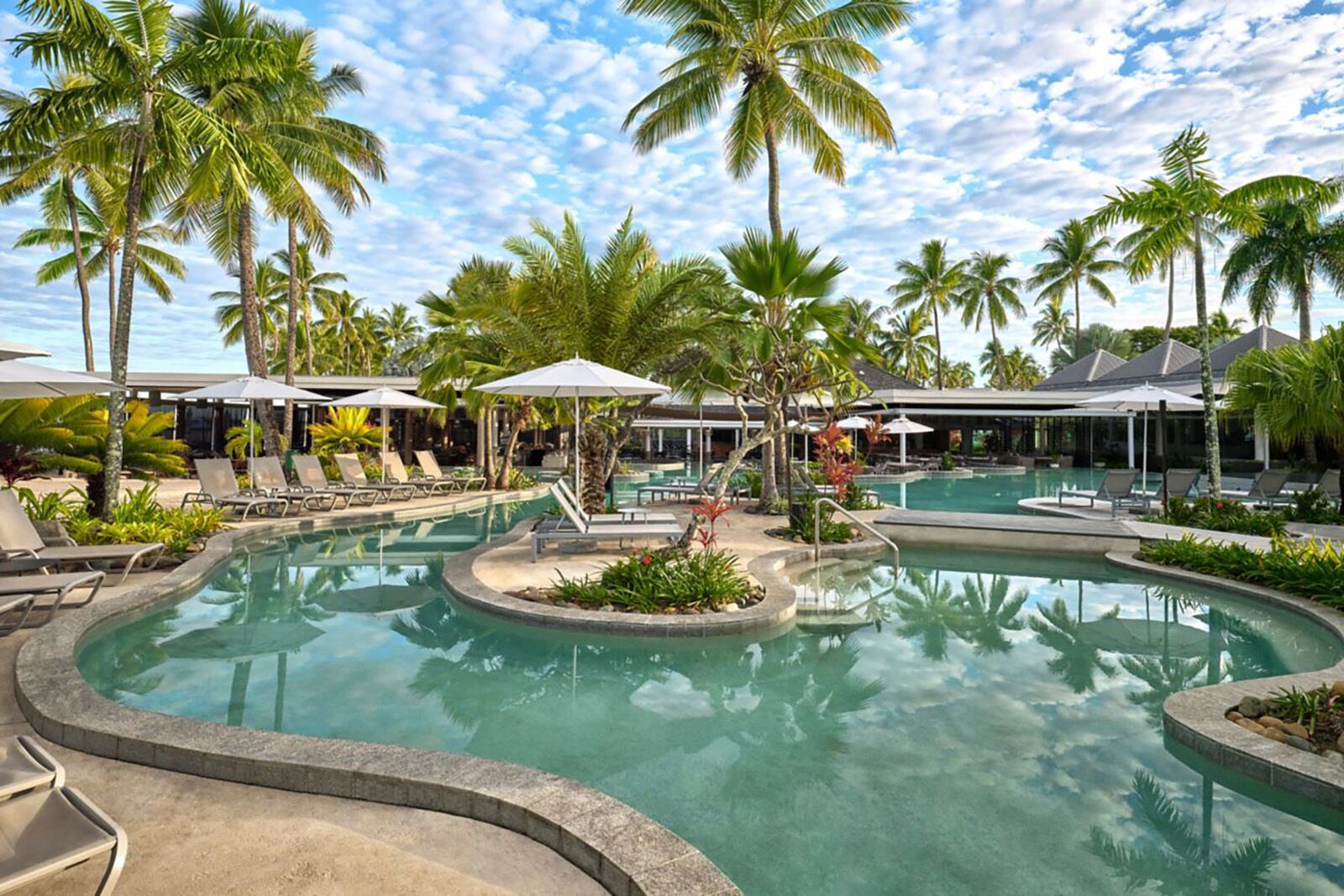
Photo: Sheraton Fiji Golf & Beach Resort
I was a little skeptical about trying Latin American-inspired cuisine in Fiji, but after learning that the head chef, Alfredo, is from Mexico — and then trying the food — I was 100 percent sold. Some dishes I recommend trying here are the yasawa gorditas (octopus, prawns, and lobster in homemade corn shells with cheese, avocado cream, and salsa), the crusted cheese (deep-fried cheddar cheese that has the consistency of paneer, served with fire-roasted salsa tatemada, avocado cream, and pickles), and the salmon with crispy skin (the skin is fried separately eaten like a piece of dried seaweed).
As an alternative to Tatavu, the buffet here was the largest we ran into on our whole trip, having almost every type of cuisine to choose from for both the breakfast and dinner options. A lot of the fresh produce used in the resort’s restaurants and bars comes from the Sheraton Fiji Farm, another Good Travel with Marriott Bonvoy initiative. You can tour the farm to learn about the organic farming methods and farm-to-fork dining that the hotel offers.
Outside of dining experiences, the hotel had a handful of similar experiences to the other two properties: village tours, surfing, PADI scuba school, jet skiing, etc. But one big standout here is the 18-hole golf course. I wouldn’t consider myself a golfer by any means, but the resort has a driving range where I had a blast getting a bucket of balls and working on my form.
This resort also had a secret elevated cocktail experience: Cellar & Barrel, Fiji’s first speakeasy, although there’s no password to enter (yet). Each drink on the menu is handcrafted by the mixology team based on a mix of Fijian folklore and mythical tales. I tried a few. The Tuwai (a bold rum-based cocktail with passion fruit, lime ginger, and hazelnut) and Uisge Beatha (named after The Morrigan, the Celtic goddess of fate and transformation) were my favorites. Cellar & Barrel also hosts a fun afternoon tea experience where your tea is actually a gin cocktail, paired with small Fijian bites and desserts decadently spread as if you’re at a real high tea.
After visiting all three Marriott properties, it clicked why Fiji felt different to me than any other place I’d been. The most memorable moments of my trip weren’t measured in opulence but in connection — with the locals, the land, and the lifestyle.
Getting to and around Fiji
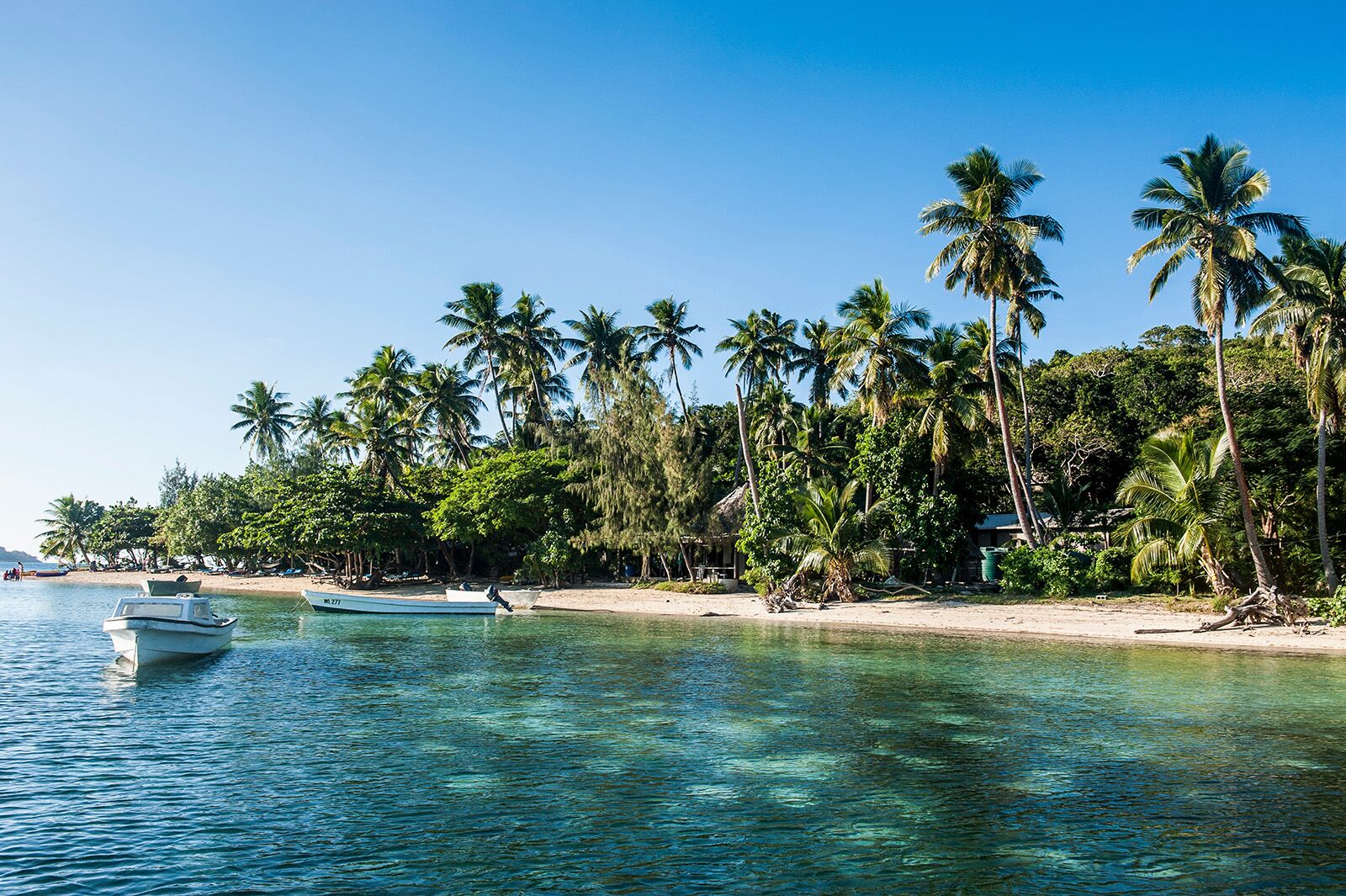
Photo: Robert Harding Video/Shutterstock
Contrary to everything I’d been told before my trip, traveling to Fiji from the US was extremely stress-free with Fiji Airways. From LAX, I was able to hop on a direct flight that was about 10.5 hours. I don’t usually opt for a red-eye, but flying this far west means you land two calendar days after you take off, and the overnight flight was a great idea. (We took off at about 11 PM and landed at about 6 AM.) The ride itself was so comfortable; the economy seats are definitely larger than some of the planes I’ve taken to Europe. Fiji Airways also has some of the best sustainability efforts I’ve seen offered by an airline: with every international flight, they plant a mangrove tree. More than 84,000 mangrove seeds have been planted to date.
As for getting around while in Fiji, depending on where you’re headed, there are a few options. If you’re staying in a hotel on the main island of Viti Levu, getting around by car is your best option (I’d recommend private transfers). For island hopping, a mix of private boat transfers and ferry catamarans is your best option. Here’s what worked for me on my tour of the Marriott properties:
- When arriving at Momi Bay from Nadi International Airport (NAN), a private driving transfer is a great option for the approximately 45-minute trek.
- For traveling to Tokoriki, the most common way to visit the Mamanuca Islands is by a catamaran from Port Denarau or by private boat taxi transfer. If it fits in your budget, a 15-minute helicopter ride from the airport is also an option.
- Getting to Sheraton Fiji Golf & Beach Resort was about a 30-minute drive from Nadi airport.

More like this
Cultural TraditionsThis Music Festival in Fiji Is a Dream Island Vacation — Plus World-Famous DJsСхожі новини

На гірськолижному курорті на Львівщині збудують апарт-готель на 170 номерів
First look: Inside Air India’s new Maharaja Lounge at SFO
