Favourite Finland and Israel make it through to Eurovision final

 Facebook
 Twitter
 Flipboard
 Send
Send
 Reddit
 Linkedin
 Messenger
 Telegram
 VK
VK
 Bluesky
 Threads
 Whatsapp
Acts from 15 countries performed their 3-minute songs onstage – often with eye-catching choreography and pyrotechnics – in a bid for votes from juries in participating nations and viewers around the world.
Favourite Finland and nine other countries, including Israel, made it through the first Eurovision Song Contest semi-final on Tuesday.
 ADVERTISEMENT
ADVERTISEMENT
ADVERTISEMENT
Acts from 15 countries performed their 3-minute songs onstage – often with eye-catching choreography and pyrotechnics – in a bid for votes from juries in participating nations and viewers around the world.
Finland, the favourite on betting markets, made the cut with “Liekinheitin,” or “Flamethrower,” a mashup of pop singer Pete Parkkonen’s anguished vocals and violinist Linda Lampenius’ fiery fiddling.
Joining them in the final on Saurday are Greece’s Akylas with party-rap track “Ferto," or "Bring It”; Serbian goth metal band Lavina with “Kraj Mene”; Moldovan folk-rapper Satoshi with “Viva, Moldova!”; and “Andromeda” by Croatian female ensemble Lelek.

Belgium upset the odds to make it through, with Croatia, Lithuania, Poland, and Sweden also progressing.
Five countries were sent home after the music competition's first night of performances. Estonia, Georgia, Montenegro, Portugal and San Marino were eliminated — despite a guest appearance by 1980s icon Boy George on singer Senhit's San Marino song, “Superstar.”

10 more finalists will be chosen in a second semi-final on Thursday. The UK, France, Germany and Italy automatically qualify for the final because they are among the contest’s biggest funders. Austria, last year’s winner, gets a place in the final as host country.
Biggest-ever boycott
This year marks the 70th edition of Eurovision, which despite its spectacle rarely escapes the politics in the background - Russia was expelled in 2022 after its full-scale invasion of Ukraine.
Under the contest’s “United by Music” motto, singers and bands from 35 countries will compete onstage in host city Vienna for the continent’s musical crown.
But divisions are clouding the contest’s 70th anniversary edition, with five countries — Spain, Ireland, the Netherlands, Slovenia and Iceland — boycotting to protest Israel’s inclusion.
Israeli singer Noam Bettan was met with shouts of protests as well as cheers in the auditorium when he performed the rock ballad “Michelle”, but was one of 10 acts voted into Saturday's final.
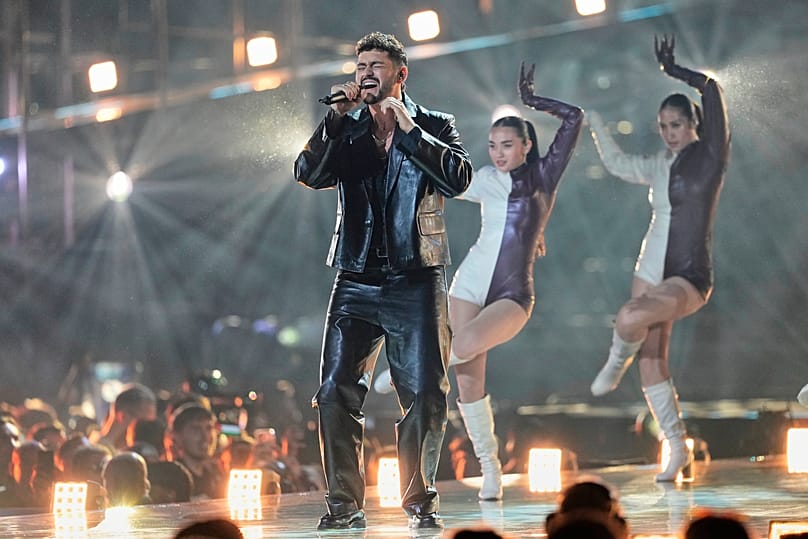
The 2024 contest in Sweden's Malmö, and last year’s event in Basel, Switzerland, saw pro-Palestinian protests that called for Israel to be expelled over its conduct in the war in Gaza. There were also allegations it ran a rule-breaking marketing campaign to get votes for its contestant.
The European Broadcasting Union, which runs Eurovision, has toughened voting rules in response to the vote-rigging allegations, halving the number of votes per person to 10 and tightening safeguards against “suspicious or coordinated voting activity.”
But the EBU declined to kick Israel out, spurring five countries to announce in December that they would not participate this year.

Several pro-Palestinian demonstrations are planned during Eurovision week, including a musical event dubbed No Stage for Genocide. Its backers urged Eurovision performers to pull out of the competition.
The five-country boycott is a revenue and viewership blow to an event that organisers say was watched by 166 million people around the world last year.
Bulgaria, Moldova and Romania have returned after skipping the event for artistic or financial reasons in recent years, but the number of participants, at 35, is still the lowest since 2003.
Jonathan Hendrickx, a media researcher at the University of Copenhagen, said any more boycotts will stress the structure of the contest and raise doubts about its future.
“They really are at their limits now, in terms of what they can handle with the current format,” Hendrickx said.
Go to accessibility shortcuts Share CommentsRead more