Exams on the beach: Israel laid waste to Gaza’s classrooms – now students sit on the sand
This article first appeared on our partner site, Independent Arabia
Under an April sun already holding the sharp heat of summer, Iyad, a fourth-year engineering student, dragged his feet across the sand of Gaza’s shoreline. There was no fishing rod in his hand nor a beach towel over his shoulder; instead, he clutched a worn-out plastic folder under his arm containing pages of his coursework on reinforced concrete.
Exam Hall: ‘Seashore’
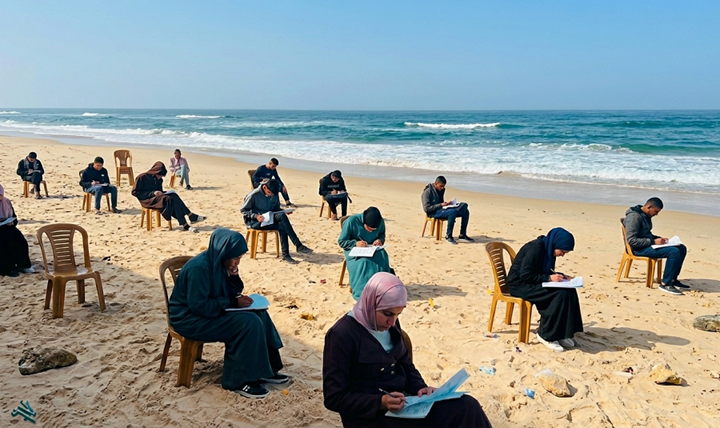
A few metres from the crashing waves stood a sign reading: “Exam Hall: Seashore”. Beside it, a long row of plastic chairs had been neatly arranged on the sand, without desks, for university students to sit their exams.
“Before the war, I would walk onto campus well dressed, sit my exams in an air-conditioned classroom, and then visit the main conference hall,” Iyad recounted to Independent Arabia.
He took his place on chair number 14, resting his folder on his knees as a makeshift desk. Beside him, his classmate Omar wiped sweat from his brow with the collar of his shirt. In front of them stood Hamid, the lecturer who had lost both his home and his university but not his authority. He moved with quiet dignity across the sand, silently handing out the exam papers.
“Begin in the name of God. You have two hours. And do not forget that your names are the most important thing you will write today, so your rights are not lost in this chaos,” he said, his voice blending with the sound of the waves. At once, the students began reading the final exam questions that stood between them and graduation.
 open image in gallery
A battle for focus
Iyad began reading the first question as strong sea winds tried to snatch the paper from his hands. He placed a bottle of water on top of it as a weight, anchoring his dream to the page. A strange mix of sounds filled his ears: the relentless roar of the waves, the cry of a child in a nearby displacement tent, and the distant hum of a surveillance drone on the horizon.
He closed his eyes for a moment, inhaled the sharp scent of iodine, and imagined himself back in that old lecture hall with its wooden seats. Then he began writing quickly, solving complex mathematical equations as though his pen were his only means of striking back against the reality of displacement.
As the exam reached its midpoint, the sun grew harsher, the sea breeze offering the only relief. For a brief moment, Iyad looked towards the horizon, catching sight of a small child running along the water’s edge before returning his gaze to his equation. In that instant, he realised that passing this exam was not just a mark on an academic record, but a declaration that the engineer within him had not been buried beneath the rubble of the university buildings destroyed by Israel.
As time ran out, Iyad stood up, brushing the sand from his trousers. He looked at the rows of chairs beginning to empty, then handed in his paper. The scene was not merely a university exam; it was a silent epic, written in the ink of determination across the soft sands of Gaza’s shore.
He returned to his tent carrying his folder, filled with hope that the person who solved reinforced concrete equations under the blazing sun would one day be capable of rebuilding all that had been destroyed.
Recommended Israel national security minister served golden death penalty noose birthday cake
 Javier Bardem claims he’s lost out on roles and brand deals over his support for Palestine
 Israeli raid in the West Bank leaves 1 Palestinian dead and 4 wounded
‘Educational genocide’
Gaza’s education system has lost irreplaceable human capital. More than 20,000 students from schools and universities have been killed. The sector has also lost more than 1,000 teachers and administrative staff in addition to more than 220 university professors and scientists, many of whom were internationally recognised authorities in specialised academic fields.
Academic institutions have been reduced to rubble or overcrowded shelters, while Gaza’s main university buildings have been fully or partially destroyed. This includes advanced laboratories, smart lecture halls and research centres.
Avichay Adraee, a spokesperson for the Israeli army, said: “Universities were transformed from educational institutions into centres for developing combat capabilities, training military intelligence personnel and factories for producing explosive materials. Physics and chemistry laboratories in universities were used to develop the range of rockets and the technical capabilities of [Hamas].”
However, the Palestinian ministry of higher education describes the attacks on universities as “educational genocide”. Its spokesperson, Saad Khaddour, said: “Israel has carried out systematic acts aimed at eliminating education and the academic elite. The targeting of schools and universities constitutes a war crime. We have called on the International Criminal Court and Unesco to launch urgent investigations into the destruction of educational facilities and the targeting of scientists, academics and students.”
 open image in gallery
‘The university exists wherever there is a teacher, a student and a book’
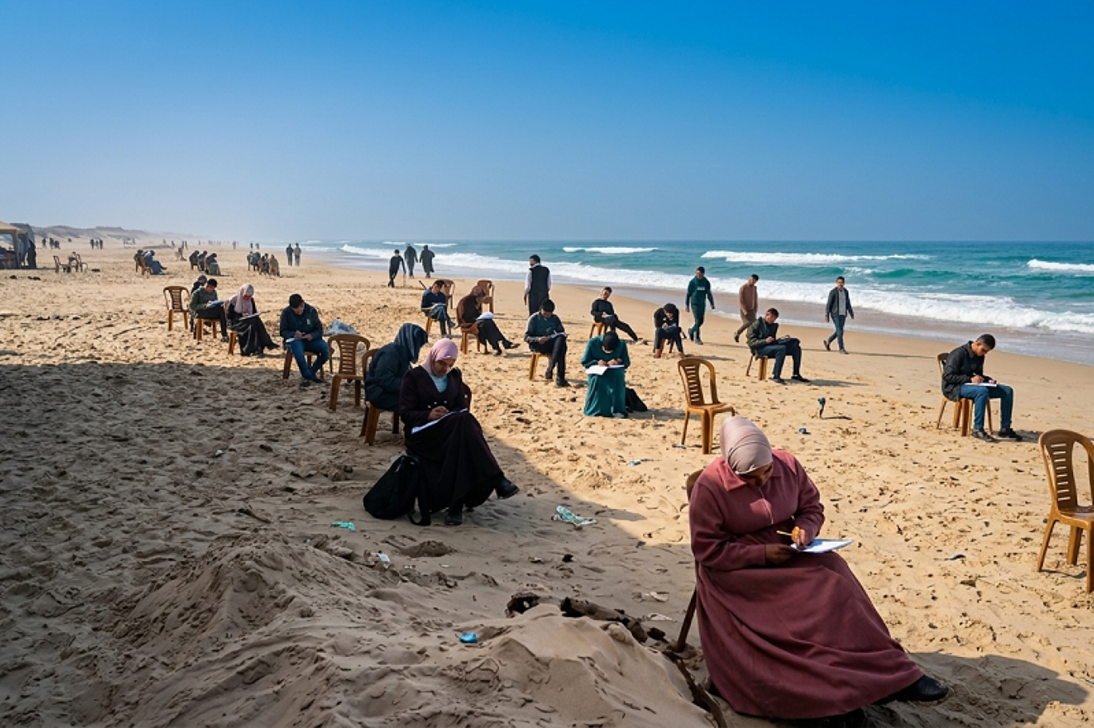
The academic Nasser Al-Ghussein told Independent Arabia: “When the world sees students sitting exams over the rubble, in front of the sea, just days after the guns fell silent, it understands that this society possesses immense energy for rebuilding.”
The Palestinian deputy minister of education, Basri Saleh, said: “This scene carries profound meanings that go beyond the act of studying itself. It encapsulates a reality filled with contradictions and determination. Sitting before the crashing waves is not a recreational choice, but a declaration of survival.”
Mr Saleh added that the scene was “a cry to the world that these young people are holding on to their right to education, even if classrooms, laboratories and libraries have been taken from them. It is a message that the destruction of buildings has not succeeded in destroying minds, and that the university exists wherever there is a teacher, a student and a book.”
Resistance through knowledge
The Palestinian ministry of higher education views the sight of students sitting their exams on the seafront as a document of indictment to the world and a testament to an unbreakable will.
The minister of higher education, Professor Amjad Barham, sent images of the students to international organisations, saying: “Our students in Gaza are giving an exam in resilience as well as in their subjects. Sitting the exam on the sand is a sovereign decision of the Palestinian academic authority. The students who have spread out on the sand to sit their exams are the guardians of the Palestinian dream. This scene is part of the Education Everywhere strategy launched by the ministry in 2026, which aims to utilise open spaces as alternatives to destroyed buildings.
“This is resistance through knowledge. Every exam paper completed on the beach is a nail in the coffin of policies of ignorance, and a confirmation that Palestinian identity is inseparable from education as a tool for liberation and survival.”
Translated by Dalia Mohamed; Reviewed by Tooba Khokhar and Celine Assaf
Join our commenting forum
Join thought-provoking conversations, follow other Independent readers and see their replies
CommentsСхожі новини
Hantavirus: WHO chief reassures Tenerife residents as Spain prepares for cruise ship's arrival

Fico briefs Putin on Zelenskyy talks during Moscow Victory Day visit

Добровольцев не будет. В Испании суд постановил отправить на карантин пассажиров лайнера со вспышкой хантавируса
