Escapes, fires, stabbing: catastrophic security failures revealed in Australia’s immigration detention network

Exclusive: prison multinational MTC uses a ‘minimalist staffing model’ that critics say is putting detainees and staff in serious danger
-
Get our breaking news email, free app or daily news podcast
A series of catastrophic security failures involving the US private prison company running Australia’s immigration detention centres has allowed the escape of high-risk detainees, caused ill-equipped staff to be stabbed and hospitalised, and triggered multiple investigations, one of which warned its “minimalist staffing model” was putting workers and detainees at risk.
Guardian Australia can reveal that in September 2025, just six months after Management and Training Corporation assumed control of onshore detention, the home affairs minister, Tony Burke, was forced to haul in the company’s president from the US to dress him down in a secret face-to-face meeting.
MTC won a $2.3bn contract to run onshore detention from last year under its local subsidiary Secure Journeys, a deal struck despite serious concerns about MTC’s track record in the US and at Parklea prison in Sydney.
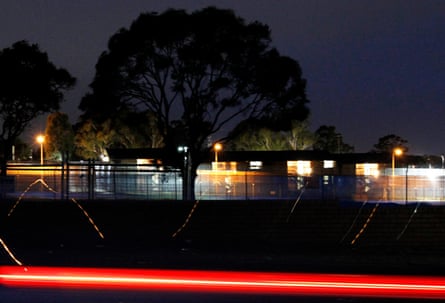
Using internal documents obtained through freedom of information and interviews with MTC staff, detainees and government sources, Guardian Australia has established that:
-
Seriously ill detainees are missing medical appointments because MTC lacks the staff to escort them to health centres, a situation that has infuriated the home affairs department.
-
Two MTC staff members were admitted to hospital with smoke inhalation after trying to rescue an unconscious detainee from a fire. Investigators found MTC had not given the staff basic respiratory equipment and fire-response training six months after assuming control of the centre.
-
More than 12 escapes or attempted escapes have occurred in the 14 months MTC has had control of the system. A significant number took place during transport and escort operations to hospitals, airports or detention centres.
-
A child sexual abuse offender deemed high-risk escaped MTC custody during an escort to Sydney’s Bankstown hospital despite being handcuffed and supposedly under close watch.
-
In September a detainee absconded by shimmying up a light pole next to a boundary fence at Brisbane immigration detention centre. His disappearance was not discovered for 12 hours.
-
Late last year two detainees were able to flee a guarded MTC vehicle travelling less than 500m in Melbourne. One managed to evade capture for four days.
-
The risk assessment system MTC uses to classify detainees is so broken that Comcare, the federal work safety regulator, has warned the home affairs department it is putting staff at serious risk of violence.
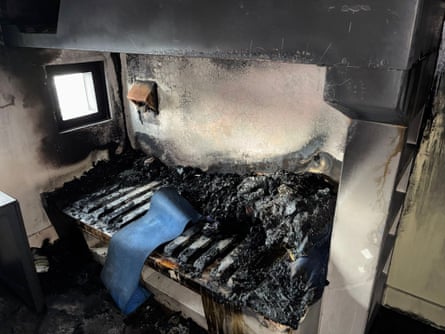
Comcare has now set up a dedicated inspection program to scrutinise immigration detention, citing an “increase in notifiable incidents, the severity and the profile of the reported incidents involving the [contractor]”.
The regulator said it had received numerous reports of “serious injury or illness to both workers and others (detainees)”, “self-harm ideations and death involving detainees” and “detainee on detainee violence”.
It has since privately issued a damning report to the home affairs department, finding that it was contravening work health and safety laws at at least one centre. The report says the risk was foreseeable and the department “failed to ensure … the health and safety of workers and other persons”.
The government has already charged MTC hundreds of thousands of dollars in “abatements” – fines for performance failures.
But any action to remove MTC from the centres would be hugely expensive, particularly in the context of a home affairs budget so stretched that redundancies are being pursued to cut costs, and the number of potential replacements is limited.
Serco, which ran the system for years, is thought to be the only other option but it would take the company months to retool and rehire a workforce.
One departmental source, speaking on condition of anonymity, described the situation as a “sinking ship” that is no longer salvageable.
“Secure Journeys’ 14 months delivering Facilities and Detainee Services in Immigration Detention has been marked by chaos, incompetence and a lack of capability,” the source said.
“How no Secure Journeys staff member or detainee hasn’t died yet from systemic incompetence is sheer luck.”
Australian Border Force (ABF) and MTC did not respond to specific questions, but a spokesperson for the government agency said immigration detention was “a complex operating environment”, and that the “welfare, safety and dignity of people in immigration detention, as well as the safety of staff” were its highest priorities.
“Where issues are identified, providers are required to implement immediate corrective actions and longer-term improvements,” an ABF spokesperson said. “Performance is closely monitored.”
An MTC Secure Journeys spokesperson said the company “takes the health, safety, and wellbeing of our people seriously”.
“We have established systems, training and support arrangements in place to help staff perform their duties safely, including initial role-based training and ongoing refresher training to support currency of knowledge, safe work practices, and operational readiness.
“We continue to review and strengthen these arrangements as part of our ongoing commitment to safe operations.”
Contractor ordered to do better
On the afternoon of 30 September 2025, the mood in MTC’s national office was tense.

Heavy-hitters were in town to meet Burke, including the MTC global president, Dan Marquardt, usually based at the multinational’s Utah headquarters.
Things were not going well.
Four months earlier, a detainee being transported from Villawood immigration detention centre in western Sydney to the airport for deportation had allegedly stabbed an MTC worker, assaulted another and fled, sparking a police manhunt. The escape hit the headlines in May.
But what was not reported was that the escape was the result of disturbing process failures.
The detainee was deemed to be high risk but was not handcuffed. And he was driven in a standard Kia Carnival lacking any of the usual safety features, such as Perspex barriers.
Registration records obtained by the Guardian suggest the Kia used by MTC was a hire car.
Three sources across MTC and the department have confirmed that the company was using hire cars to escort detainees.
There were other worrying incidents.
Internal Comcare documents reveal that on 23 September 2025, a week before the Burke meeting, MTC staff responded to a fire in a locked room at Villawood.
Flames and smoke were visible and the detainee inside was unconscious.
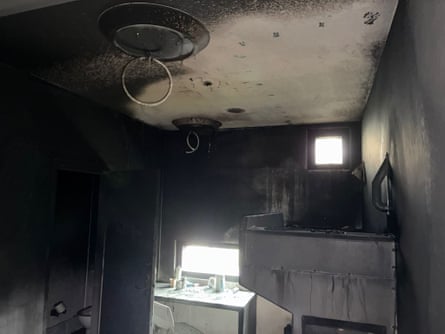
Such fires are common in detention centres. A Comcare report described them as an “inherent and predictable aspect of operating within detention centres”.
Despite this, the MTC staff were operating without respiratory equipment, resulting in “two staff members requiring hospitalisation due to smoke inhalation”, Comcare said in a notice.
When Comcare investigators questioned MTC, the company offered a troubling explanation.
“On Friday 3 October, the Centre Manager for Secure Journeys confirmed in response to my inquiries that workers have entered active fire zones voluntarily, without appropriate training, formal risk assessments, or authorisation,” documents show.
Comcare had received a separate complaint in July about an “alternative place of detention” – usually hotels where detainees are held – that lacked basic emergency and evacuation plans.
The regulator’s investigation identified a disturbing lack of basic processes, including documented inductions, training records and evidence of emergency preparedness activities, creating “a clear and ongoing risk of repeated or continued contravention of [work health and safety laws and regulations]”.
“The absence of these safety systems, and the Department’s failure to identify or address them through routine oversight, exposes workers and detainees to unnecessary and foreseeable risk in the event of an emergency,” the regulator told the department in late July.
At the meeting, Burke made his displeasure clear. Sources with knowledge of the meeting say MTC’s president was dressed down and told to urgently improve his company’s performance.
When the executives returned from the meeting, MTC staff were asked what they needed to improve their performance. Those who did speak up said simply: “Staff.”
Hospital getaway
The escape in May was far from isolated.
Last month Michael Angok, a convicted child sexual abuse offender, was escorted to Bankstown hospital from Villawood. He was deemed a high-risk detainee, a designation supposed to trigger a higher degree of control and monitoring during travel.
Angok saw an opportunity and fled the hospital, triggering a four-day police operation to recapture him.
Internal documents show MTC executives responded by instructing transport and escort teams to use “mandatory restraints” for every detainee, regardless of whether they posed a risk.
“I am emailing to further instruct that the following occurs, effective immediately: mandatory restraints must be used for all T&E [transport and escort] tasks, unless medically contraindicated,” a missive read.
That has alarmed many MTC staff, who say body belts and handcuffs are now being applied without any consideration for harm to detainees who pose no risk.
Jonathan Hall Spence, a principal solicitor at the Justice and Equity Centre, said a blanket policy of handcuffing people for transfers was “almost certainly unlawful”.
“Without a specific and immediate risk, it’s doubtful the use of handcuffs could be justified as ‘reasonably necessary’, which is the requirement under current laws,” he said.
On 14 April the Justice and Equity Centre wrote to the home affairs minister and the general counsel of Secure Journeys, warning that a detainee handcuffed under a blanket policy “could well have claims of assault, battery and false imprisonment” against the company and the government. There has been no response.
“People in detention shouldn’t be suffering because the contractor can’t get itself sorted to do transfers safely and properly,” Hall Spence told Guardian Australia. “They’re receiving more than $2bn to perform these services.”
Staff shortages have forced multiple detainees with serious illness to miss medical treatment.
A March report by the National Preventive Mechanism, an independent monitor of places of detention, found that “critically” low levels of staffing were compromising the centres’ safety.
Sources said a detainee who had been flagged for more frequent monitoring was able to set fire to a staff compound at Villawood last month.
The compound had been left without staff for hours before the fire, the source said.
At Brisbane immigration detention centre, staff did not realise that a detainee had climbed up a light pole beside an exterior fence and escaped. The escape was not discovered for 12 hours because of an error in a subsequent headcount.
At some point after MTC took over the contract, the home affairs department set up a dedicated team to conduct a six-week inspection blitz at detention centres across the country.
The team, known as the operational inspection program, found a “minimalist staffing model that does not provide adequate contingencies to manage safety as well as security risks and vulnerabilities”.
Problems at Parklea
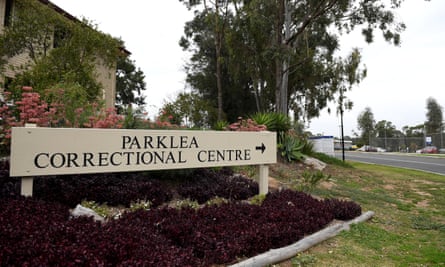
MTC has a chequered past in the US, where it runs private prisons and immigration detention centres, which are being used in Donald Trump’s ICE crackdown.
The company has been sued for a range of alleged security lapses there, court documents show, including alleged failures that led to the gang-rape of a woman in detention and the murder of two retirees by escaped prisoners. Both cases were settled.
In New South Wales, MTC runs Parklea correctional centre but the facility will be taken back into public hands in October.
The management of the prison by private operators has been marked by longstanding concerns about overcrowding and poor conditions, as well as staffing levels.
MTC’s management of Parklea should have been a warning sign, said Troy Wright, the branch assistant secretary of the Community and Public Sector Union in NSW, which represents prison staff.
“Their expertise was just not there,” he said of MTC’s Parklea takeover, pointing to the company’s limited track record in Australia in 2019. “And, sure enough, it’s been a bloody disaster.
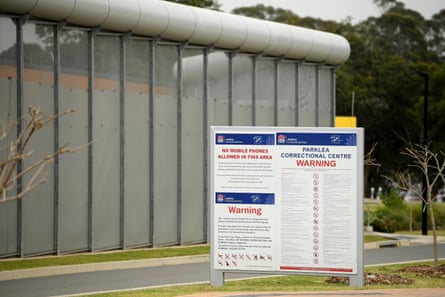
“I always say a company can’t make money off the prisoners, so they make it off the staff. They don’t fill all their roles and they run their place understaffed.”
Wright was surprised when MTC was awarded the immigration detention contract and said no one from the government had contacted the union to ask about its experience with MTC in NSW.
As Guardian Australia has previously reported, some MTC staff at Parklea have been seconded to the immigration detention network due to staff shortages. “They were short right away in immigration detention,” Wright said.
After MTC took over from GEO Group at Parklea in 2019, the NSW prison inspector remarked on problems with staff levels – including “transitional gaps in the staffing model”.
“It was unclear MTC-BRS had engaged sufficient staff to meet the high volume of escorts from Parklea CC for medical and hospital care,” a 2022 report said.
During an inquest into the death of James Cunneen, a Parklea inmate, the coroner found he had died of heart disease in 2019 after his “deterioration went largely unrecognised”.
The coroner noted many failures on the part of the prison’s medical service provider but also examined concerns from the healthcare team that a lack of MTC staff meant it was difficult to ensure inmates were taken to the clinic.
MTC said many of the shortcomings in Cunneen’s care involved matters beyond its control, but the coroner said in his 2025 findings this was “misconceived”.
The coroner recommended that the corrective services commissioner “take steps to ensure that MTC remains compliant with its contractual obligations with respect to the number of correctional and health staff it is contracted to provide”.
Worsening conditions
Detainees have reported deteriorating conditions in immigration detention centres.
At Villawood, some say they have been sleeping on the floor in common areas after a fire lit by an inmate damaged multiple rooms.
Guardian Australia has seen images of bedrooms with charred mattresses and severely smoke-damaged walls, as well as inmates with multiple mattresses set up next to a pool table and another putting up curtains in a portico for privacy.
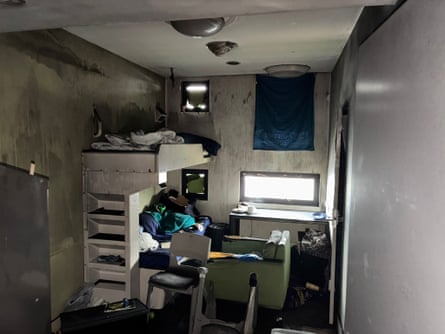
One detainee said he was sharing a classroom with five others due to the fire damage. “There’s no bathroom, no shower,” he said. “They just pass the buck.
“This company that took over – they try to run it like a prison.”
Another said understaffing meant detainees were at risk – pointing to the alleged murder of a 51-year-old man by another detainee at Villawood in January. “Since they’ve taken over … the quality of life has dropped significantly,” he said.
The departmental source said there were a lot of good staff working in Secure Journeys, who were doing their best.
But morale had reached critically low levels and, despite significant assistance from the department, little was changing.
“Fourteen months into the contract, Secure Journeys still can’t staff their centres, continue to let escapes occur and miss several contract obligations regularly,” the source said.
“The Department of Home Affairs can’t afford to replace Secure Journeys – they are stuck with them for five years. It will take a whole facility burning down or deaths for this to come to a head.”
-
Do you know more? Contact christopher.knaus@theguardian.com or ariel.bogle@theguardian.com
- Australian immigration and asylum
- Prisons
- Health
- Business
- Tony Burke
- New South Wales
- Australian trade unions
- news
Схожі новини
XPENG Offers More Human-Like Autonomous Driving
99% топ-менеджеров ждут увольнений из-за ИИ — и большинство даже не верит в совместное будущее людей и машин
Warhorse не отдыхает: третья Kingdom Come подтверждена — и уже известно, когда ждать