EastEnders star on the mental health story 'for everyone'

 BBC/Jack Barnes/Kieron McCarron
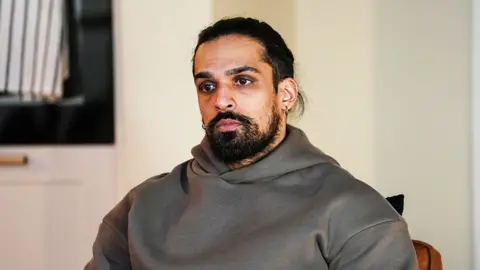
When Aaron Thiara reflects on his central role in EastEnders' recent mental health storyline, he's aware of the expectations on him from the South Asian community.
"Because of the colour of my skin, people will identify themselves through that," he tells BBC Newsbeat on the soap's set.
"You can't help but think [about those expectations]. Your mind goes in certain directions, but first and foremost I have a job to do."
The 32-year-old who plays Ravi Gulati, emphasises the story is not just for the South Asian community, but "universally for everyone and anyone".
Warning: This story contains details that some readers may find upsetting.
In the show, Ravi has been diagnosed with Complex PTSD (CPTSD), which according to the NHS, can develop after long-term trauma such as child abuse.
Symptoms include risk-taking behaviour, feelings of emptiness and suicidal thoughts.
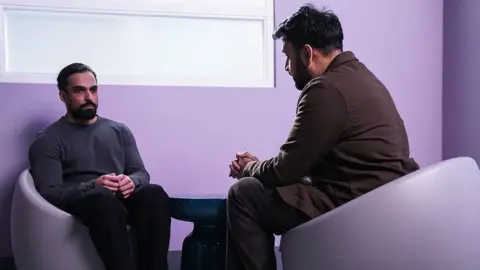
Following a series of breakdowns and an attempt to end his life in earlier episodes, Ravi is shown in a mental health facility receiving treatment.
 BBC/Jack Barnes/Kieron McCarron
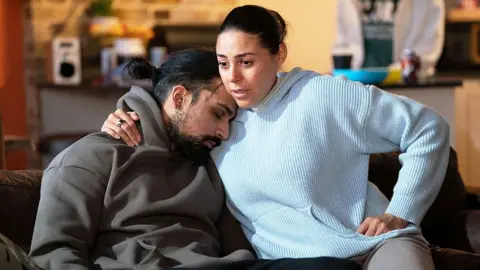
In the show, Ravi's family are supportive but also keen to keep things hidden from outsiders.
Research has shown that for many years mental health has been considered a taboo issue in South Asian communities around the world.
"There is a rich history over many, many years of what our South Asian community want to [show] to the outside world," Aaron says. "And that is strength, honour, culture.
"By any means necessary get the job done on a day-to-day basis."
But the story of Ravi is relatable more widely, he feels.
The character has been most strongly associated with his looks, strength and personality on Albert Square, but "an illness like this can catch anyone", says Thiara.
According to the charity PTSD UK, about 6.6 million people are expected to develop PTSD or CPTSD at some point in their life.
"My hope for us is that we can look beyond the colour of our skin and support one another," says Aaron. "And we can seek help and be delicate and empathise with anyone and everyone who may be going through certain problematic issues."
'We need to entertain'
Ravi's character has had a dark past, committing multiple crimes and spending time in prison. But viewers have also found out about the abuse and trauma he suffered as a child.
EastEnders' writers sought advice from mental health charities Samaritans, Mind and Rethink Mental Illness. And while it is a sensitive topic which required "months and months of preparation", there was also a question of keeping the audience engaged.
"How do we delicately tell this story in our way?" asks Aaron.
"[But] in an entertaining way, because we also need to entertain our audience."
Aaron admits feeling a big responsibility, but says he didn't want it to become "a great pressure" and take away from the story.
"The responsibility is just to be in a place where I can spiritually, mentally, emotionally give myself to the story in service of Ravi's illness," he says.
 BBC/Jack Barnes/Kieron McCarron
Aaron says he avoided learning too much about Ravi's illness, allowing him to mirror the character's confusion and portray the role more "organically".
"I haven't experienced the illness, I didn't know much about it," he says.
"Not only is Ravi not knowing what's happening, I don't know what's happening.
"So I can allow myself to just go moment to moment," he says.
However, Aaron says more planning did go into some of the key moments, such as a series of events depicting Ravi's decline.
Viewers saw him hold people hostage in a pharmacy while trying to obtain medication for his son, admit to being a police informant and look to end his life after a car crash.
"It was important for me to map those out because we wanted each [part] to feel different," says Aaron.
 BBC/Jack Barnes/Kieron McCarron
EastEnders has a long history of tackling difficult issues, and Aaron tells Newsbeat the work of portraying mental health struggles on screen doesn't end with a single storyline.
He says examples such as Mark Fowler's HIV diagnosis, Stacy Slater's experience of bipolar disorder and Phil Mitchell's psychosis, are where "EastEnders shines for the last 40 years".
In his view "[tackling] those things in different ways with different characters and finding different angles of mental health illnesses for people to resonate with," is one of the soap's big strengths.
And if there is one thing he wants the audience to take from the story, it's about looking beyond someone's past.
"Given what Ravi had done previously on the Square, his history has been one that's probably not the best," he says.
"The hope that I had from it was that people can look beyond and just see the human being.
"As people we can grow from that in terms of empathy and love."
You can catch up with EastEnders on BBC iPlayer.
- If you have been affected by any of the issues in this story, help and support is available at BBC Action Line

Listen to Newsbeat live at 12:45 and 17:45 weekdays - or listen back here.
More on thisHow London's East End has changed since EastEnders began
Gay kiss 'furore' to domestic violence: How EastEnders shattered taboos
TelevisionHealthEastEndersMental healthСхожі новини

До програми «Доступні ліки» планують додати мінімум 60 діючих речовин від серцево-судинних хвороб

Tatra відзначить 40 років на "Дакарі": на подіум виїде 20 легендарних машин

"Йдем на філіжанку кави і пляцки": які фрази та слова передають весь колорит Львова
