Drake: Iceman / Maid of Honour / Habibti review – triple-album comeback is a boring, bloated disaster

(OVO/Republic)
It’s possible that the world’s biggest rapper is using this epic content drop to get out of his record deal, but aside from some bright spots on Iceman, should the public really be subjected to it?
It is easy to over-estimate Drake’s fall from grace. True, he was unanimously declared the loser in the most high-profile rap beef of recent times, and is currently engaged in a protracted legal battle with his own record company over said rap battle that everyone except Drake and his lawyers seems to think smacks of the worst kind of bad loserdom. He is also fighting lawsuits alleging that he illegally misled viewers during gambling livestreams – pretending to bet his own money while actually using funds from an online casino he promotes – and that he furthermore channelled funds from said online casino into artificially inflating streaming figures (Drake has not commented on the allegations; Stake, the casino, described one of the lawsuits as “nonsense”). Also in the lawsuits is Adin Ross, a denizen of the manosphere who Drake has been palling around with, unbothered that the other guests on Ross’s stream have included Andrew Tate and Nick Fuentes.
Equally, Drake is still the most-streamed rapper in the world. Had all this really impacted on his mainstream popularity, his last album – Some Sexy Songs 4 U, 2025’s collaboration with PartyNextDoor – would have died at the box office, rather than entering the US charts at No 1 and going on to sell a million copies. If his public reputation is looking a little tarnished, well, we live in an era of short attention spans and shorter memories: it would probably only take one unequivocal banger – a One Dance or Hotline Bling 2.0 – for the slate to be wiped clean.
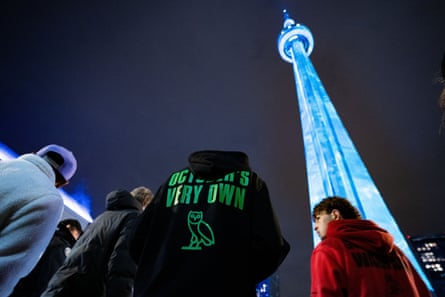
Instead, Drake has simultaneously released three albums: not just Iceman, the album he’s been promoting for weeks via a series of high-profile stunts, but the hitherto-unmentioned Habibti and Maid of Honour. There are doubtless stans out there besides themselves with excitement at this act of munificence, but for anyone other than the diehards, the reaction to this news to likely to be: uh-oh.
A perpetual criticism of Drake’s latterday albums is that they’re far too long, but between them, Iceman, Maid of Honour and Habibti contain 43 tracks and more than two and a half hours of music: if you thought Scorpion or Certified Lover Boy droned on a bit, it turns out they were merely the amuse-bouche. The smörgåsbord of droning on, the menu dégustation of outstaying your welcome, is now served.
In fairness, there are some good things here, all of them on Iceman. Ran to Atlanta is superbly produced, a chilly blast of menacing electronics. Burning Bridges is great, deftly switching between jazzy piano and a ghostly sounding R&B slow jam. National Treasures likewise transforms itself midway through, eerie synths and trap-inspired beats – co-produced by British man of the moment Wraith9 – giving way to a nightmarish plethora of sampled voices and a faintly industrial rhythm. They collectively conjure up a desolate, lonely atmosphere that undercuts the defiant lyrics, full of boasts about his wealth and sexual irresistibility and jabs in the direction of other artists: a profoundly unconvincing suggestion that Kendrick Lamar was privately desperate to stop the lyrical feud that he won; attacks on A$AP Rocky and NBA star LeBron James for their disloyalty. Anyone in search of an insight as to Drake’s state of mind in the wake of public humiliation – disdained, isolated, still chewing over the events of two years ago while affecting not to care – might look here.
The issue is that the great moments are adrift amid a lot of underwhelming stuff: filler along the lines of Janice STFU (which lazily interpolates a very old and well-known Lykke Li chorus) and B’s on the Table, during which guest 21 Savage sounds as if he’s bored out of his mind. Little Birdie and Don’t Worry are undernourished, and all the vocal effects in the world can’t enliven them. Some lyrics are just clunky – “I feel like BTS ’cause it took the whole career for me to be so discovered” – while others shout out Adin Ross and seem designed to appeal to Ross’s fanbase (“I put the man into manipulation when I pay your rent”). It’s as uneven as every other album Drake’s released in the last decade, but the real issue is that there are two more albums to go.
And that’s when the problems really begin. Broadly speaking, Maid of Honour is more dancefloor-focused – Cheetah Print samples not just Peggy Gou’s house hit (It Goes Like) Nanana, but, oh Christ, DJ Caspar’s novelty dance track Cha Cha Slide – while Habibti leans more into R&B. You could argue that this amounts to Drake showing his diversity, but it would be a more convincing argument if either album contained a single memorable hook or melody. But they don’t. Drowned in Auto-Tune, the contents of Habibti sound like old ground being half-heartedly retrodden for the sake of it, a plethora of familiar musical and lyrical tropes – “big crib but I feel like no one’s home”, “some people fucked me over but I can’t let it go” – that feels worryingly like what might happen if you asked ChatGPT to come up with a Drake album. Maid of Honour is better in so far as it feels less predictable, but it’s filled with decent sounds looking for a tune to attach themselves to – the explosion of distorted synth at the end of BBW, the subtle mid-80s funk of Stuck, the electro pastiche of Road Trips – and features Drake once more favouring the world with his famous Jamaican accent. Against some fairly stiff competition, this is perhaps the least endearing of Things Drake Is Wont To Do.
It ends with Princess, a scrappy, half-formed mess of distorted guitar and more Auto-Tuned vocals. In fact, there’s something oddly scrappy about the whole three-album enterprise, as if it hasn’t been thought through properly. What’s the point of opening it with a loud boast about how Drake refuses to acquiesce to fans’ demands for high-profile guest appearances when it’s full of high profile guest appearances, from Central Cee doing his best to enliven the meagre backing of Which One, to Molly Santana’s impressive turn on Ran to Atlanta? What possessed him to think releasing the minute of tuneless acoustic guitar backed rambling that is Habibti’s Rusty Intro was a good idea?
Indeed, what possessed him to think that releasing three albums was a good idea? You have to rack your brain trying to think of any artist in the history of pop who was so multifariously gifted, so blessed with things to say, that they could come up with two and half hours of compelling music in one go. The posthumous super-deluxe version of Sign o’ the Times suggested Prince at the dizzying zenith of his powers was able to – the quality barely dips over the course of CD after CD of unreleased material – but even Prince, not a man given to understating his own genius, clearly thought that bombarding his audience with the lot at once would amount to testing their patience.
But if Drake in 2026 is evidently not Prince in 1987, he does seem to resemble Prince a few years after that, when he took to releasing deliberately substandard albums as a means of fulfilling a record label contract he decried as “slavery”: at one juncture, he even lobbied his label to release two on the same day. One of the album’s lyrical themes is how much Drake wants out of the deal with Universal that he once claimed had netted him $360m: “I’m better off independent … I just wanna be free”, he raps on Make Them Pay, while on B’s on the Table, he frames his ongoing legal action against the label not as the peevish actions of a sore loser, but “fighting the Man”. However many albums he owes them, there’s three fewer due now – a victory of sorts. But it’s a risky strategy: this bloated content drop could easily diminish Drake’s standing with all but the aforementioned stans.
Explore more on these topicsShareReuse this contentСхожі новини
US-China summit exposes Trump's limits on Iran war, Taiwan
