Don't take this lying down: Trauma explored at the Kunstenfestival des Arts in Brussels

 Facebook
 Twitter
 Flipboard
 Send
Send
 Reddit
 Linkedin
 Messenger
 Telegram
 VK
VK
 Bluesky
 Threads
 Whatsapp
At the Kunstenfestivaldesarts in Brussels, French choreographer Boris Charmatz and Italian director Romeo Castellucci turned performance into an exploration of intimate fragility by interpreting childhood trauma through silence and by transforming a parking lot into a cathedral.
At the Kunstenfestival des Arts (KFDA) in Brussels, artists spent the weekend turning global tensions and social fractures into deeply intimate performances.
 ADVERTISEMENT
ADVERTISEMENT
ADVERTISEMENT
Through dance and theatre, the festival has given a voice to the silenced, transformed personal trauma into collective experience and confronted dystopia with striking artistic force. A must-see.
Charmatz explored intimate pain through silence
Silence became a form of confinement in Muette, a piece by French dancer and choreographer Boris Charmatz, who performed a solo piece, naked and without music, where the lighting design shaped his body — at times reduced to ash, at others softened — amplifying a sense of vulnerability and pain.
Charmatz said one of his inspirations was the Bétharram scandal in France, where complaints of multiple sexual abuses over recent decades in the Catholic school institution Notre-Dame de Bétharram were filed in 2025.
On stage, the dancer’s face became performative, like a sad clown. His solitary body, moving slowly, evoked the fragility of childhood and the lasting impact of trauma into adulthood.
RelatedDystopia in a parking building
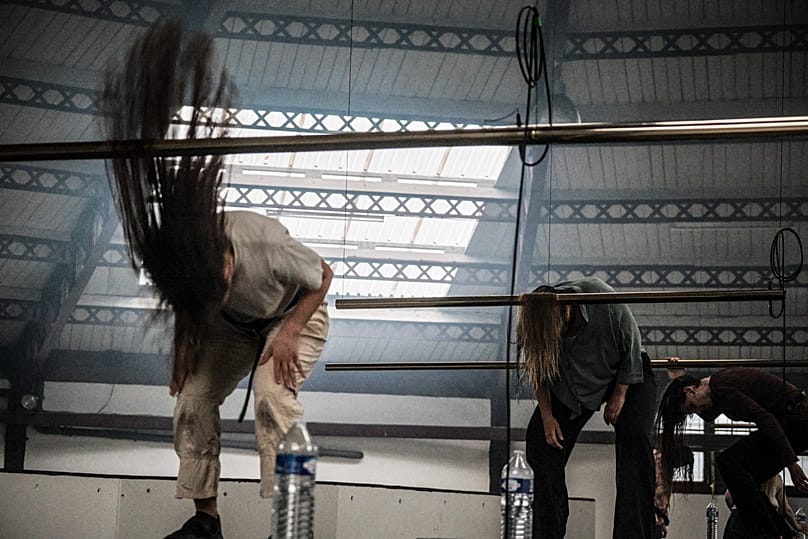
Religion also permeated the work of Italian director Romeo Castellucci. He staged his performance on the top floor of a Brussels parking building, beneath a roof resembling a cathedral. His show is titled “To Carthage Then I Came”, a phrase from the Confessions of Saint Augustine, before his conversion.
On a raised platform, six actors whip their wet hair over long tubes, the sound echoing through the vast space for 35 minutes. The atmosphere is dystopian, with the performers appearing to surrender to a superior force — possibly a Christ-like presence, as bells ring in the final moments of the performance.
Liddell pushes theatre's boundaries
Among other artists lined up to close the three-week festival, include the Spanish director Angélica Liddell, who premiered on Monday with a work inspired by Japanese writer Yukio Mishima and his ritualised representation of suicide through seppuku.
In El funeral de Mishima o el placer de morir, the flamboyant Spanish director pushes the boundaries of theatre to provoke, delivering a hymn to the untamed side of life.
The final week of the festival will also feature Family Triangle, where Taiwanese directors Chien-Han Hung, Wei-Yao Hung and Ray Tseng explore the desire to have a child through sperm donation, examining how the act of building a family is shaped and constrained by cultural traditions, gender norms and legal frameworks.
"The strongest bonds are not those of blood, but those—overlooked by the law—of commitment and care," is how the programme describes the festival's last show.
The Kunstenfestival des Arts ends in Brussels on Saturday 30 May.
Go to accessibility shortcuts Share CommentsRead more
So long, ‘Saxophone Colossus’: Jazz legend Sonny Rollins dies aged 95
Схожі новини
Бережна: Якщо на "Тисячовесну" подадуться "Курган & Agregat" – прекрасно, ми чекаємо
How jazz became an act of defiance in Nazi Germany