‘Cries of delight’ as Sumatran orangutan filmed using canopy bridge to cross road for first time
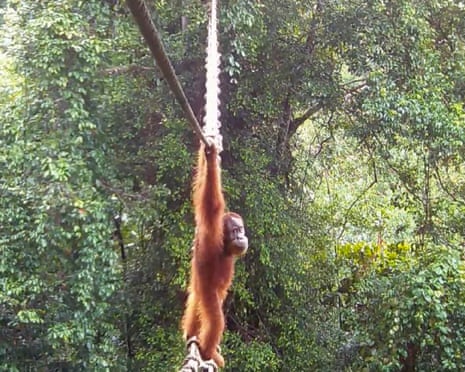
After a two-year wait, video of a young male crossing above a road gives hope that critically endangered species can survive habitat fragmentation
The critically endangered Sumatran orangutan has been filmed for the first time using a canopy bridge to cross a road.
In 2024, conservationists in the Pakpak Bharat district of North Sumatra in Indonesia built the bridge high over the Lagan-Pagindar road, which provides an essential route for local people but which became a barrier for animals.
Natural crossing was “impossible for wildlife”, said Erwin Alamsyah Siregar, director of Tangguh Hutan Khatulistiwa (TaHuKah), the environmental organisation that helped install the bridge.
For two years, the Sumatran Orangutan Society (SOS) and TaHuKah, its local partner, had been watching camera-trap footage of the bridge, waiting for the day that an orangutan would finally cross.
“You should have heard the cries of delight from the team,” said Helen Buckland, chief executive of SOS. “After two long years, it’s finally happened.”
This is the first time the species has been caught on camera crossing a wildlife bridge, offering a glimmer of hope to conservationists worried that this population would become functionally extinct if it were sequestered in one part of the forest.
For the 350 orangutans in the area, the road spelled disaster, as it split them into two populations, one at the Siranggas wildlife reserve, the other at the Sikulaping protection forest.
“Orangutans have a very slow life history, and are really prone to genetic bottlenecks,” said Buckland. If they are kept in small groups, they will be weakened by inbreeding until they are functionally extinct: surviving for now but heading towards long-term extinction.
After building the bridge with the help of the local government, a few different species began to use it: black giant squirrels, long-tailed macaques, agile gibbons – but no orangutans.
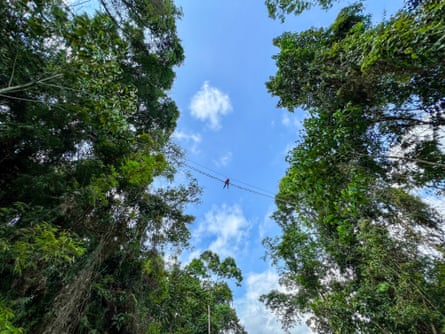
The young male orangutan is seen edging on to the bridge before making its way across. Halfway across, it pauses to look down at the road below, then back at the camera, before proceeding into the Sikulaping protection forest.
Orangutans, the largest arboreal (tree-dwelling) mammal, are a keystone species and spend more than 90% of their time in the forest canopy. They have excellent memories and can make mental maps of new routes through their forest habitat.
In total, there are three species of orangutan, and the entire wild population is concentrated in this corner of south-east Asia. There are only 14,000 Sumatran orangutans left, which makes them one of the world’s most threatened apes.
Franc Bernhard Tumanggor, head of the Pakpak Bharat district, said: “Witnessing a Sumatran orangutan confidently crossing that bridge is living proof that we need not sever the forest’s lifeline in order to build our communities’ own. Modernisation does not have to mean destruction.”
Find more age of extinction coverage here, and follow the biodiversity reporters Phoebe Weston and Patrick Greenfield in the Guardian app for more nature coverage
Explore more on these topics- Endangered species
- The age of extinction
- Indonesia
- Wildlife
- Conservation
- Animals
- Asia Pacific
- Endangered habitats
- news
Схожі новини
British Airways warns of higher airfares as Iran war pushes up oil prices

Canadian court pauses deportation of Jaskirat Singh Sidhu over 2018 crash that killed 16
G7 says nature talks a success as climate sidelined for U.S.