Could German ex-leader really negotiate Ukraine peace?
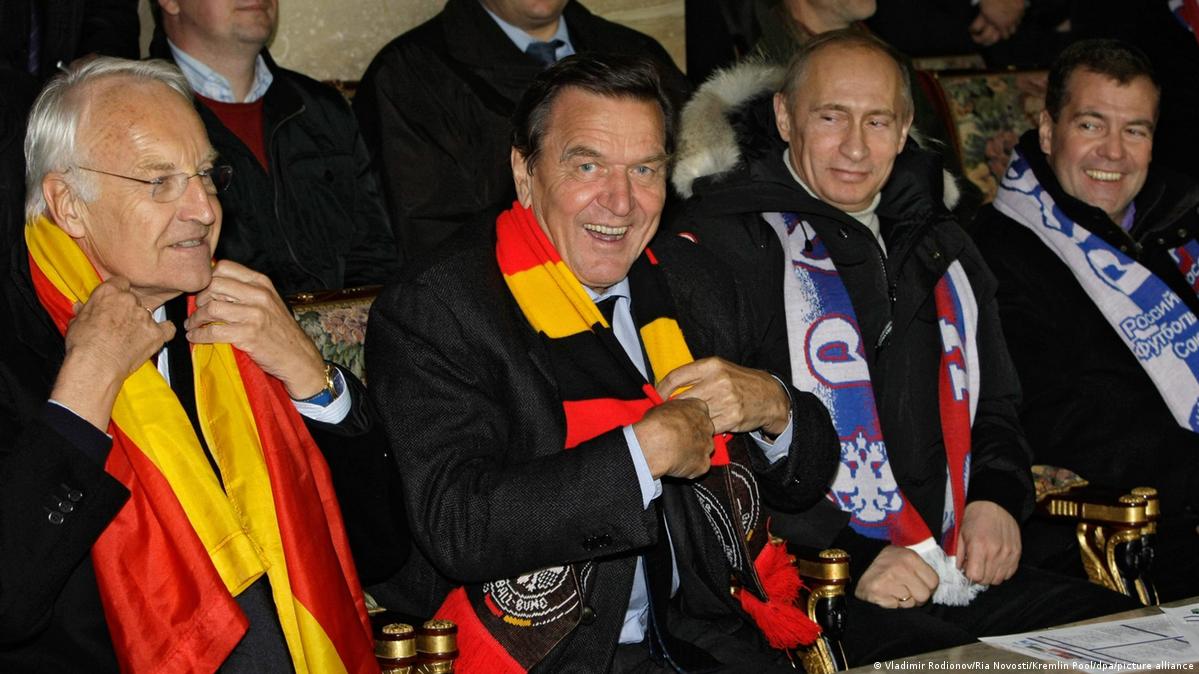
As head of the center-left Social Democrats, Gerhard Schröder was chancellor of Germany between 1998 and 2005. Now Russian President Vladimir Putin says he would like Schröder as a possible European mediator in peace talks to end the Ukraine war.
During his tenure as chancellor, Schröder's Russia-friendly foreign policy attitude was not that different from other German politicians. Other German leaders, including Angela Merkel and Olaf Scholz as well as current President Frank-Walter Steinmeier, all played a role in establishing closer ties between Berlin and Moscow through projects such as the Nord Stream gas pipelines
But what made Schröder's stance different has been his support of Russia in the face of public outcry over Putin's aggression toward Ukraine. This estranged the now-82-year-old from Berlin's political establishment and from his own party, which tried to expel him.
A long friendship
Schröder has been friends with Putin since he became the German chancellor in 1998. He even attended the Russian president's birthday in 2014 in Moscow.
After his tenure as chancellor, Schröder was criticized for being deeply involved with Russian state-owned energy companies. He approved the first Nord Stream pipeline shortly before leaving office in 2005 and in 2016, joined the board of the venture behind the second gas pipeline, Nord Stream 2; the latter never went ahead because of the war in Ukraine in 2022.
The social democrat was meant to join the supervisory board of Russian state energy company Gazprom in 2022 too but eventually backed out, as he came under increasing pressure after the Russian invasion of Ukraine.
Heavily criticized
In an interview that year with Germany's Bild tabloid, prominent Russian opposition leader Alexei Navalny, who died in a Siberian prison in early 2024, called Schröder out over his close relationship with Putin.
"Gerhard Schröder is paid by Putin," Navalny told Bild in an interview published in 2022.
"He's still the former chancellor of the most powerful country in Europe," Navalny said. "Now he's Putin's errand boy, he protects murderers."
At the time, a senior German politician said Schröder's position on the Navalny case — Schröder said there were no hard facts to prove Navalny had been poisoned — "fills many in Germany with shame."
That same year, politicians from Germany's Christian Democrats and the Green party also demanded Schröder step down from his position as chairman of the board of directors of the Nord Stream 2 project, as well as all other posts in Russia. Critics accused Schröder of lobbying for the Kremlin.
Nord Stream: Germany's thwarted dream of energy security
To view this video please enable JavaScript, and consider upgrading to a web browser that supports HTML5 video
Angela Merkel, his Christian Democrat successor, approved the second pipeline project in 2018.
His former colleagues also questioned Schröder's right to a state-funded office and staff.
The right to a staffed office is common for former government leaders but in May 2022, the Bundestag's budget committee stripped Schröder of the right, arguing that he was no longer fulfilling any obligations tied to his previous role in government.
In 2022, Schröder traveled to Moscow to meet Putin to discuss a "negotiated resolution" in Ukraine, a move Ukrainian President Volodymyr Zelenskyy called "disgusting."
In a 2024 interview, Schröder said that negotiations with Putin might be the only way to end the war in Ukraine.
"We have worked together sensibly for many years. Perhaps that can still help us find a negotiated solution; I don't see another solution," he told Germany's DPA news agency.
A personal relationship for peace?
During that interview, Schröder was asked why, despite Russian war crimes, he still maintained a friendship with Putin. He replied by saying the two matters were distinct.
Schröder said he did not want to forget the "positive events" with Putin. He felt that his personal relationship could also prove beneficial in addressing a challenging political issue.
"It is obvious that the war cannot end with the total defeat of one side or the other," the former chancellor argued.
Writing in the Berliner Zeitung newspaper in January this year, Schröder conceded that the Russian invasion was contrary to international law.
"But I'm also against demonizing Russia as the eternal enemy," he added, before urging Germany to restart imports of Russian energy, which were cut over the conflict.
AdvertisementСхожі новини
ОВА: поранена внаслідок російського удару жителька Комишан померла в лікарні
Сибіга: дрони, які впали в Латвії, потрапили туди через роботу російської РЕБ
«Шахтар» достроково став чемпіоном України, завоювавши 16-й титул в історії