China’s new rules give the West a new headache
When Western firms pull production out of China or buy fewer parts from there in order to be less dependent on the country, this is called decoupling or de-risking.
And you would think that China can’t stop the rest of the world from decoupling, right? Tell that to Beijing.
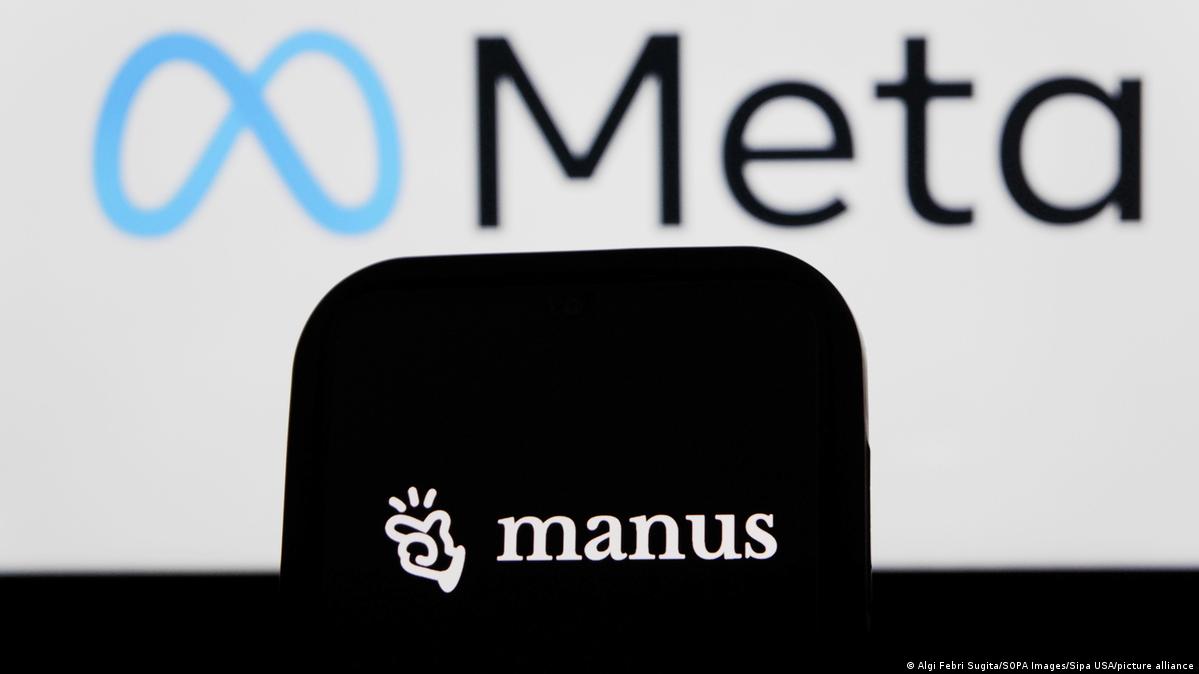
Chinese authorities blocked Meta’s $2 billion (€1.7 billion) takeover of the artificial intelligence (AI) startup Manus last month, sending a clear signal that even deals structured outside China's borders are no longer safe.
Manus is headquartered in Singapore, but has strong Chinese roots. China viewed the firm as one of its strategic assets in the global AI race and blocked the deal on national security grounds.
The move followed Beijing's swift introduction of the Regulations on Industrial and Supply Chain Security, also in April. These measures strengthen its ability to stop US tech giants from buying up high-end Chinese technologies.
Economic powerhouse China — a risky partner?
To view this video please enable JavaScript, and consider upgrading to a web browser that supports HTML5 video
New rules deter 'decoupling'
The new rules, however, have much broader consequences. In practice, Beijing is warning foreign governments and companies against decoupling.
Chinese authorities can now retaliate against foreign firms that move factories to countries like Vietnam or India, or reshore production back home. They could also face fines and supply chain blacklisting if they comply with United States and European Union export controls or sanctions targeting Chinese entities.
"It’s effectively meant to derail de-risking measures such as those the EU and member states, including Germany, have been taking to reduce dependency on China," Rebecca Arcesati, an analyst at the Mercator Institute for China Studies (MERICS), told DW.
Since the pandemic, both the EU and the US have stepped up efforts to make supply chains more resilient and less dependent on China. Many foreign companies have scaled back their operations there. Some production has been reshored nearer to home.
Trade tensions between China and the West have simmered for years, but US President Donald Trump’s aggressive new tariffs on Chinese goods in 2025 significantly accelerated the shift. Together, these disputes have hastened the move away from globalization toward a more fractured, bloc-based global trading system.
Europe strikes back over Chinese overproduction
Faced with repeated dumping of cheap Chinese goods — most recently electric vehicles (EVs) — flooding the European market as a result of Trump's tariffs, the EU is increasingly taking concrete steps to better guard its trade with China.
In March, the European Commission, the EU's executive arm, published details of the bloc's Industrial Accelerator Act (IAA). While it does not explicitly single out China, the IAA aims to cut Europe’s strategic dependencies on Chinese goods and investments and counter unfair competition from Chinese rivals, who often benefit from huge state subsidies.
This regulatory tug-of-war is putting multinationals — especially Germany's carmakers — in an increasingly difficult position as the likes of Volkswagen, BMW and Mercedes-Benz are keen to protect their substantial market share in China.
They also profit from producing a considerable proportion of their vehicles in China, which are then exported to other territories. At home, they face pressure to reduce reliance on Chinese components while also competing with fast-rising Chinese EV competitors.
No EVs without China?
To view this video please enable JavaScript, and consider upgrading to a web browser that supports HTML5 video
Firms face impossible balancing act
Jens Eskelund, president of the European Union Chamber of Commerce in China, described Beijing's new powers as an "extraterritorial toolbox" that will further add to "complexity in global trade."
"You could have situations where companies are caught in between regulatory measures being imposed in the US or Europe and in China, where it's impossible to comply with them all," Eskelund told DW.
There is anecdotal evidence, MERICS-analyst Arcesati said, that China is already pressuring foreign companies over their plans to move some production to other countries.
"China's leaders have determined that the best way of ensuring national leadership in this technology is for China to become more self-sufficient ... and for the world to rely more on China for supply chains and technology," she told DW.
Beijing has already shown its willingness to weaponize supply chains, tightening export controls last year on rare earth elements and other critical minerals. These materials are vital for the production of EVs, defense systems and advanced electronics.
Chinese pressure to water down IAA
The EU is under growing pressure from Beijing to water down the IAA. Several EU states with strong economic ties to Beijing, including Germany, are also urging a more cautious approach.
Despite the EU’s trade deficit with China reaching a staggering €360 billion ($424 billion) in 2025, Brussels may struggle to hold firm, even as many analysts warn that Europe must urgently protect its industrial future.
“If I were a European policymaker, I would ... double down,” Alice Garcia Herrero, Chief Economist for Asia Pacific at French Investment Bank Natixis told DW. "If we keep on accepting the threat from China, we’ll have less and less room."
Additional reporting by Clifford Coonan
Edited by: Andreas Becker
AdvertisementСхожі новини
Trump becomes first U.S. leader to visit China since ’17 as high-stakes summit looms
Japan suspends Eddie Jones for verbally abusing officials

Mexico City’s underground secret world: Ancient temples, ritual skulls and a lost civilisation still hidden beneath modern streets