China Resilient Against Trump's Tariffs, But Middle East Conflict Threatens Economic Stability
China's manufacturing sector faces mounting pressure as the US-Israel conflict with Iran disrupts global shipping routes and drives up production costs, despite the country's earlier resilience against American trade barriers.
While Beijing successfully weathered tariffs imposed by the Trump administration last year—maintaining approximately 5% GDP growth and boosting exports—the escalating Middle East tensions are now creating fresh economic headwinds that threaten factory orders, employment, and worker livelihoods across the industrial heartland.
Factory Workers Feel the Squeeze
In Foshan, Guangdong province, one of China's largest manufacturing centres, temporary factory positions paying 18 to 20 yuan per hour (equivalent to just a few dollars or pounds) offer grim prospects. Workers, many over 40 years old, expressed frustration about mounting uncertainty, with some pleading for assistance amid stagnant wages and diminishing opportunities.
The transformation of Chinese manufacturing from mass-produced goods to automated advanced technology has already created significant displacement. The Middle East conflict now compounds these challenges by disrupting supply chains and increasing operational expenses.
Oil Crisis Hits Supply Chains
Guangzhou's sprawling fabric market—the world's largest—illustrates the ripple effects of the conflict. Traders reported cost increases of approximately 20% as disruptions to the Strait of Hormuz, a critical shipping corridor, constrain petrochemical supplies essential for fabric production.
"It means fewer orders," one trader explained, noting that some customers refuse price increases while inventory accumulates in warehouses. Operating on thin profit margins, fabric sellers face an impossible choice: absorb costs themselves or lose business.
The contrast with last year's trade war tensions is striking. Where defiance once characterised the streets of Guangzhou, resignation now prevails.
Electric Vehicles Offer Bright Spot
China's electric vehicle sector demonstrates the country's strategic positioning. Chinese manufacturers exported 350,000 EVs in March alone—a 30% surge from February and a 140% increase compared to March of the previous year, according to the Chinese Passenger Car Association.
However, trader Joyce Liu faces complications. "Last year 90% of our cars went to the Middle East but this year because of the war we almost stopped doing business with them," she stated. "Some of the cars are still waiting at Chinese ports."
Liu is now pursuing alternative markets in Africa and South America, though delegations from India, Bangladesh, Turkey, and Oman are actively negotiating at the Canton Fair, where waiting lists for Chinese EVs are growing in countries experiencing soaring petrol and diesel costs.
Beijing's Diplomatic Balancing Act
China is actively calling for a ceasefire while diplomatically pressuring Iran toward negotiations. Xi Jinping is simultaneously engaging with the crown princes of the UAE and Saudi Arabia, demonstrating Beijing's expanding diplomatic influence.
Yu Jie from London-based think tank Chatham House notes that while US decline benefits China strategically, Beijing "would prefer a US that is more predictable, and that is perhaps easier for Beijing to manage."
However, China remains cautious about antagonising Trump ahead of a scheduled May summit. "Beijing wants to do whatever it can to secure that meeting," Jie explained.
William Figueroa, professor of History and International Relations at the University of Groningen, characterises this as China flexing diplomatic muscle: "It wants to show both the United States and its partners in the region that it's serious about its commitments there - and that obviously has a global audience."
Broader Implications
China's expanding role extends beyond economics into global power dynamics. Yet this elevated status rings hollow for workers like those at the Canton Fair, where one cleaner earned 150 yuan ($20; £14.80) for a 14-hour work day.
As Beijing positions itself as a responsible global actor while managing economic turbulence, ordinary workers struggle with stagnant wages and diminishing prospects in an increasingly unstable world.
Схожі новини
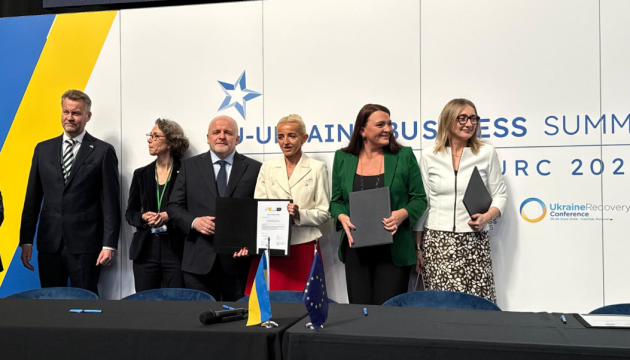
Чотири країни ЄС спільно інвестуватимуть 175 мільйонів євро в безпеку та відбудову України
«ПриватБанк» зафіксував зниження котирувань іноземних валют

Україна запускає масштабний проєкт відновлення лісів вартістю 5,4 мільйона доларів