Canada Needs A Second Golden Spike For Electricity
 Infographic of critique of Canada's new electricity strategy by author with ChatGPT
May 15, 20263 hours
Michael Barnard
0 Comments
Support CleanTechnica's work through a Substack subscription or on Stripe.
Infographic of critique of Canada's new electricity strategy by author with ChatGPT
May 15, 20263 hours
Michael Barnard
0 Comments
Support CleanTechnica's work through a Substack subscription or on Stripe.
Canada’s federal government has finally put electricity where it belongs: at the centre of the national economy. That is the most important thing about Mark Carney’s newly announced National Electricity Strategy. This is not just a climate file. It is an industrial strategy, an affordability strategy, a trade strategy, a sovereignty strategy, and a productivity strategy. Canada has spent decades treating electricity as a provincial utility matter and fossil fuels as the national energy story. That framing made sense in the 20th century, when oil and gas exports dominated the energy conversation and electricity was mostly something reliable that arrived quietly at the wall. It makes much less sense in the 21st century. The future economy runs on electrons. Carney’s strategy does not solve the problem, but it does name the right problem.
The federal framing is large. Canada has an electricity system that is already roughly 80% clean, mostly because of hydro, nuclear, and growing wind and solar. Demand is expected to double by 2050. The government’s goal is to double grid capacity by then, while keeping electricity clean, reliable, and affordable. The strategy is built around generation, transmission, distribution, storage, grid modernization, east-west-north interties, workforce development, and domestic manufacturing. The government also claims that the strategy could deliver up to $15 billion in total energy savings by 2050 and reduce total household energy costs for 7 in 10 households. Those are sensible claims directionally, because electrification usually replaces inefficient combustion with efficient electric machines. The issue is whether Canada can build the grid, shape demand, and retire fossil fuel use fast enough to make those savings real.
Electricity is different from other energy carriers because it is both efficient and flexible. Burning fuels wastes a lot of useful energy. Electricity can power a heat pump with a coefficient of performance of 2.5 to 4, move a car 100 kilometres on 15 to 20 kWh, run high-efficiency motors, charge batteries, and support digital infrastructure. That is why electricity demand can rise while total energy demand falls. Canada can use more electricity and less energy at the same time. That sounds odd only if energy is treated as a pile of fuels rather than a system of useful services.

This is where Carney’s strategy aligns with the basic electrification-first argument I have made for years. Canada does not need to invent most of the technologies required for decarbonization. Heat pumps, EVs, wind and solar, batteries, high-voltage direct current transmission, dynamic line ratings, reconductoring, power-flow control, demand response, and grid-forming inverters all exist. The barrier is not physics. It is implementation, permitting, provincial coordination, cost of capital, institutional conservatism, and the habit of treating every legacy fuel pathway as if it deserves a seat at the strategy table forever.
Canada starts from a strong position, but not from a coherent one. The national grid is clean in the aggregate, but there is no single Canadian grid. There are provincial and territorial systems, each with its own history, utility structure, resource base, regulatory culture, and politics. Hydro provinces, nuclear-heavy Ontario, fossil-heavy Alberta and Saskatchewan, wind-rich Atlantic Canada, and diesel-dependent northern communities are all hidden inside the same national average. Canada has clean electricity, but it does not yet have a national electricity system.
That is why the east-west-north transmission pillar matters. Canada built too much of its electricity system as provincial islands with north-south trade relationships into the United States. That made sense in slices. It does not make sense as a national strategy. The country needs more interprovincial capacity, more regional sharing, and a better ability to move clean electricity from where it is available to where it is valuable. This is the second golden spike argument. Canada’s first national infrastructure project connected the country physically by rail. The 21st-century equivalent is not another railway. It is a set of high-capacity electrical corridors, interties, substations, controls, storage, and market rules that let clean power move across provincial boundaries with less friction.
This does not mean one giant wire from Victoria to St. John’s, built all at once in a burst of national romance. That would be a good way to produce court cases, procurement delays, and consultant slide decks. The useful version is a sequence of practical projects: stronger ties between hydro provinces and fossil provinces, Atlantic wind connections, northern clean power replacements for diesel, stronger Ontario-Quebec coordination, and targeted high-voltage direct current where distance and scale justify it. The federal government’s job is not to run every provincial grid. It is to lower the cost of capital, support Indigenous equity, accelerate interprovincial coordination, standardize some planning assumptions, and make nationally useful projects easier to finance and permit.
The demand story needs more precision than the announcement gives it. “Demand will double by 2050” is useful as a headline, but planning requires separating annual energy from peak power. Annual electricity demand is measured in TWh. Peak demand is measured in GW. They are not the same problem. A country can add a lot of annual electricity demand through EV charging, industrial electrification, and heat pumps without adding the same share of peak demand, if it manages loads properly. Conversely, a few cold winter evenings can drive a lot of grid investment if buildings are inefficient, heating is unmanaged, and utilities plan around worst-case peaks without enough flexibility. The expensive part of the system is often not the average hour. It is the hardest hour.
That distinction matters for Ontario, Alberta, and much of Canada. If EVs charge whenever drivers plug in at 6 p.m., they add to evening peaks. If charging is managed overnight and around renewable output, they become flexible load. If heat pumps are installed without attention to building controls, thermal storage, envelope improvements where sensible, and peak management, they can stress winter systems. If they are integrated with demand response, better rates, water-heater storage, district energy, and targeted efficiency, they reduce fossil fuel use without requiring absurd overbuilding. Canada should not treat all new electric demand as a problem. Much of it is the replacement of waste with useful work. But it does have to distinguish flexible load from firm peak load.
The build order is where the strategy needs more discipline. Politically, Carney’s strategy lists almost everything: hydro, nuclear, wind, solar, gas, carbon capture, geothermal, storage, transmission, distribution, efficiency, and manufacturing. That is understandable. Canada is a federation. Premiers defend local resources. Utilities defend their legacy systems. Federal politicians want broad coalitions. But a strategy is not a menu. It is a sequence of choices. The key question is not whether every technology gets mentioned. The key question is what gets built first, what gets financed most cheaply, what gets permitted fastest, and what reduces fossil fuel dependence soonest.
The sensible build order starts with getting more value from the grid Canada already has. Dynamic line ratings can reveal unused capacity on existing lines when weather conditions allow. Reconductoring can increase capacity in existing corridors. Grid-enhancing technologies can control flows and reduce congestion. Batteries can absorb surplus and reduce peaks. Demand response can turn load into a resource. Better interties can reduce the need for duplicate generation in each province. These are not as politically photogenic as a new megaproject, but they are often faster and cheaper. New transmission can take 10 to 15 years once routing, permitting, consultation, procurement, and litigation are included. Canada should build new transmission, but it should also wring every useful MW out of the system it already owns.
Next comes proven clean generation. Canada has been too slow on wind and solar relative to its potential. By the end of 2025, Canada had roughly 19 GW of wind capacity, but 2025 additions were only about 347 MW, a growth rate below 2%. That is not what urgency looks like. Wind and solar are not perfect resources, because no resource is perfect, but they are modular, fast to build, cheap in many markets, and complementary across regions when paired with storage and transmission. Atlantic Canada has strong wind resources. Alberta and Saskatchewan have strong wind and solar resources. Ontario has room for more renewables if it stops treating nuclear as the only serious tool in the drawer. Hydro provinces can provide flexibility and storage value if interties are strong enough. The country has the pieces. It needs the build rate.
Gas is the biggest ambiguity in Carney’s strategy. The federal government says natural gas will remain part of the affordability and reliability mix, and it intends to adjust the Clean Electricity Regulations to provide more flexibility. Reuters reported that the changes would allow more use of credible offsets and more flexibility for existing gas plants. That may sound modest, but it is the point where a useful electricity strategy can start to leak. Gas used rarely for reliability during a transition is one thing. Gas used as an excuse for long-lived baseload or high-capacity-factor generation is another. One is insurance. The other is a fossil fuel strategy wearing a reliability badge.
The Canadian Climate Institute has already made the right warning. The strategy points in the right direction, but it gives too little clarity on gas. If new or existing gas plants are allowed to run often, Canada risks locking in emissions and crowding out cleaner flexibility options. The solution is simple in concept. If gas remains, define it tightly. Publish operating-hour limits, annual emissions budgets, expected capacity factors, retirement dates, and rules that prevent offsets from becoming a loophole big enough to drive a combined-cycle gas plant through. Gas should be a declining reliability resource, not a growth platform. If a gas plant is needed for the coldest 30 or 100 hours a year during a transition, say so and regulate it that way. If it is expected to run thousands of hours a year, it is not backup. It is the plan.
Nuclear deserves realism, not reflexive dismissal or reflexive preference. Canada has nuclear expertise. Ontario’s existing CANDU fleet has supplied large volumes of low-carbon electricity for decades. Darlington New Nuclear is one of the projects moving through the Major Projects Office. None of that means nuclear should be treated as the default answer to every planning problem. New nuclear is slow, capital-intensive, and hard to deliver on time and budget. Small modular reactors remain mostly a promise, not a deployment class. The risk is that nuclear planning is allowed to justify 15 years of extra gas generation while faster resources are underbuilt.
This is a sequencing problem. If a nuclear project is genuinely economic, deliverable, and system-useful, it can compete. But it must compete against faster modular resources, interties, grid-enhancing technologies, and demand-side flexibility. It should not be protected by planning models that assume weak demand response, limited interties, slow renewables, and unmanaged peaks. Every $10 billion allocated to a slow resource is $10 billion not allocated to faster resources unless the system can absorb both.
Efficiency and flexible demand should be funded and measured like supply. Efficiency Canada made the useful point that the cheapest electricity is the power never used, and that the government’s target of retrofitting up to one million homes should be treated as a starting point, not a ceiling. Canada has roughly 16 million households. One million homes is about 6% of them. That is not trivial, but it is not a national transformation. Heat pumps should be central, especially for homes using heating oil, propane, and inefficient electric resistance heat, while low-income households should be prioritized because energy affordability is not an average.
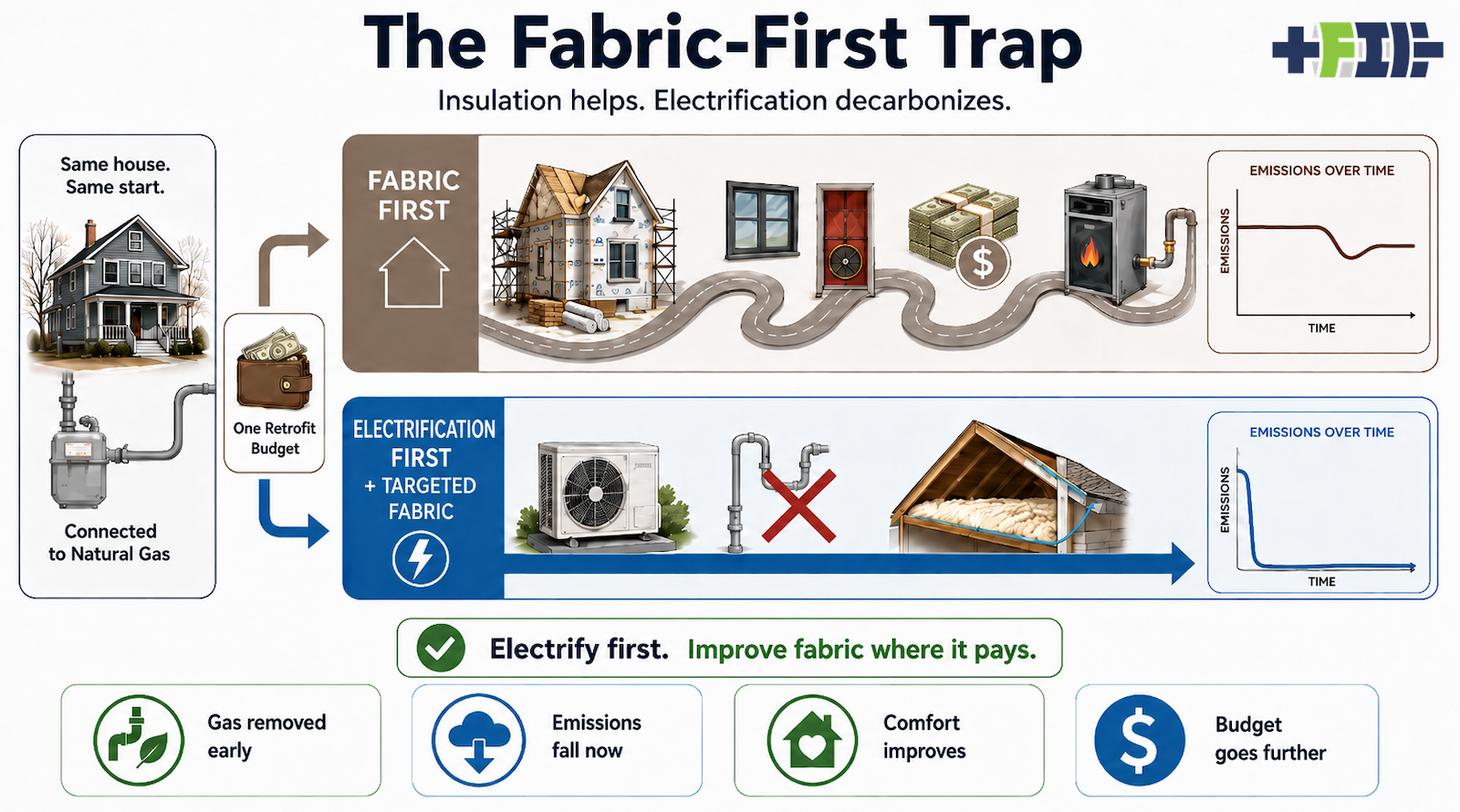
The retrofit strategy should avoid the fabric-first trap. Deep envelope retrofits have their place, especially in leaky buildings and cold climates, but Canada should not make perfect building shells a prerequisite for electrification. Heat pumps, air sealing, attic insulation, controls, and targeted envelope measures can deliver faster savings than waiting for deep retrofits in every home. A practical program would focus on fuel switching, peak reduction, comfort, and bill savings, and track kWh, peak kW, emissions, and household energy costs, not just grant approvals.
The workforce and supply-chain pillars are not decorative. The federal strategy says doubling the grid will require more than 130,000 skilled workers by 2050. That number should make people pause. Canada cannot build a doubled grid with press releases and procurement frameworks. It needs electricians, line workers, protection engineers, civil engineers, welders, substation specialists, project managers, power electronics specialists, environmental reviewers, Indigenous partnership teams, and utility planners. It also needs transformers, high-voltage equipment, cables, switchgear, control systems, steel, software, and manufacturing capacity in the places where Canada has advantage. A worker cannot train against a slogan. A manufacturer cannot expand capacity against a vague aspiration. The country needs visible demand.
Indigenous participation must be central to delivery, not appended to consultation. Transmission corridors, hydro projects, wind farms, solar sites, storage projects, northern grids, and mining electrification all intersect with Indigenous rights, lands, ownership, and community benefits. The federal Indigenous Loan Guarantee Program, expanded from $5 billion to $10 billion, is important because equity ownership changes the structure of projects. Indigenous participation is not a favour granted by developers. It can make projects more legitimate, more bankable, more durable, and more likely to survive political cycles. If Canada wants east-west-north electricity infrastructure, Indigenous partnership is part of the project architecture.
The federalism problem remains the core delivery test. Electricity is mostly provincial. Climate, fiscal capacity, Indigenous relations, trade, and national infrastructure are federal. That means the federal government can set direction, provide financing, convene provinces, support major projects, and shape tax credits, but it cannot simply order every utility to build the optimal system. Alberta, Saskatchewan, Ontario, Quebec, British Columbia, and Atlantic provinces have different politics and different assets. That is why the strategy needs more than consultation. It needs named interties, dated milestones, project scorecards, federal-provincial agreements, and transparent assumptions. Without that, the strategy risks becoming a polite container for provincial delay.
A better implementation plan would identify the first tranche of priority interties and estimate their MW, expected TWh flows, avoided gas generation, cost, permitting path, and Indigenous ownership structure. It would set annual targets across five categories: clean supply, storage and flexibility, intertie capacity, gas decline, and household affordability. It would publish household energy cost impacts by income group, because national averages conceal the households that need the most help.
Carney’s electricity strategy gets the direction mostly right. That matters. It recognizes that clean electricity is not a niche climate solution but the foundation of the next Canadian economy. It aligns with the electrification-first thesis, the second golden spike thesis, and the need to turn Canada’s provincial grids into a more coherent national asset. It puts electricity into the same conversation as productivity, competitiveness, affordability, and sovereignty.
But naming the right national project is not the same as delivering it. The test now is whether the federal government can turn a broad political tent into a ranked build program. Without disciplined sequencing, the strategy could preserve the fossil, megaproject, and provincial-delay habits it needs to overcome. With discipline, it could become the moment Canada stopped treating electricity as a utility file and started building it as the common infrastructure for affordability, reliability, competitiveness, and decarbonization.
Sign up for CleanTechnica's Weekly Substack for Zach and Scott's in-depth analyses and high level summaries, sign up for our daily newsletter, and follow us on Google News! Advertisement Have a tip for CleanTechnica? Want to advertise? Want to suggest a guest for our CleanTech Talk podcast? Contact us here. Sign up for our daily newsletter for 15 new cleantech stories a day. Or sign up for our weekly one on top stories of the week if daily is too frequent. CleanTechnica uses affiliate links. See our policy here.CleanTechnica's Comment Policy
Share this story!
Схожі новини

Скільки коштує валюта в Україні сьогодні: курс долара та євро 16 травня

Російська економіка воєнного часу скоротилася вперше з 2023 року, - Bloomberg

Super-rich NRI who called himself 'recession-proof' in 2008 sent to jail: His New Jersey mansion had salt water pool surrounded by imported sand