Bundesliga games abroad unlikely, but for how long?
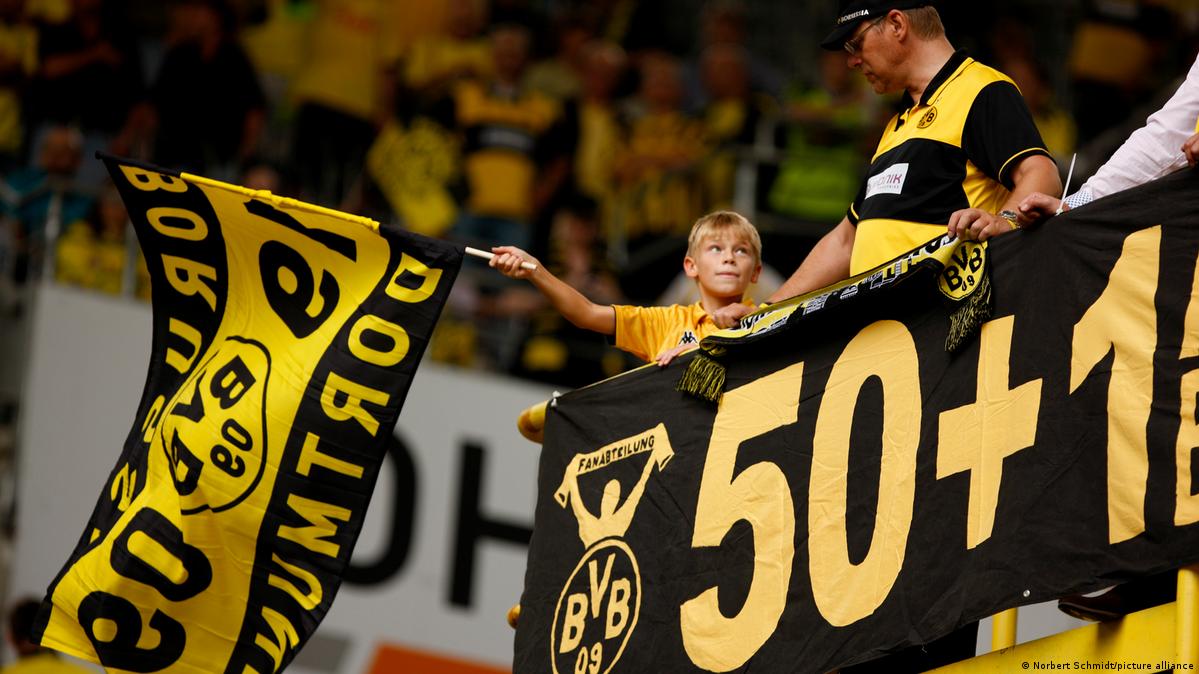
After the news that FIFA is set to allow domestic football leagues to play one game a season abroad, German football faces a familiar battle between tradition and growth.
English newspaper The Guardian exclusively reported that new FIFA proposals will allow domestic leagues to have one game a season hosted in a foreign country. The host country will reportedly be allowed to host a maximum of five games from other countries, with the US the favored target.
"I think the German members would object to that and there would be mass protests in the stadium," Martin Endemann, head of policy at Football Supporters Europe, who advocate for fans on the continent, told DW. "Any football official who would try to do this would have a very, very hard time with those fans in the stadium as well as the members of the respective clubs."
The discussion of playing domestic league games abroad is not new. Last October, UEFA gave La Liga (Spain) and Serie A (Italy) permission to play a game abroad, but the games were scrapped after local authorities raised concerns. The fallout was ugly.
Germany's Dortmund invests in Ghana's emerging players
To view this video please enable JavaScript, and consider upgrading to a web browser that supports HTML5 video
The new FIFA protocol for moving a competitive game abroad would require approval from all major stakeholders, and FIFA would still have the right to reject the switch.
"It is the formalization of something that has been economically inevitable for years," Dominik Schreyer, a professor of sports economics at Germany's Otto Beisheim School of Management, told DW.
"Football has been shifting from a locally anchored product to a globally monetized media asset, and once that transition happens, geography becomes flexible," Schreyer added.
"FIFA is not leading here, it is reacting under pressure and trying to regulate a development that was already underway through preseason tours and earlier league attempts to stage games abroad. Framing it as one game per season makes it politically digestible, but economically it starts to normalize the idea that domestic competitions are no longer strictly domestic. You could say, the product has already gone global, now the matches are catching up," he said.
German football structure different to rest of Europe
While many believe such developments have long been an inevitability for clubs in England, Spain and Italy, German club ownership structure differs to other major European leagues, presenting a more complex conversation.
The 50+1 rule essentially guarantees that 50% plus one share of a club's total shares must be owned by members, ruling out ownership by rich individuals or even nation states. The power of German fans is not to be underestimated, as was recently seen by the failed attempt to secure investment from a private equity partner.
However, if domestic league games abroad become a reality for clubs in Europe, then the Bundesliga will likely return to walking along the familiar tightrope of tradition and growth.
"Financially, the upside exists but should not be overstated," Schreyer said of playing league games abroad. The example of the National Football League (NFL) in the US playing competitive games abroad is proof of this. Ahead of the first league game in Germany in 2022, the head of NFL Germany said they could have sold over 3 million tickets. Business and finance source BNN Bloomberg explained that when the Jacksonville Jaguars play in London, the team generates roughly $35 to 50 million (€30 to €42.5 million) in revenue each time they play.
"A competitive match abroad carries more commercial weight than a pre-season game because it combines scarcity, sporting relevance and global media attention. As such, a club like Bayern or Dortmund could maybe expect a low double-digit million euro uplift for a match in the US," Schreyer said, adding that an exact number is hard to come by. Figures released by Sport Bild in late 2025 suggest that Bayern reportedly makes around €5.7 million per home game in revenue.
"This is about positioning, not payday. That becomes even clearer once you factor in compensation for local fans, especially season ticket holders, who would miss out on a high-value fixture at their home stadium."
Opposed to the idea, but for how long?
Herein lies the major challenge for German football. The tradition that many football clubs are rooted in in Germany, combined with the 50+1 structure, mean that maintaining the local market remains imperative even in the face of football's global growth.
The DFL (German Football League), the organization that operates the Bundesliga, have publicly spoken out against the idea, and have been as far back as 2018 when Christian Seifert was boss. More recently, Hans-Joachim Watzke, the chairman of the DFL supervisory board and a former Dortmund CEO, couldn't have been clearer when speaking on the topic.
"As long as I am responsible for this league, there will be no match abroad, when it comes to competitive matches. Full stop," said Watzke.
Bayern Munich's CEO Jan-Christian Dreesen is also opposed to the idea, but what if these games become a regular reality for the likes of Manchester City, Paris Saint Germain and Real Madrid?
"For German clubs, the real constraint is cultural," argued Schreyer. "German football still defines itself through local identity, while competitors have fully embraced global market logic. In the short term, Bundesliga clubs will not fall behind simply by abstaining, because media rights still carry the bulk of revenues. But if others consistently monetize international demand through premium events and German clubs opt out, the gap in global relevance will widen, and the money will follow."
For Germany, this possibility is only really a concern for a handful of clubs.
"Fans are buying a spectacle, not a league fixture. Nobody will fill an arena in the US for Hoffenheim versus Augsburg. So, this will work for a handful of clubs, not for the league as a whole," Schreyer said, with Bayern Munich and Borussia Dortmund the obvious two candidates.
While Bundesliga games being played abroad remains extremely unlikely, pressure will grow if other major clubs do take the step.
Edited by: Matt Pearson
AdvertisementСхожі новини

Чемпіонат України з боксу серед молоді та жінок‑молоді пам’яті П.Р. Поповича: Біла Церква стала ареною для нових чемпіонів
Анна Письменська представила Україну у суддівстві на турнірі зі стрибків у воду в Німеччині

AIG Women's Open prize pot increased to $10m