Bondi beach was where her parents met – and where her father died defending his people

Sheina Gutnick, daughter of Reuven Morrison who was killed fighting alleged Bondi beach terrorists, is first witness at royal commission on antisemitism and social cohesion
-
Get our breaking news email, free app or daily news podcast
For Sheina Gutnick, Bondi holds both treasured memories and torment. The place where her parents met, where she spent happy childhood summer days, is today, also the place where her father died defending his people.
“Bondi holds many complicated and conflicting feelings for me,” Gutnick told the opening day of public hearings of the royal commission on antisemitism and social cohesion.
Gutnick’s father, 62-year-old Reuven Morrison, was one of 15 people shot and killed at Bondi on 14 December, allegedly by two Islamic State-inspired gunmen in an antisemitic terror attack on Jews celebrating Hanukah at a beachside event.
Morrison was killed after he threw bricks at the gunmen.
“It was somewhere where my parents had started their history together,” Gutnick, the commission’s first witness, said. “Somewhere I had spent many days in my childhood, I had beautiful memories there with my family, I had spent a lot of time there with my children during school holidays.
“And now Bondi holds a really heavy weight in our community’s heart.”
Gutnick’s father fled to Australia from Ukraine at the age of 14 and met his wife, another Jewish refugee, at the beach.
“He was deeply proud to have moved to Australia and been an Australian citizen, and grateful for a nation that welcomed Jews when so many others turned them away at that time.”
Gutnick told the commission that in December 2024 – a year before the Bondi massacre – she was walking through Westfield Bondi Junction with her baby when a man pointed at her Star of David necklace and called her a “fucking terrorist”.
“I felt shocked, exposed and unsafe. There were many people around me, but no one intervened,” she said.
She said she lived with a constant fear and a heightened sense of vigilance in public spaces.
Several members of Australia’s Jewish community have given evidence to the first day of public hearings of the royal commission before former high court justice Virginia Bell in Sydney.
An anonymised witness, AAK, told the commission how she had encountered rallies in the city that made her feel unsafe.
She said as Jewish people “we’ve had many generations of discrimination and we have a bit of a sixth sense when things are going to be potentially uncomfortable or even dangerous for us”.
AAK told a friend who reached out in support after the Bondi massacre that warnings from the Jewish community about the dangers of rising antisemitism were downplayed or ignored.
“Dead Jewish people don’t need love, alive Jewish people need people to listen to us when we tell people we feel like history is repeating itself.”
Another witness, given the pseudonym AAL, told the commission he had fallen in love with Australia while visiting from South Africa, and immediately felt Australia was his home. But he said the growing incidence and violence of antisemitism had made him question his family’s future in the country.
“I have to admit, things have changed: I really have to think very, very seriously whether this is the country for my grandchildren.”
The royal commission last week issued its interim report, focused on the intelligence and security response to the December attack on Bondi beach.
Bell addressed the commission to begin hearings Monday morning.
“The sharp spike in antisemitism that we’ve witnessed in Australia, has been mirrored in other western countries, and seems clearly linked to events in the Middle East,” she said.
“It’s important that people understand how quickly those events can prompt ugly displays of hostility towards Jewish Australians simply because they’re Jews. Displays of hostility that are sometimes expressed in images and sentiments that can sometimes be traced back to the middle ages if not earlier.”
The current fortnightly block of hearings is focused on defining antisemitism, its historical and contemporary manifestations and its current impact on Jewish Australians.
Counsel assisting the commission, Richard Lancaster SC, said subsequent hearing blocks will interrogate “the conduct of intelligence and law enforcement agencies in the lead-up to the attack … and in light of the terrorism threat level”.
A third hearing block will examine institutions and industries of concern, hearing evidence on the role of social media and “the radicalisation it may generate”.
On Monday afternoon, the co-chair of Jewish peak body, the Executive Council of Australian Jewry, Alex Ryvchin, gave impassioned evidence, saying Australia now resembled the antisemitic Soviet Union his family had fled when he was a child.
“The things we’ve seen in this country replicate what happened there: the rampant abuse, the violence, the denigration, and the sheer relish with which it is inflicted on the Jewish people.”
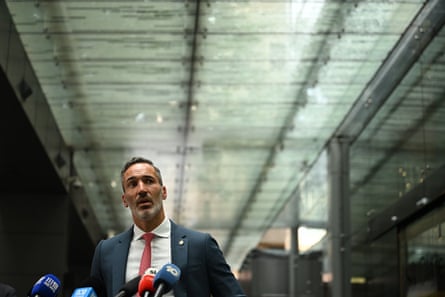
As a prominent advocate for Australia’s Jewish community, Ryvchin said he faced consistent death threats, threats against his children and family, and “fixated individuals” who posted personal pictures online. He said being called a “Jewish dog” in the street in Sydney “stopped me in my tracks”.
He said Jewish Australians feared the country was no longer safe for them and told the commission Jewish families had called, asking him “completely calmly, ‘will you tell me when it is time to go’.”
“And I’ve told them I would. I told them I will call them and advise them.
“I’m not going anywhere, I’m going down with the ship if that’s what is required: I love this country and I will continue to fight for the future of this country. But I completely understand those … thinking about exit strategies and plan Bs. That’s what’s necessary: history has shown how quickly things can change.”
On Monday morning, Bell announced the commission had granted the Jewish Council of Australia leave to appear at its first hearing block.
The progressive JCA, which states it has more than 2,500 Jewish supporters across the country, says its intervention aims to ensure the Commission avoids treating the Jewish community as a political monolith.
“A core feature of antisemitism is the stereotyping of Jewish identity,” executive director of the JCA, Sarah Schwartz, said in a statement. “When institutions treat Jews as a politically homogenous bloc, who all support Israel, it obscures the real diversity of our community and misdirects policy responses away from the genuine drivers of racism.”
Explore more on these topics- Royal commission on antisemitism and social cohesion
- Bondi beach terror attack
- Sydney
- New South Wales
- Judaism
- Antisemitism
- news
Схожі новини
Silicon Valley made AI powerful. Tokyo wants to make it work
Japan eyes going digital for emergency welfare loan applications

GameStop хоче купити eBay за $56 млрд. Що відомо про угоду?