Berlin Hauptbahnhof at 20: A rail hub with symbolic power
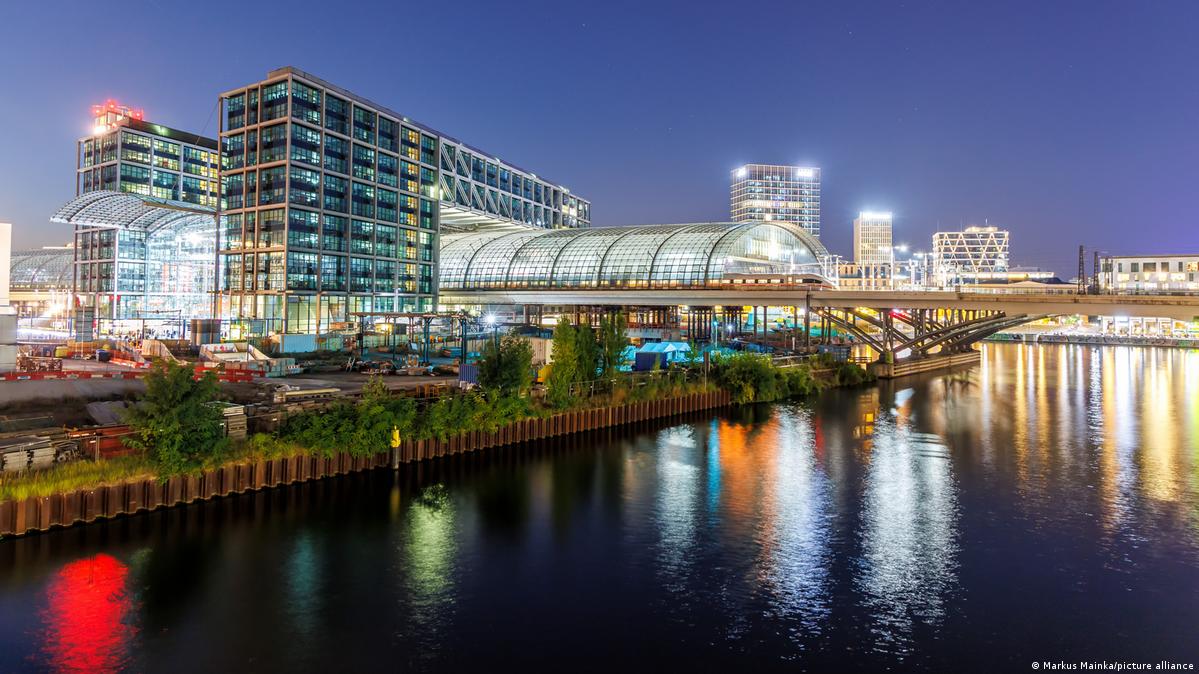
"This is a symbolic day, since this is also such a symbolic location. Right next to the former [Berlin] Wall, a new bridge is now being built between different directions, connecting the once-separated parts of Berlin in a completely new way," said then-Chancellor Angela Merkel in her speech marking the inauguration of Berlin Hauptbahnhof, the capital's new central train station, on May 26, 2006.
Merkel went on to praise the multilevel transportation hub as "a modern, open-minded and cosmopolitan structure" that also embodied the spirit of recently reunified Berlin and Germany.
The location was particularly symbolic, because the modern station was built on a site that had spent years in neglect, along a historical no-man's land.
Central station's location reflects Berlin's tumultuous history
After World War II, when Berlin was divided between the capitalist West and the communist East, the city's rail network was also split in two.
East Berlin had its Ostbahnhof while long-distance trains ran from the infamous Bahnhof Zoo in West Berlin.
After German reunification in 1990, planners wanted a completely new central station that would physically and symbolically reconnect the city. The chosen site was on the location of a former 19th-century station, Lehrter Bahnhof.
When that station opened in 1871, it quickly became the landing point of Germany's most important east-west rail line. During World War II, Lehrter Bahnhof was heavily damaged. Then, between 1957 and 1959, the building's remains were bulldozed.
However, the S-Bahn station with the same name was retained; it was the final stop in the suburban train network on the West Berlin side, before crossing the border into the East.
Planning a reunified rail network
When Berlin suddenly had to function as one city again in 1990, its long-divided rail system also needed to be redefined and modernized.
The new central station was designed as the key node of this unified network, with multiple levels of railway traffic intersecting at different heights, crossing through the center of the city like a giant steel "X."
The architectural design competition was won by German architect Meinhard von Gerkan (who died in 2022), and his firm Gerkan, Marg and Partners, or gmp architects.
The alignment of the tracks and platforms had been predetermined by Deutsche Bahn, Germany's national railway company, explains architect Stephan Schütz, executive partner at gmp architects. "The task was therefore to create, on this basis, a structure that opened itself onto the city while simultaneously providing both orientation and clarity," Schütz tells DW.
Von Gerkan, whose standing in the world of architecture had been cemented through his firm's design of Berlin's Tegel Airport in the 1970s, envisioned the station as a "cathedral of transport."
"Daylight plays a special role in this context, which is why steel and glass define the station's appearance," Schütz points out. The design offered a bright, futuristic and spacious feel.
Another highlight, notes Schütz, is the station's "precise alignment with the dome of the Reichstag, serving as a visual focal point." Incidentally, the dome of Germany's parliamentary building was also rebuilt after the reunification of Germany — and in glass too, as a symbol of democratic transparency.
Ready for the 2006 World Cup
The construction of the train station officially began in 1995 and continued for 11 years.
Building directly next to the River Spree was one of the main challenges, as groundwater levels in the area are extremely high. Tunnels needed to be built under water.
Berlin also sits atop thousands of unexploded bombs still remaining from World War II, which means that delicate bomb disposal interventions were also part of the excavation process.
The station opened shortly before Germany hosted the FIFA World Cup in 2006. But in order to meet this deadline all while cutting costs, Deutsche Bahn, Germany's national railway company, decided to modify the architects' concept.
The building's signature glass roof on the top level was shortened, which means that the outer parts of those platforms are not covered. And in the subterranean platforms, bland flat panels were installed instead of the vaulted ceilings planned by von Gerkan.
Von Gerkan sued Deutsche Bahn for altering his original design. The court ruled in favor of the architect, determining that altering the ceilings was a falsification of his concept and therefore constituted a direct violation of his copyrights under German law.
Even though Deutsche Bahn was ordered to remove the flat ceilings and reconstruct the building exactly according to the architect's original plans, the company eventually reached a formal out-of-court settlement with von Gerkan in 2008, avoiding costly reconstruction and lengthy platform closures.
"But that's all water under the bridge now," says Schütz, as all parties involved in the dispute are back on good terms. He notes that the lawsuit essentially served to demonstrate how deeply the firm and von Gerkan personally identified with the building they had designed.
Still, the case established an important precedent in German architectural law, as it affirmed that buildings are not simply construction projects, but protected works of art.
A monument on the Spree
Two days after Berlin Hauptbahnhof was inaugurated with Merkel's opening ceremony and fireworks along the Spree River, the train station officially went into operation on May 28, 2006.
Today, approximately 1,800 trains and more than 300,000 passengers travel through the station every day, making it one of Germany's busiest transport hubs.
The station houses more than 300 shops and restaurants, leading some critics to argue that its design feels closer to a multi-story shopping mall.
But anyone who looks into the history of the glass-and-steel giant on the Spree River will realize that it is also a monument to German reunification, one even more impressive after dark. Through its illuminated surfaces, it is one of Berlin's most iconic modern landmarks.
Edited by: Brenda Haas
Advertisement