Berlin: Fighting the city's young far-right scene
Anne isn't afraid. But she is cautious. That's because she has chosen to take a stand against right-wing and racist violence in the German capital, Berlin, and as a result has found herself facing hostility from right-wing extremists — which is why DW is not using her real name.
The 30-year-old keeps track of the far-right scene in the Berlin district of Marzahn-Hellersdorf, documenting right-wing violence, propaganda, and everyday racism. "You have neo-Nazis here who want to assert their dominance on the streets, who want to project symbols of their control of the streets, who use stickers or graffiti to show: 'We are here and this is our neighborhood,'" Anne told DW during a tour of the district.
Across Berlin's various neighborhoods, there are young people like Anne who document right-wing and racist incidents, to make the extent of the threat visible. And they want to give a voice to those affected. "There are people who are threatened because they have pink hair," Anne explained, "or because they wear a jacket from a supposedly left-wing brand. We've had several neo-Nazi-motivated robberies here."
Europe's largest prefab housing estate
Marzahn-Hellersdorf is a world of its own in the German capital. A huge district on the city's eastern edge, it is full of contrasts: It is home to Europe's largest prefabricated housing estate, built up quickly in the aftermath of World War II, now a socially deprived area where one in four children is categorized as living in poverty. At the same time, the district is rich in nature and green spaces — and attractive to families: Marzahn-Hellersdorf is also home to Germany's largest single-family and multi-family housing developments.
It takes just 20 minutes to travel by subway from Hellersdorf to Alexanderplatz, the square in the heart of eastern Berlin with its massive TV tower — the city's most conspicuous tourist attraction. But for many people, the glittering city center feels far away: "There are many young people who never leave the district," says Anne. "It's also a stark reality that a neighborhood like this can mean your whole life."
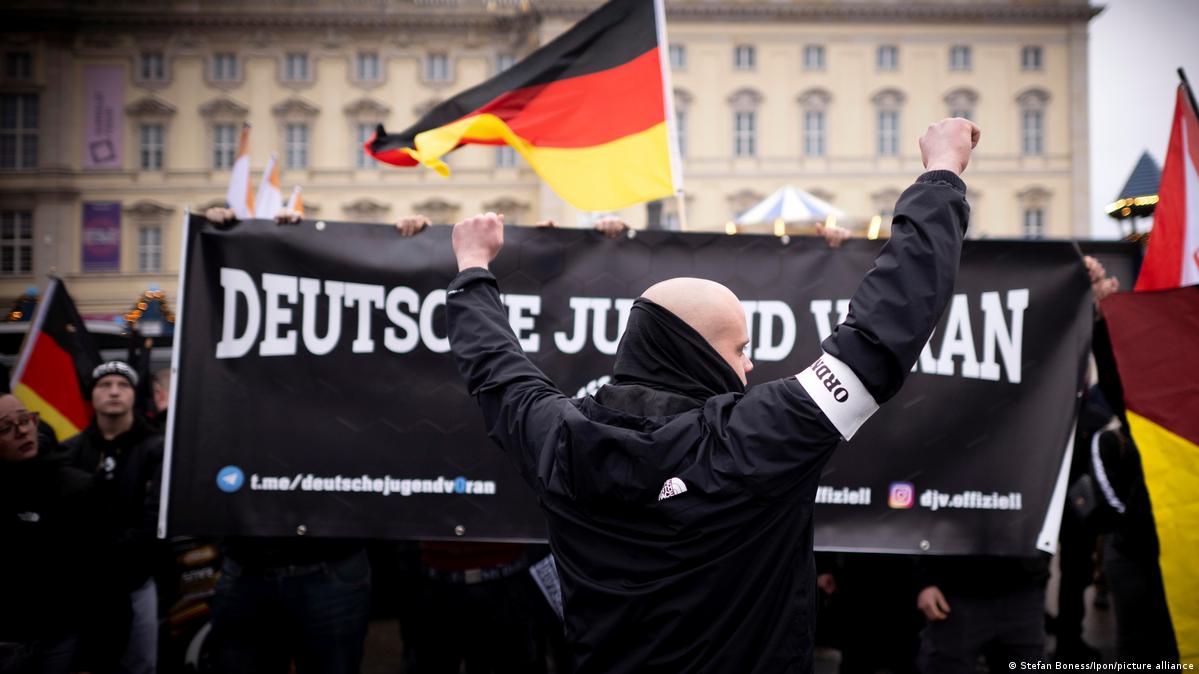
For years, young neo-Nazis have been trying to gain a foothold in Berlin — especially in Marzahn-Hellersdorf. At the forefront are two of the groups that were the targets of police raids in Germany this week: Deutsche Jugend Voran ("German Youth Forward") and Jung und Stark ("Young and Strong"). Both of these have become adept at using social media to spread their hatred toward queer people, immigrants, or political opponents. But here in Marzahn-Hellersdorf, they also make their presence known on the streets — as with a violent attack during the LGBTQ community's Christopher Street Day celebrations. The police reported at the time that two of the neo-Nazis were under the age of 14.
Nazi stickers and far-right symbolism
This xenophobia isn't always immediately visible in the neighborhood: Many streets are beautifully kept, with plenty of flowers and trees. Everything is neat, quiet, and clean. But the far-right undercurrent is still part of everyday life. During DW's tour, a man on a bicycle rode past and called out, "Heil Hitler."
In Germany, this statement, along with the Nazi salute and several other Nazi paroles are banned in public.
A few hundred meters further down a busy street, a sticker affixed to a lamppost read the racist slogan "Germany for the Germans," next to the logo of a small neo-Nazi party.
Anne gathers the stories of those affected by hate and violence: "People have called me and said: 'I'm hiding right now — I just ran away from a group of ten teenagers!'" Young people have been brutally beaten up. "This is immense, escalating violence that people can feel. And you think twice about how you dress if you're young and anti-Nazi."
Gordon Lemm, deputy district mayor of Marzahn-Hellersdorf, has also observed the spread of violence and hate. A member of the center-left Social Democratic Party, Lemm grew up in this neighborhood. For some time now, he says, queer people in particular have been targeted: "Unlike in other Berlin neighborhoods, there aren't any queer cafes here that are a normal part of the cityscape," he told DW. "We have fewer safe spaces here in the neighborhood. I'm hearing that queer young people are becoming less and less willing to be visibly queer."
Lemm has noticed a growing backlash against liberal values among young people. "According to their ideas, women are supposed to return to traditional roles, and men are supposed to be the breadwinners," he says. This backlash is also fueled by growing social insecurity. "I sense a certain coldness in my neighborhood. People keep to themselves and don't want to stand out. They don't want to be approached or looked at strangely. There's a kind of protective wall that many try to project through their appearance: Hair cut as short as possible and clothing that conveys a certain strength outwardly, because they don't want to be seen as victims. I'm seeing this become more pronounced again in Marzahn-Hellersdorf."
Of old and new Nazis
To view this video please enable JavaScript, and consider upgrading to a web browser that supports HTML5 video
Everyday racism against migrants
People like Farzaneh are the first to feel this. Like Anne, she is 30 and lives in Hellersdorf. Farzaneh wears a loose headscarf. Her family is from Afghanistan, but she herself was born in Iran, and they have lived in Hellersdorf for many years. She met Anne when she reported the everyday racism to the online registry Berliner Register, where users can report racist incidents they experienced in Berlin.
"In my family's building, my mother was insulted by an older woman: Every time she saw my mother, she would say some insult." Farzaneh herself laughs off the hostility she faces in her daily life: The stares she encounters at the supermarket, on the subway, on the street. That's how racism starts for her. But she fights back. "I'm not weak just because I'm a woman. I can protect myself."
And despite everything, she loves Berlin: "When I was in South Tyrol for a while recently, I missed multicultural Berlin." She enjoys living in Germany and, after many years — having graduated from high school and college — now wants to become a naturalized citizen. "The good thing about Germany is: You can at least report incidents to the [Federal] anti-discrimination office. That doesn't exist in Iran. At least here, you can defend yourself."
Barbara Jungnickel also wants to stand up for herself. Once a week, she opens her converted construction trailer in the heart of Hellersdorf, which she calls her "Cafe on Wheels," where she invites neighbors over for coffee and cookies. Jungnickel is a community educator for the local Protestant church.
She wants to start dialogues with anyone she can. "I don't steer the conversations in any particular direction," she tells DW, "I don't want to."
She launched her cafe project in 2013, when a shelter for refugees opened in the neighborhood. "Right-wingers came from all over Germany to march through the streets here and shout, 'No to the shelter.' And we as a church community, were shocked to see how many neighbors simply ran after them and shouted along with them."
The cafe might be a modest starting point from which to counter xenophobia, but it is proof that every single person can make a difference. Barbara Jungnickel, Anne, Farzaneh, and Deputy Mayor Gordon Lemm — they all refuse to cede the city to an aggressive minority. They are fighting back against what has become a worrying trend in Germany.
This article was translated from German.
AdvertisementСхожі новини
Africa summit in Kenya: France seeks new partners
Hantavirus: First evacuation flight leaves Tenerife
'No comment' after Schröder named by Putin for Ukraine talks