At Auto China, Geely Leans Heavily On The Software Defined Vehicle
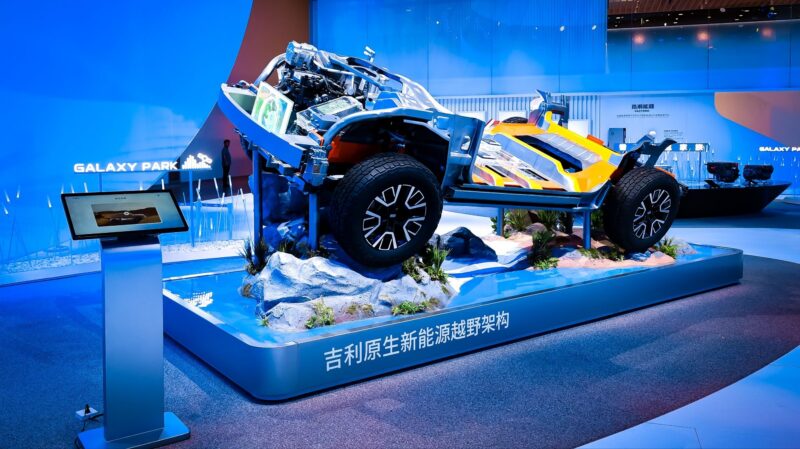 This is Geely's first dedicated off-road new energy vehicle architecture. (Photo from Geely)
May 7, 20263 hours
Raymond Tribdino
0 Comments
Support CleanTechnica's work through a Substack subscription or on Stripe.
This is Geely's first dedicated off-road new energy vehicle architecture. (Photo from Geely)
May 7, 20263 hours
Raymond Tribdino
0 Comments
Support CleanTechnica's work through a Substack subscription or on Stripe.
I arrived late to the Auto China 2026. Media day was already 2 days over and the crowds filled the China International Exhibition Center and every brand was doing its best to attract the crowds. Chery had Chinese superheroes on stilts to launch its new QQ EV. Brands like BYD and its luxury sub-brand Yangwang stole the spotlight with the DiSus-X system, allowing the U9 supercar to perform rhythmic jumps and sway its body in sync with music. NIO demonstrated its SkyRide intelligent suspension by making the ET9 flagship sedan sway with fluid, human-like grace, while AITO utilized its Huawei-powered active suspension to maintain a perfectly level cabin while its wheels vibrated rapidly on simulation platforms.
These displays were more than mere entertainment; they were designed to showcase the arrival of physical AI, proving that modern electric vehicles can now manipulate their mass and suspension in real-time to enhance both safety and passenger comfort.
Geely did not rely on spectacle to hold attention.
The stand was dense with hardware, cutaways, and engineers moving between media briefings, a setup that made it clear the company wanted to be read through its systems rather than its staging. Compared with the louder, crowd-heavy booths elsewhere in the halls, Geely’s presence felt deliberate and technical, closer to a working lab than a theatrical reveal.
The Hangzhou-based manufacturer is no longer framing its transition as a shift from combustion to electrification alone, but as a move into an AI-defined vehicle architecture layered across multiple powertrains. That framing anchored a presentation built around three pillars: a new design direction, a dedicated electrified off-road platform, and a hybrid system intended for scale.
Unveiled were the “Galaxy Light” 2nd Generation Concept model and their first dedicated off-road new energy vehicle architecture. A full line-up of Geely Auto’s best-selling models were on display including the Galaxy M9, Galaxy V900, Xingyao (Starshine) 8, Xingyue L (Monjaro) i-HEV, Galaxy M7, and StarWish (EX5).
The Galaxy Light second-generation concept was the visual entry point. On the floor, it reads less like a distant concept and more like a near-production statement of intent. The proportions are controlled, the surfacing restrained. What Geely calls “Ripple Aesthetics” is not expressed through aggressive form but through light management and surface continuity. The front end is anchored by a wide, illuminated grille pattern that transitions into slim headlamp units, while the body side avoids heavy sculpting in favor of long, uninterrupted lines. The overall stance is composed rather than dramatic, signaling a shift toward a more mature design language.
The interior is where the concept becomes more assertive. Instead of the now-standard minimalist, screen-dominated layout, Geely is pushing a layered, atmospheric cabin. Materials move between wood textures and crystalline elements, and lighting is treated as a primary interface rather than a background feature. The system actively changes tone to simulate environmental conditions, from daylight to overcast, paired with climate controls that mirror those shifts. The references to West Lake and traditional Chinese design are not subtle, and that appears intentional. Geely is no longer masking its cultural origin for global markets; it is exporting it.
Away from the concept car, the more consequential engineering reveal sat deeper into the stand: a purpose-built new energy off-road architecture. This is not an adaptation of an existing combustion platform. The layout is designed from the outset around electrified propulsion, and that starting point shows in both packaging and control strategy.
The system uses a three-motor configuration, with a front-mounted drive unit and two independent rear motors. Combined output is quoted at over 1,000 horsepower, with acceleration figures in the four-second range. More relevant than peak output is how that power is managed. Torque distribution is handled through software, with the system able to allocate drive at each wheel in real time based on terrain feedback. The absence of a conventional rear differential allows for finer control, particularly in low-traction environments.
The platform retains a body-on-frame construction, paired with double wishbone suspension front and rear. This combination targets durability and articulation, critical for off-road use. Battery placement is low and protected by a multi-layer structure designed to absorb impacts from below. Engineers at the booth repeatedly pointed to the separation of high-voltage systems from fuel and cooling circuits, a design decision intended to reduce fire risk under extreme operating conditions.
Weight distribution is held at an even front-to-rear balance, improving stability across uneven terrain. Packaging efficiency is also a priority. By integrating the battery, motor, and control systems within a dedicated architecture, Geely has minimized intrusion into passenger and cargo space while still allowing for larger energy storage capacity. The message is direct: electrified off-road vehicles do not need to compromise on capability, range, or usability if the platform is engineered correctly from the beginning.
Running alongside this was Geely’s i-HEV intelligent hybrid system, which drew consistent attention from both media and industry visitors. Unlike the concept or the off-road platform, this is a technology ready for immediate deployment across the company’s lineup. It is built on the GEEA 3.0 electronic architecture and integrates what Geely describes as a full-domain AI control layer for managing power delivery and efficiency.
The system’s headline figure is an engine thermal efficiency of 48.41%, placing it at the top end of current mass-production benchmarks. On the show floor, Geely tied that claim to a Guinness World Record result, where an Emgrand i-HEV achieved fuel consumption of 2.22 liters per 100 kilometers under test conditions. The electric motor produces up to 230 kW, enabling extended low-speed electric driving and reducing reliance on the combustion engine in urban environments.
What Geely is emphasizing, however, is not just efficiency. Engineers described the system in terms of feel, specifically the ability to replicate the smooth, immediate response of a battery electric vehicle while retaining the range flexibility of a hybrid. That includes reduced noise and vibration, faster torque delivery, and more seamless transitions between power sources.
Durability claims are equally aggressive. The system has undergone 15,000 hours of bench testing, equivalent to approximately 4.8 million kilometers of use, and is supported by architectures already deployed across more than a million vehicles globally. The intent is to position i-HEV not as a transitional technology, but as a core component of Geely’s medium-term strategy.
The product announcements surrounding these technologies reinforce that approach. The Galaxy M7 long-range hybrid is entering the market with a claimed total range of 1,730 kilometers and a pure electric range of 225 kilometers, figures that place it at the upper end of current hybrid capabilities. The Galaxy M9 received an updated variant with the H7 intelligent driving system, while the Starshine 7 sedan is being positioned as a global contender in the premium mid-size segment.
Underlying the presentation is a strong commercial base. Geely reported first-quarter 2026 sales of 709,358 units, maintaining its position as the leading Chinese automotive brand by volume. The Galaxy series, launched only three years ago, has already surpassed two million cumulative sales, indicating rapid acceptance in the new energy segment.
Walking the stand, the through-line is consistency rather than disruption. The concept car defines a controlled evolution in design. The off-road architecture opens a new technical segment within electrification. The hybrid system provides a scalable bridge across markets where full electrification remains uneven.
Geely is not presenting a single defining breakthrough. It is presenting a coordinated system of technologies designed to operate in parallel, supported by a common AI and electronic backbone. That coherence, more than any individual product, is what the company is putting forward as its competitive advantage.
Sign up for CleanTechnica's Weekly Substack for Zach and Scott's in-depth analyses and high level summaries, sign up for our daily newsletter, and follow us on Google News! Advertisement Have a tip for CleanTechnica? Want to advertise? Want to suggest a guest for our CleanTech Talk podcast? Contact us here. Sign up for our daily newsletter for 15 new cleantech stories a day. Or sign up for our weekly one on top stories of the week if daily is too frequent. CleanTechnica uses affiliate links. See our policy here.CleanTechnica's Comment Policy
Share this story!
Схожі новини

росіяни скинули три авіабомби на спальний район Краматорська - є жертви