ARIDGE Land Aircraft Carrier: Modular Electrification Takes Flight
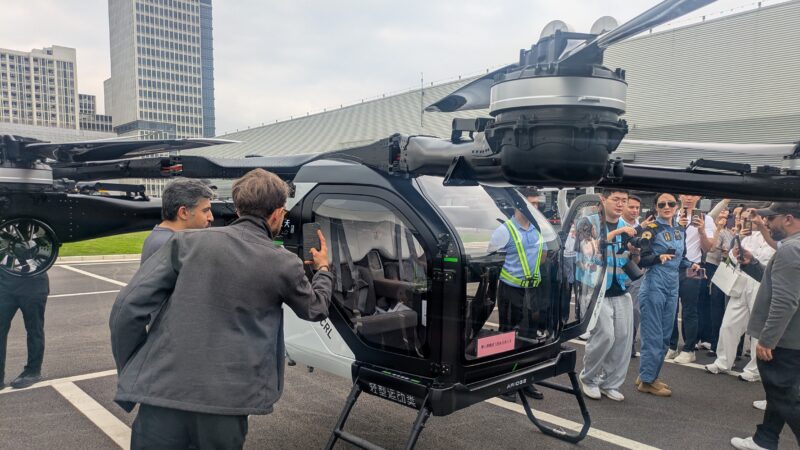 ARIDGE flight demonstration. Photo by Larry Evans
May 6, 20263 hours
Larry Evans
0 Comments
Support CleanTechnica's work through a Substack subscription or on Stripe.
ARIDGE flight demonstration. Photo by Larry Evans
May 6, 20263 hours
Larry Evans
0 Comments
Support CleanTechnica's work through a Substack subscription or on Stripe.
XPENG gave us the opportunity to tour its facilities in Guangzhou, prior to traveling to Beijing for Auto China and to test drive VLA 2.0. One of the most interesting parts was the ARIDGE factory tour and flight demonstration. ARIDGE is a division of XPENG dedicated to electrified, highly automated flight, as part of an overall push in China to develop a low-altitude economy. I typically focus more on electrified ground vehicles. However, seeing electric flight in person sparked the imagination and makes you think about the possibilities.
ARIDGE calls it “The World’s First Modular Flying Car Set for Mass Production.” The company has already started trial production and will start consumer deliveries later this year. It is already sold out for 2026 and is looking into expanding production capacity based on consumer response. The land vehicle will be produced at XPENG’s highly automated automotive manufacturing plant, while the aircraft will be built at a more manual but still high-tech facility. Having toured both plants, aerospace and automotive manufacturing look significantly different and have very different requirements.
According to ARIDGE, the two-part system will “make personal flight accessible and bring it from professional domains into everyday life. By simplifying operational processes and enhancing the user experience, the ‘Land Aircraft Carrier’ makes flying easy, safe, and enjoyable. This phase allows more people to experience the thrill of flight, explore new possibilities for future mobility, and serve as a valuable piloting stage for public services.”
A price range of roughly 2 million RMB/US$300k is a lot of money to most people, but it starts to look more reasonable in context. The two module system costs less than an AMG G63 G-Class in China. It is significantly less expensive than a four-seat V8 Range Rover SV. Those cars could largely go unnoticed driving down the street.

In comparison, the Land Aircraft Carrier ground module stands out as significantly more advanced. All three axles have electric motors and steering, allowing for high levels of traction and tight maneuverability despite its size. An active suspension system provides improved on-road and off-road capability. The EREV platform has a combined range of over 1000 km. Bi-directional charging between the modules lets the helicopter charge on the go or provide additional range to the ground vehicle. The ground vehicle is designed to be able to operate without needing a special driving license and is capable of self-driving. In some ways, the ground vehicle alone could be seen as justifying the price.
And that is before getting to the 700kg aircraft that deploys and unfolds automatically from the back. If you ever look into buying a new two-seat helicopter, $300k for just the aircraft starts sounding like a bargain. Helicopters are not cheap. Beyond the construction itself, there are embedded costs associated with all the regulatory compliance and certifications needed for aircraft. The construction combines carbon fiber with forged aluminum mounting points. Multiple tests and verifications are made at each step. The manufacturing is more akin to Formula 1 car production than it is to the typical road car.

For a traditional aircraft, fuel and maintenance also are significant expenses that are greatly reduced through electrification. In addition, if you have ever seen a traditional helicopter pilot in action, the process is more like a complex dance than driving. Hands and feet need to be coordinated to operate a traditional helicopter. The simplified single-stick, single-hand control of the flying car makes operation more accessible to the average person and eliminates much of the expensive training and certification needed for traditional helicopters.

In addition, the aircraft also offers automated flight. The pilot can select a flight path, cruise automatically, and automatically return home. Whereas most aircraft still have the pilot fly for takeoff and landing, the aircraft can also do those automatically. Simply select the landing spot on screen and land like a self-parking car.

The aircraft uses two 25 kWh CALB batteries for redundancy in an 800V system. Each can provide up to roughly half an hour of flight time. The “Topflow High-Energy Solid-Liquid Hybrid Battery” offers an energy density of 360 kWh/kg and a 10C charge speed. It is designed specifically for aviation applications. In addition to the redundancy in the batteries, the 6 propellers allow for the aircraft to continue operating if one of the propellers fails, and layers of redundancy are built into the flight systems, providing an added level of safety.

Overall, when seeing the flight demonstration, it seemed much quieter than a traditional helicopter or even a straight-piped Harley Davidson motorcycle. More like a lawn mower. You probably wouldn’t want one taking off right outside of your window at night, but I probably would sleep through it traveling overhead. Not louder than the LIRR trains that run a few blocks away from my apartment.
Compared to a traditional helicopter, the system would significantly reduce emissions. Providing enough thrust to lift a payload vertically off the ground takes a lot of energy. In a traditional helicopter, that consumes a lot of fuel. In addition, flight might not be needed for the entire journey. By having an electrified vehicle transport the aircraft for much of a journey, the net energy needed is reduced.
For someone with the means, I could see this being an attractive option. It could potentially get you to the office or the airport when traffic is congested. Billionaires could have it transport them to the helipad on their yacht. You could use it to get to a remote cabin in the woods or island a few miles offshore. Private islands might be seeing a depressed real estate market due to current connotations, creating an opportunity for the wealthy to buy now at low prices.

Beyond transportation for the wealthy, the system has several other potential uses. I could see it being popular in tourism applications. People could drive up to a remote location and then fly over a natural landmark or historical architecture. I could also see it being useful to transfer people to remote locations or ski slopes.
I could also see it being useful for inspections where an unmanned drone is not sufficient. Harbor pilots could use it to board ships being taken into port. Emergency personnel could be transported where they are needed. People could be evacuated. With autonomous operation, both seats could be used.
I could also see XPENG getting greater scale for the ground vehicle by transporting other types of vehicles. I mentioned a small boat, although an ATV or dirt bikes could also be deployed.
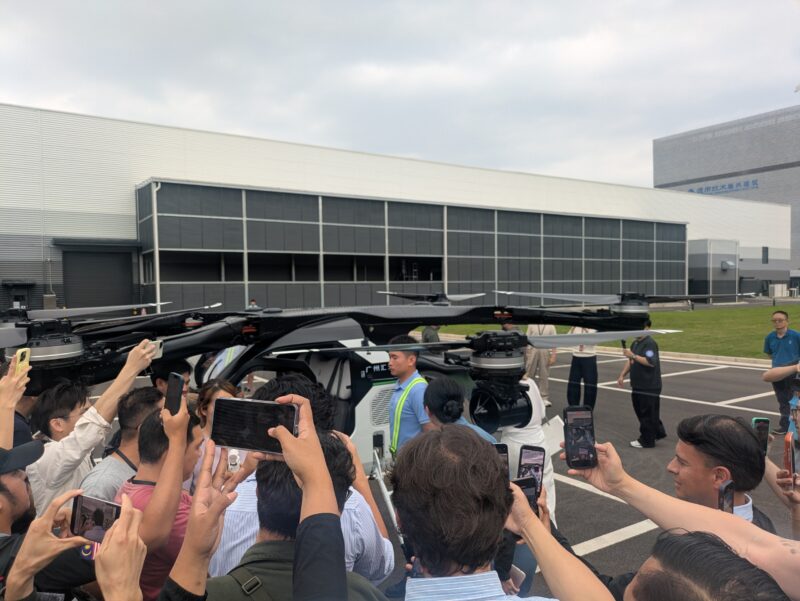
While many of us would likely never buy a vehicle like this, it sparks the imagination. You start thinking about the potential applications. You start contemplating what the next generation vehicle could become or what new markets could be addressed with economies of scale. I have no doubt that there is a market for the current vehicle now. I also have little doubt that this endeavor will lead to the development of multiple technologies that we could soon see trickle into a wide range of efficient products.
Sign up for CleanTechnica's Weekly Substack for Zach and Scott's in-depth analyses and high level summaries, sign up for our daily newsletter, and follow us on Google News! Advertisement Have a tip for CleanTechnica? Want to advertise? Want to suggest a guest for our CleanTech Talk podcast? Contact us here. Sign up for our daily newsletter for 15 new cleantech stories a day. Or sign up for our weekly one on top stories of the week if daily is too frequent. CleanTechnica uses affiliate links. See our policy here.CleanTechnica's Comment Policy
Share this story!
Схожі новини

“Pretty easy to clear up”: Candace Owens questions Blake Neff over Erika Kirk TPUSA leadership video after Charlie Kirk death
What happens when cities ban cars?
What happens when cities ban cars?
