Architecture of remembrance and hope: Daniel Libeskind at 80
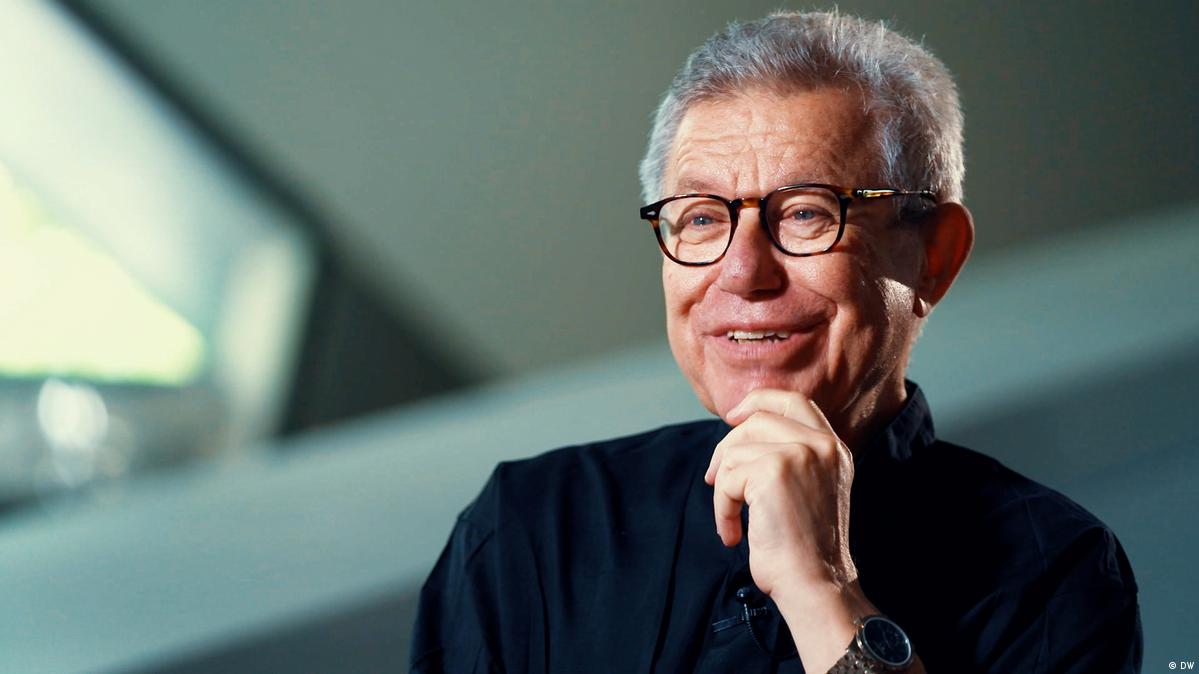
As Daniel Libeskind turns 80 on May 12, the renowned Polish-American architect shows no signs of slowing down and remains one of the most sought-after names in his field.
With his firm, Studio Daniel Libeskind, he is best known for large-scale projects and deconstructivist designs that frequently tackle complex cultural narratives, such as Ground Zero, built on the former site of the Twin Towers in New York City, and Berlin's Jewish Museum.
Not only are there several new projects in the works, but many of them underscore Libeskind's ongoing engagement with historical memory.
Among them, the Auschwitz Research Center on Hate, Extremism and Radicalization (ARCHER) project, announced in 2025, will convert the Auschwitz commandant Rudolf Höss' house into an anti‑extremism and education center.
The Albert Einstein Discovery Center in Ulm is set to become a major center dedicated to Einstein's contributions to science, technology, pacifism, humanism and international understanding in the theoretical physicist's birth place; its construction is scheduled for the early 2030s.
His most recent structures include a sculptural cancer‑care center in London called Maggie's Centre at the Royal Free Hospital, which opened in 2024. Libeskind also recently completed two major affordable‑housing works in the state of New York, the Rosenberg Residences and the Atrium.
The Museum of Zhang ZhiDong, a spectacular twisting structure that opened in 2018 in Wuhan, was his firm's first in mainland China.
Remembrance in architecture
His first major project, the Jewish Museum in Berlin, was completed in 2001.
The zinc-coated building has become a landmark of the German capital. The jagged floor plan is reminiscent of a fractured Star of David, representing the Jews who were arrested and assassinated in concentration camps during the Holocaust.
One of the central concepts of the building is its voids; these empty spaces that cut through the building from the basement to the roof acknowledge the erasure and void of Jewish life in German history.
"It's an experience, and some of it is foreboding," said Libeskind of the building. "Some of it is inspiring, some of it is full of light. Some of it is dark, some of it is disorienting; some of it is orienting."
The architect's own parents, who were Polish Jews, survived the Holocaust after being arrested.
Libeskind was then born one year after the end of the war, on May 12, 1946, in the Polish city of Lodz.
In 1957, his parents emigrated to Israel before moving on to the US several years later.
In an interview with the magazine Lufthansa Exclusive, Libeskind said that he continued to feel like a migrant throughout his life, just as his parents did. He added that, in his view, people have to learn that the world, and the city in which they live, is not their property, that all of us have to understand that our existence is only temporary.
Libeskind, an architect and a professor
Following his architecture studies, Libeskind was not only involved in architectural projects but also taught as a lecturer and professor at numerous universities, among them Harvard and Yale. From 1978 to 1985, he was dean of the architectural faculty of Cranbrook Academy of Art in Bloomfield Hills, Michigan.
The famous architect has also taught at German universities such as Humboldt University, Berlin, where he received an honorary doctor's degree in 1997, and at Leuphana University, Lüneburg, for which he designed the main building. Libeskind has also received other honorary titles from other universities, among them his former university in Essex.
In 1989, Libeskind moved with his family to Berlin, where he based his studio, in order to start designing the Jewish Museum there.
After he was chosen in February 2003 to rebuild the area around the former World Trade Center in New York, he moved to that city, where he founded a new studio managed by his wife, Nina.
Ground Zero, a truly gigantic project
The Ground Zero project needed years to be completed. Disputes surrounding the costs of the project and the realization of Libeskind's plans, including court cases, slowed down the work.
Many claim that not much has been left of his original drafts, but Libeskind himself recognizes his own concepts, claiming that the precise location and height of the buildings, as well as the streets, follow his original drawings. For example, he had planned his Freedom Tower, now called the One World Trade Center, to be 1,776 feet (541 meters) high, symbolizing the year the US declared its independence.
Buildings of remembrance
Symbolism in remembrance architecture, Libeskind's specialty, always tends to be controversial. In his publicly funded projects, he expresses through architectural forms the different breaks with the past, by adding modern geometrical glittering elements of steel and glass. Sharp angles and corners as well as light-flooded empty rooms are among his trademarks.
But even though the architect is renowned for the jagged, angular forms of his designs, for him, each project is about much more than having an eye-catching structure: "Every building needs to be memorable, that's what makes it sustainable," he once told DW. "Sustainability is not just technology, but the fact that people relate to a building over a long period of time." He pointed out that buildings that tell important pieces of history, "have even more responsibility to show the past in order to have a future."
#DailyDrone: Jewish Museum Berlin
To view this video please enable JavaScript, and consider upgrading to a web browser that supports HTML5 video
This article was originally written in German and is an updated version of a previous profile of Daniel Libeskind.
AdvertisementСхожі новини
Quote of the day by German philosopher Friedrich Nietzsche: “I cannot believe in a God who wants to be praised all the time”

World’s longest wild snake in Indonesia: The 23-foot ‘Baroness’ that stunned scientists and raised conservation concerns

ChudTheBuilder breaks silence after Nashville arrest and shocking FBI questioning over restaurant dispute