Anti-work anthems, Boy George and controversial lyrics: A guide to all 35 Eurovision songs

 BBC / EBU
Like a ray of sunshine on a cloudy day, the 2026 Eurovision Song Contest has arrived to dispel the gloom of a weary world.
With 35 countries taking part, it's the most compact competition since 2003 - due to a partial boycott over Israel's presence.
If you can put the politics aside (and many fans feel they can't), the competition presents its usual mix of mayhem and spectacle.
This year's hopefuls include a man entirely covered in silver paint, a fake gorilla, an actual Boy George - and the longest high note in Eurovision history.
With the semi-finals starting in Vienna this Tuesday, here's a guide to all 35 songs, sorted into poorly defined musical categories - because no functionally accurate system could define this madness.
Fandoms of the opera
 France Télévisions
Aria paying attention? OK, let's begin.
The last two Eurovision winners – Switzerland's Nemo and Austria's JJ – both deployed operatic vocal runs in their songs. So, naturally, there's a whole Liszt of copycats in 2026.
Best of the bunch is French prodigy Monroe – who, at the age of 17, is this year's youngest entrant.
Her song, Regarde!, combines a frenetic string section, glitching drum beats and Queen of the Night vocals in a way that suggests, "Hello, I have listened to the output of Spanish recording artist Rosalía" (this is a compliment).
Described as a "celebration of the richness of all of France's musical cultures," it builds to an earth-quaking climax, with stunning live vocals. With the right staging, it looks set for a Top 10 finish.
Montenegro's Tamara Živković takes a maximalist approach, plonking a Greek Chorus onto a jack-hammer techno beat on Nova Zora.
Co-written by actual opera singer Vesna Aćimović, it's all about women breaking free of gender stereotypes and striding towards a new dawn.
Montenegro haven't qualified from the semi-finals since 2015. Could this be the song to break their losing streak?
Finally, we have Latvian singer Liene Atvara, whose heart-rending ballad, Ēnā, addresses the lifelong impact of growing up with an alcoholic parent.
Full of sorrow and restraint, the opening verses are entombed by muffled synths before Liene explodes into an operatic wail of catharsis in the dying moments.
There won't be a dry eye in the house.
Lyrical controversies
 EBU
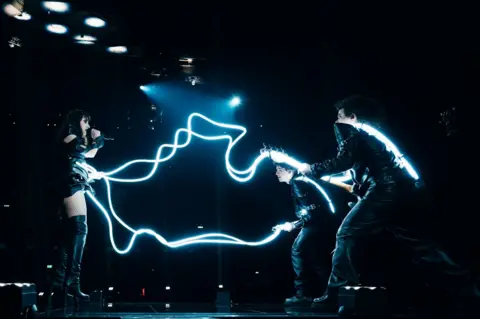
EBURomania's Eurovision entry, Choke Me, has been labelled "dangerous" and "reckless" for lyrics that appear to reference sexual strangulation, an unsafe practice that can lead to brain injury and death.
But Alexandra Căpitănescu, a Master's student at the Faculty of Physics in Bucharest, says campaigners have got it all wrong.
"Choke Me is a metaphor for the pressure we sometimes place on ourselves," she says.
"It speaks about inner fears, self-doubt, and the feeling of being emotionally suffocated by our own expectations. It was never intended to represent anything sexual."
What's not in doubt is that the song is powerful. Demonic guitar riffs churn under Căpitănescu's raspy vocals, giving the track a thrilling urgency. It's good to have Romania back after their two-year absence.
Equally compelling is Swiss star Veronica Fusaro. On the surface, her waltz-time ballad, Alice, seems to be a saccharine tale of love and devotion.
Dive deeper, however, and it's a horrific portrayal of abuse, written from the point of view of a stalker - an extra layer that makes a good song great.
Uncomplicated bops
 Getty Images
Sometimes, all we need is an excuse to cut loose and dance. Luckily, Eurovision's here to help.
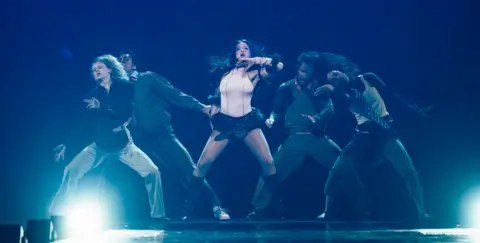
One of my favourites this year is Bulgaria's entry, Bangaranga. Sung by Dara, a proven pop star with a clutch of Top 10 singles, it's brilliantly unhinged and full of sass.
"I'm an angel, I'm a demon, I'm a psycho for no reason," she sings, channelling my cat's personality over a drum sound that could shatter windows.
Totally lacking in substance, with a gratuitous dance break – what's not to like?
Germany's Sarah Engels tries a similar trick with less success on her Euro-dance anthem Fire.
A relatively anonymous take on Dua Lipa's dance-pop, it loses points for rhyming "fire" with "desire" - but I can't get it out of my head. Don't write it off in the televote.
"Call me queen, though I'm not royal," declares Essyla on Belgium's brooding pop banger, Dancing On the Ice.
Sleek and hypnotic, it lacks the killer chorus needed to claim the Eurovision crown.
Finally, Cypriot entrant Antigoni - who you might recognise as a former Love Island contestant - beckons us onto the dancefloor for three minutes of Mediterranean escapism.
The lyrics to Jalla reference Tsifteteli - a popular Greek belly dance – and you can hear traces of Shakira in its mix of Eastern rhythms and sun-kissed sensuality.
The song's music video proved too much for a group of "concerned" public figures in Cyprus, who called it "unsophisticated" and "insulting to Cypriot history, traditions and aesthetics".
Needless to say, their complaints only make the song sound better.
Complicated bops
 EBU
EBUYou've only got three minutes to make an impression at Eurovision. Some contestants take that as a challenge to cram as many ideas as possible into their allotted time.
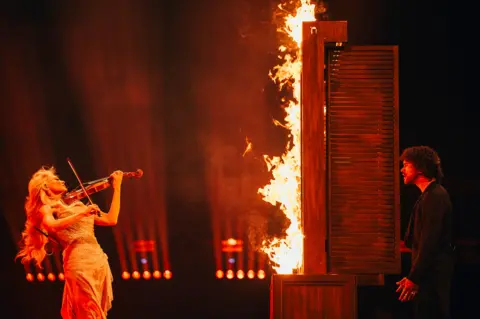
This year's alchemists include Finland's Linda Lampenius & Pete Parkkonen, whose song Liekinheitin (flamethrower) does a brilliant rug pull - transforming from impassioned ballad to demonic electro-pop, complete with a frenetic violin solo.
Already a number one hit at home, it's built around a disturbing metaphor for red-hot love ("Every time we're skin to skin/ You give me third-degree burns") and builds to a thrilling climax, like the countdown clock for a bomb that's about to explode.
It's currently the favourite to win – but Greece isn't far behind.
They're sending Akylas, who's taken the unusual step of combining traditional Greek instruments with Super Mario-style sound effects and a rib-shaking house beat.
Titled Ferto ("Bring It"), his song initially seems to be a hymn to fame: "I want glory, eternity, and cash".
Then the music falls away and Akylas sings directly to his mum, who raised him single-handedly during Greece's financial crisis.
"[I'll] make sure we never lack again," he promises.
Over in Poland, Alicja does a clever piece of misdirection on her song, Pray.
Playing on the title, it opens with a big gospel organ and a massed chorus, before a handbrake turn into lip-smacking rap. Nice idea, but it's a bit of a muddle.
Risking death from pore asphyxiation is Lithuania's Lion Ceccah, who performs Sólo Quiero Más (I Just Want More) covered head to toe in silver paint.
Sung in six languages, it's themed around the rise of artificial intelligence, and how humans become detached from reality the more they use it.
On stage, Lion re-enacts the struggle between man and machine, going from ChatGPT to ChatGP-Free. It's all a bit overwrought for my taste.
Sticking it to 'the man'
This year, we have not one, but two, songs that declare: "Take your job and shove it".
First to hand in his resignation letter is 31-year-old Simón Hovhannisyan, representing Armenia, with the grinding rock track Paloma Rumba.
"This meeting could have been an email / Free coffee won't keep me here, man."
On stage, Simón flings around reams of paper as he marches (and backflips) towards the exit, accompanied by Armenian folk instruments like the duduk and the dohl.
Ironically, for a song about burnout, it's exhausting to listen to.
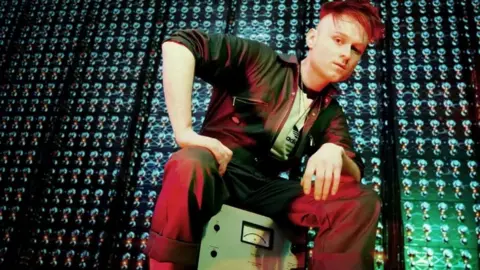
Representing the UK, the fantastically monikered Look Mum No Computer has similar complaints.
"The office cubicle has trapped me again," he squawks on a rambunctious synth-driven stomper that's equal parts Kraftwerk and The Kaiser Chiefs.
To resolve his dilemma, he takes a road-trip to Europe and delivers his naggingly catchy chorus – Ein, Zwei, Drei - in German.
It's a shameless attempt to court the EU voting bloc, and God knows we need it.
So far, the song's been divisive. Some have praised the UK for taking a risk, others find it irritating. A lot will depend on how it's performed.
The ballads
 EBU
EBUTurn on the wind machines, pump out the dry ice, set the lights to "romantic" - it's time for the slow ones.
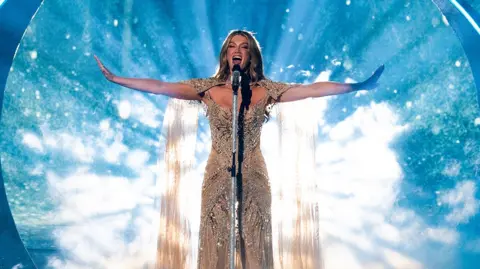
Top of the heap, alphabetically at least, is Australia – who are sending actual pop royalty Delta Goodrem to Vienna.
She goes full Celine Dion on Eclipse, a song about a passion so strong it blocks out the sun. It's scientifically unlikely, but Delta delivers the big notes with such conviction you almost believe her. It feels like a potential winner.
Equally dramatic is Danish star Søren Torpegaard Lund, who wraps his lungs around a torrid tale of toxic romance titled Før Vi Går Hjem (Before We Go Home).
"Kiss me, take my heart, break it again," he sings atop a convulsive electro pulse, as dancers pull him into a transparent "sweat box" that represents the relationship he can't escape.
I'm not a huge fan of the chorus – a simple climb up the scale of C Minor – but Lund's simmering intensity is captivating.
Azerbaijan's singer Jiva is much more ruthless as she dispenses with a lover on the cinematic ballad Just Go.
"I don't love you anymore," she seethes. "I will erase you from my soul."
If you like your music windswept and overblown, this is for you - but it's indistinguishable from every other windswept and overblown Eurovision entry that's faltered in the semi-finals since 2020.
More affecting is Malta's elegant and sentimental ballad Bella, sung by moustachioed troubadour Aidan.
One of the country's biggest stars, he brings an air of wounded sincerity to his performance, as he pines for the titular heroine, whose name appears 20 times throughout the song.
Ploughing a similar furrow is Israel's Noam Bettan, whose heart has been shredded by a femme fatale called Michelle.
Noam is "dancing with pain" and he's "trapped in a carousel" (to be fair, that does sound like it'd hurt) and his vocals grow more and more desperate as the song progresses.
With flourishes of Spanish guitar, it's solidly constructed but fails to connect emotionally.
Finally, we have Ukrainian band Leléka, whose song Ridnym without breaking Eurovision rules on neutrality, will resonate with anyone who has lived through a war.
"It's about a moment in your life when you think everything is over and you feel hopeless," explains singer Viktoria Leléka.
"But a small, small part of your soul is screaming, 'No, you want to live and to breathe and to continue, despite everything."
Delicate and understated, the song incorporates a stunning, 30-second-long high note. I feel breathless just thinking about it.
Culturally loaded lyrics
 EBU
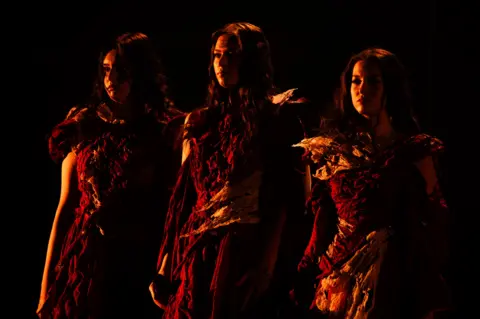
EBUAlbania's Alis has one of the year's most emotional storylines in Nân, a heart-wrenching ballad about a mother waiting desperately for their child to return home.
It's a familiar story in his country where, since the fall of communism in 1991, about 40% of the population has emigrated to find a better life.
Alis, a former X Factor winner, delivers the song with a sincerity and passion that's hard to match.
Croatia delivers a similarly harrowing story on Andromeda.
Performed in beautiful close harmonies by ethno-pop quintet Lelek, it discusses the suppression, abduction and forced marriage that Christian women endured in the Ottoman empire, and how they'd protect themselves by tattooing their bodies with symbols of the cross.
Portugal's entry, Rosa, is equally gorgeous, highlighting the a capella melodies of cante Alentejano, a musical tradition that arose amongst bull-herders who sang to co-ordinate the movement of their flocks.
In a sea of thumping dance tracks and billowing ballads, the simplicity of Bandidos do Cante's performance really stands out.
Turning the volume back up, we have Moldovan singer Satoshi.
His song, Viva, Moldova! is an absolute riot (think Chumbawamba's Tubthumping with added pan flute) that's simultaneously an anthem for the first Moldovan generation to grow up under independence.
"It's a song that cheers our culture," the 27-year-old says. "We have a very good vibe, good dances, cool music, good food, that we want to share with Europe."
Satoshi performs in a football shirt numbered 373 (the international dialling code for Moldova) and eagle-eared listeners will notice that the opening melody recreates the jingle that plays when you land at Chișinău airport. Ura!
Throwback pop
 EBU
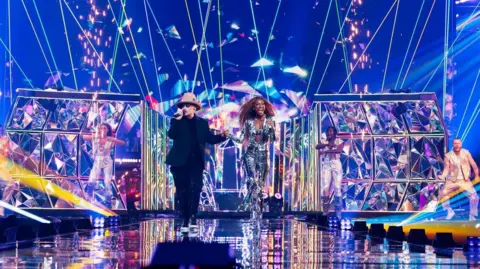
EBUSometimes, all you need is a touch of nostalgia, and San Marino's here to show why with the transcontinental disco grooves of Superstar.
It's performed by Senhit – a three-time Eurovision entrant, who made headlines in 2021 when she snared Flo Rida to perform on her 22nd-place track Adrenalina.
This year, she's enlisted Boy George, who turns up to sing about "all the boys at the bar sipping cool champagne". Sadly, the song has all the fizz of a Capri Sun.
A similar problem besets Georgia's On Replay – a generic club track with a tra-la-la chorus.
It's a shame because the band behind it, Bzikebi, are Eurovision royalty, who won the junior contest in 2008 with their song Bzzz. They still put on a great show, but this song has no sting.
I'm more partial to Per Sempre Sì, a throwback disco song from veteran Italian star Sal Da Vinci.
Dedicated to his childhood sweetheart Paola Pugliese, it's a testament to their 34-year marriage. "A love isn't a love for life / If it hasn't faced the steepest climb."
It's probably too dated to pick up the requisite votes, but Sal leaves me with a warm glow.
Finally, we have Luxembourg's Eva Marija – an accomplished musician who's currently studying songwriting at London's Institute for Contemporary Music Performance
She says that when she played her Eurovision entry, Mother Nature, to her classmates last year, "they just hugged me and were like, 'Girl, this is a hit'."
An uplifting hymn to the great outdoors, it has shades of Griff and Sigrid in its eco-friendly pop.
Kooky concepts and tortured metaphors
 ORF/Hans Leitner
Language is a funny thing. Some Eurovision songs get lost in translation. Others are just odd to begin with.
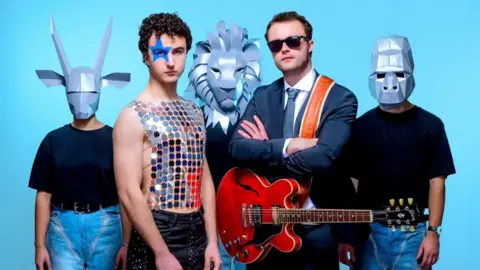
Take Austrian singer Cosmó, a 19-year-old with a blue star painted on his face, whose song Tanzschein literally translates as "dance licence".
"You need a dance licence, I have to be strict about that," he declares over a low-slung bass riff.
The song compares clubbers to jungle animals, and he's accompanied on stage by gorillas and lions. I think it's about toxic nightlife culture, unless Cosmó's accidentally stumbled into Schönbrunn Zoo?
Swedish star Felicia performs her song in a diamond-studded face mask.
"You're in my head, my heart, my body parts," she wails on My System.
But dig deeper and the mask represents her struggles with mental health and self-image. And the lyrics are really about a destructive relationship, allegedly based on Felicia's experiences in the music industry.
(The song also comes with an almighty techno drop that'll frighten your gran.)
Fans of mixed metaphors will enjoy Czechia's Daniel Žižka, whose song Crossroads finds him in open waters... and in foreign fields, and in a golden cage and also in a "vicious spider web".
Daniel says the lyrics address the difficulties of making decisions in an era of information overload – which explains his inability to pick an analogy and stick to it.
The song itself is a brooding ballad with an astonishing vocal climax, but will it leave voters trapped in a spider web of indecision?
Rock & roll, Eurovision style
 EBU
EBUThrow up your devil horns, people. The guitars are back.
Five years after Måneskin's victory, Norway is having a go at the stomp-rock thing via Jonas Lovv's Ya Ya Ya.
With a riff reminiscent of the Hives' Hate To Say I Told You So, it's a big, dumb singalong with charisma to burn.
Estonia's Vanilla Ninja – who previously represented Switzerland in 2005 - tread a similar path with the lightweight pop-rock anthem Too Epic To Be True.
It's languishing near the bottom of the bookmakers' odds, which is a shame, as I enjoyed its perky Josie & The Pussycats energy.
If you prefer your rock music sinister and creepy, then Serbia have you covered.
They're sending nu-metal band Lavina, whose song Kraj Mene (Next To You) is a smouldering story of suffocating infatuation.
Over three minutes, the pressure builds and builds until the frontman Luka Aranđelović erupts with a genuinely frightening scream.
This is what they play in hell before the demons feast on your cindered skin.
And on that disturbing note, we've reached the end of the list. Something for everyone and (hopefully) a little more than nul points for the UK.
See you in Vienna!