Abortion rights groups brace for another Supreme Court battle after justices restore telehealth access to widely used drug
The Supreme Court has temporarily reinstated mail and pharmacy access to a widely used abortion drug after a conservative federal appeals court abruptly cut off access last week, posing what advocates are calling the biggest threat to abortion care since Roe v Wade was overturned.
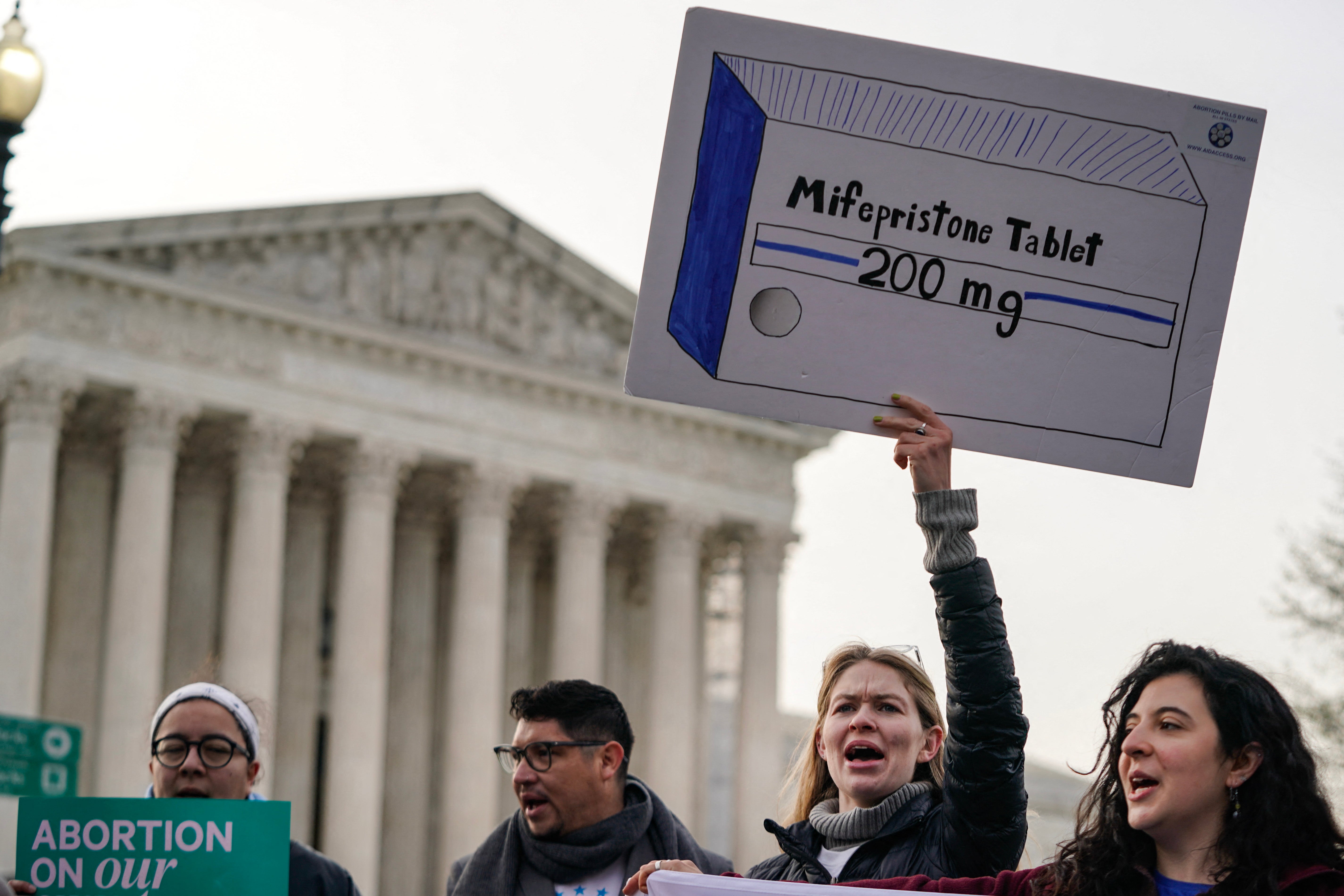
If the appeals court order is allowed to stand, patients across the country would be forced to travel to a health center to pick up a mifepristone pill in person — a journey that could be hundreds of miles for people living in states where abortion is banned.
The Supreme Court’s emergency relief will expire May 11, setting up yet another high-profile legal battle for abortion rights at the nation’s highest court.
“While this is a positive short-term development, no one can rest easy when our ability to get this safe, effective medication for abortion and miscarriage care still hangs in the balance,” said Julia Kaye, senior staff attorney for the Reproductive Freedom Project of the ACLU.
“The Supreme Court needs to put an end to this baseless attack on our reproductive freedom, once and for all,” she said in a statement Monday.
 open image in gallery
Abortion access that hinges on back-and-forth legal decisions “underscores just how unstable and politicized abortion access has become in this country,” said Nourbese Flint, president of abortion rights group All* Above All.
A “week-to-week rollercoaster” destabilizes providers and “sows real fear and confusion for people seeking time-sensitive, critical care,” Flint said in a statement.
After the Supreme Court revoked a constitutional right to abortion care in 2022, more than a dozen states outlawed abortions in virtually all circumstances, creating a patchwork of abortion access across the country. Other states added legal constraints for patients and abortion providers, who are now shielded in some states and criminalized in others.
Medication abortion accounts for the vast majority of abortions. Roughly 63 percent of all abortions are now medication abortions, according to the Guttmacher Institute, a reproductive health advocacy group.
Mifepristone, one of two prescription drugs used in medication abortions, is approved for use by the Food and Drug Administration up to 10 weeks of pregnancy. Nearly 93 percent of all abortions were performed before the 13th week, according to the Centers for Disease Control and Prevention.
The drug — which is also widely used for miscarriage care — is available through telemedicine, allowing patients to take the drug at home rather than inside a health clinic under doctor supervision.
More than one in four people who have an abortion get their medication through telemedicine, according to Guttmacher.
While anti-abortion activists push states for further restrictions to abortion care, President Donald Trump’s allies and Republican lawmakers are urging the FDA to revoke mifepristone’s approval altogether, what critics are calling a backdoor effort to ban abortion nationally.
The Trump administration has pledged to revisit the drug’s approval process. The FDA first approved mifepristone more than 20 years ago.
In 2021, the FDA under then-President Joe Biden permanently lifted the in-person requirement for mifepristone prescriptions, allowing patients to access the drugs via telehealth appointments and online pharmacies.
But on May 1, the Fifth Circuit Court of Appeals in Louisiana reinstated a nationwide requirement that patients obtain the drug in person, upending abortion access for millions of people across the country.
Drug manufacturers then turned to the Supreme Court to block the ruling.
 open image in gallery
“The order is deeply unsettling to drug sponsors, healthcare providers, patients and the public — all of whom rely on FDA’s exercise of scientific judgment and orderly administration of the Nation’s complex system of drug regulation,” lawyers for GenBioPro wrote in an emergency filing on Sunday.
Kelly Baden, vice president for public policy at the Guttmacher Institute, called the appeals court decision the “most sweeping threat” to abortion access since the Supreme Court overturned Roe v Wade.
“Reimposing medically unnecessary in-person dispensing requirements for mifepristone will send shockwaves of chaos and confusion across the country and dramatically upend patients’ ability to obtain abortion care,” she said in a statement.
The Supreme Court’s latest move provides “critical short-term relief” for abortion patients, “but the underlying threat to access remains just as dire as it was before,” she said.
“This ruling is not final — keep watching,” said Nancy Northup, president of the Center for Reproductive Rights.
“Getting abortion pills through telehealth has been a lifeline for women since Roe v Wade was overturned,” she said in a statement. “There is no reason people shouldn’t be able to get mifepristone at a pharmacy or through the mail. Louisiana's attempt to restrict access is political and not based in science or medicine.”
Nearly three-quarters of voters say decisions about medication abortion should be between a woman and her healthcare provider, according to the Committee to Protect Health Care, a political advocacy group of 36,000 medical workers.
The group’s latest survey also found that 60 percent of voters don’t want courts to overrule doctors and the FDA on abortion drugs, and 57 percent said a state’s abortion ban should not be used to restrict access to telehealth prescriptions for abortion drugs
Roughly one-quarter of respondents said states that ban abortion should also be able to stop doctors in other states from prescribing medication abortion across state lines.
Join our commenting forum
Join thought-provoking conversations, follow other Independent readers and see their replies
CommentsСхожі новини

У Києві вибухи: ППО відбиває наліт безпілотників

Голод в окупованих Олешках: як люди змушені виживати у заблокованому місті

Росія вгатила по Україні балістикою: у яких містах прогриміли вибухи
