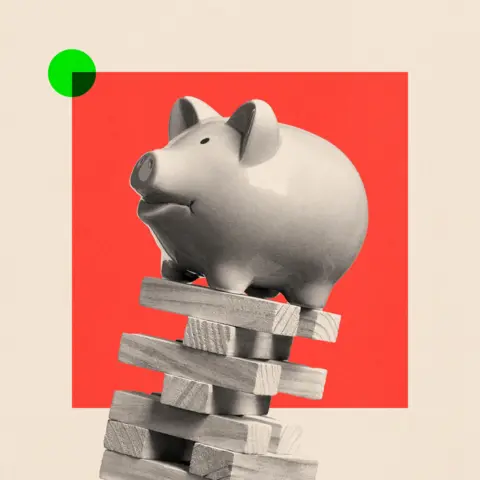
A fresh financial crisis may be coming - it won't play out like the last one

 Simon JackBusiness Editor
 BBC
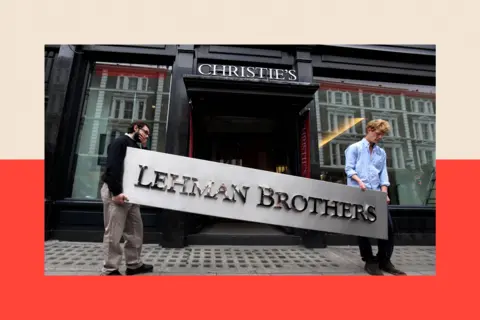
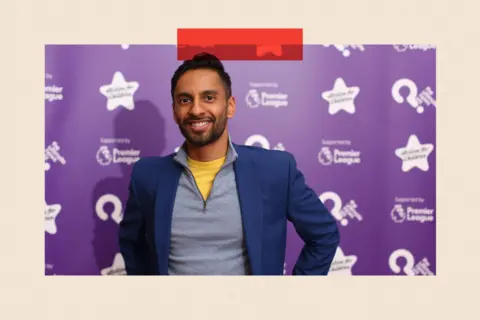
BBCOn 15 September 2008, Bobby Seagull arrived at his office in Canary Wharf just before 6am.
It was the last time he would need to be on time. He was a trader at Lehman Brothers, an American bank undergoing serious turbulence.
"We had seen on the Sunday news from America, they're filing for bankruptcy. We weren't quite sure [what] the implication was [for] us in the UK. So we were just told to turn up as normal."
Initially it was "chaos", Bobby says. "There was no direct communication with our American colleagues. They weren't picking up the phones. Some people were picking up items, like paintings on the wall and saying, 'They owe me shares'."
Bobby had an inkling that disaster might strike and was well prepared.
"I actually bought a shopping trolley on the last day. And funnily enough, that summer, people did sense a bit of disquiet. I emptied my vending machine card, [worth] £300 pounds, on chocolates, because I realised if the vending machine or the bank collapsed, my vending machine card would become defunct."
Bobby, along with thousands of colleagues, carried his career out in a cardboard box. It was a defining image of the global financial crisis which saw thousands of businesses fail and millions lose their jobs. It ushered in one of the longest and deepest recessions since World War Two.
 Getty Images
Now there are a number of warning lights flashing on the world economic dashboard that have some wondering whether we are in the foothills of another financial crisis.
What could the next meltdown look like? And with international relations in 2026 in a more febrile state than they were in 2008, will policymakers even have the tools to solve it?
Early warning signal
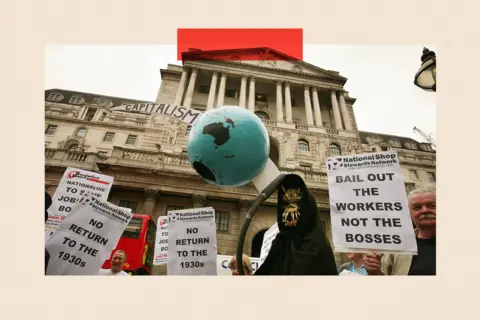
Before the crisis that engulfed the world economy in 2008, there were early warning signals in some parts of the financial system.
In 2007, investments in risky US mortgages went sour as homeowners struggled to pay. Funds run by Bear Stearns, BNP Paribas and other banks either had to freeze the ability of investors to take out their money, or liquidate the funds completely.
These problems were the canaries in what proved to be a very deep financial coal mine. As nervousness spread, even banks eventually stopped lending to each other for fear of not getting their money back, creating a so-called "credit crunch". That caused a global financial crisis.
 Getty Images
Fast forward to today.
Several funds which lend money have declared losses or restricted investors' ability to take out their money. BlackRock, Blackstone, Apollo and Blue Owl have all faced demands for billions of withdrawals from private credit funds - institutions that provide an alternative to traditional banks.
Bank regulators and financial veterans recognise the similarities.
Sarah Breeden is the deputy governor of the Bank of England, with specific responsibility for financial stability. She says the new world of private credit has grown quickly, has yet to be tested by financial adversity and is poorly understood.
"There are echoes of the global financial crisis in what we're seeing now," she says. "Private credit has gone from nothing to two and a half trillion dollars in the last 15 to 20 years. There is leverage [borrowed money], there's opacity, there's complexity, there's interconnections with the rest of the financial system. All of that rhymes with what we saw in the GFC."
She's also worried that a lot of the money lent by private credit funds has itself been borrowed, creating layers of debt - or leverage - that can amplify any losses.
"There is leverage on leverage on leverage. What we want to make sure is that everybody understands how that layer cake of leverage adds up."
 Getty Images
Mohammed El-Erian, chief economic adviser to German financial firm Allianz and former CEO of PIMCO, the world's biggest bond investor, agrees that the risk of another crisis is underestimated.
"There are certain similarities with 2007 that keep me awake at night. The similarities are clear fragilities in the financial system that are not properly appreciated."
In fact, he says, it was the restrictions placed on banks after the crisis that gave birth to this new private credit market. Banks were forced by new regulations to be more cautious, so funds that mimicked banks sprang up to fill the void.
"Suddenly the system is flooded with private creditors wishing to give money to companies. Companies see all this money available and of course too much money makes people make mistakes."
He lays out a scary scenario: "Suddenly everybody that lends you money wants their money back at the same time. The next thing you know, something that started out as a really good idea grows into something that risks instability, and rather than benefitting the economy, it actually risks pulling the rug out from under it."
But Larry Fink, the boss of the world's biggest money manager, BlackRock, recently told the BBC he did not agree that private credit posed a threat to the world economy.
The issues affecting some funds account for a small fraction of the overall market, he says.
BlackRock itself is one of several firms to have limited withdrawals by nervous investors from private credit funds. But Fink is adamant there is no chance of a repeat of the financial trauma seen in 2007-08, as he believes financial institutions today are more secure.
"I don't see any similarities at all," he says. "Zero."
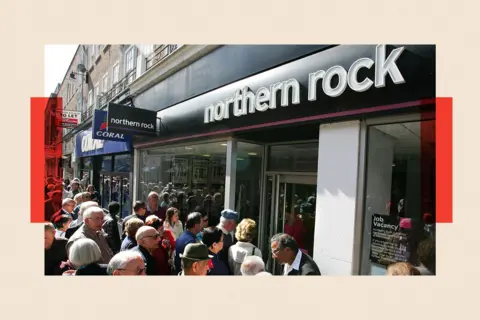
Nevertheless, some have likened what is happening in private credit to a slow run on a bank. You may not see the queues outside branches of Northern Rock, as we saw in 2007, but there is a line of people wanting their money back.
Energy
Another way in which history might be repeating itself is through surging energy prices.
That was a contributing factor to the 2008 crisis. The price of Brent crude oil went from around $50 a barrel at the beginning of 2007 to $100 by the end of the year – eventually peaking at $147 in July 2008. It was driven by surging demand from a rapidly expanding China but also in part from geopolitical tensions involving Iran.
Today, oil prices have risen to over $100 a barrel, with warnings they could go higher if there is not a speedy resolution to a conflict with Iran that has in effect shut the world's most important energy artery through the Strait of Hormuz.
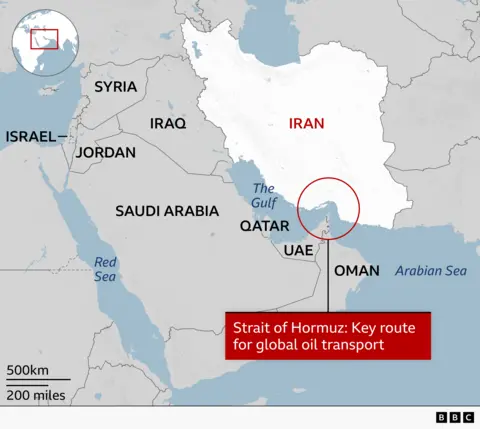
Fatih Birol, chief executive of the International Energy Agency, has called the ongoing closure of the Strait of Hormuz "the greatest energy security crisis in history", insisting it is "more serious" than the previous energy shocks in 1973 (when some Arab states imposed an oil embargo on the West), 1979 (caused by the Iranian revolution) and 2022 (Ukraine) "put together".
That level of gloom is not yet reflected in current oil prices. Although they have risen more than 50% since before the conflict with Iran, they are some way off the levels seen before the last financial crisis, when oil hit $147 dollars a barrel (in today's money, that's close to $190 a barrel).
And stock markets are currently at or near all-time highs - nothing like the oil shock of 1973, which triggered a 40% fall in US stock markets from peak to trough.
Sarah Breeden, of the Bank of England, says she expects stock markets to fall at some point, as they do not fully reflect the many current risks to the global economy. But for now, stock markets seem to assume that peace will eventually prevail, and lots of big companies are continuing to make more money than investors were expecting.
But an energy shock is part of the Bank of England's check list of risks which Breeden fears could hit simultaneously.
"What happens if a number of these risks crystallise at the same time?", she asks. "Major macroeconomic shock, at the same time as confidence in private credit goes, at the same time as AI valuations and other risky asset valuations readjust. What happens in that environment and are we ready for it?".
Artificial intelligence
And there Breeden hits on another risk to add to our potential crisis cocktail.
Over $2tn has poured into investments in AI, in what Microsoft co-founder Bill Gates has called "a frenzy" and others have described as a bubble.
It has propelled the valuations of a few mega companies to the point that 37% of the value of the main US stock market index, the S&P 500, is now concentrated in just seven companies (including Nvidia, Microsoft, Google parent company Alphabet and Amazon, which are also among the biggest spenders on AI infrastructure).
That means the millions of people who invest in index tracking funds are investing a large portion of their savings in AI, whether they want to or not.
A big sell-off in these companies would hit savers – including individuals and pension funds in the UK - and inevitably rock business and consumer confidence.
The bursting of the dotcom bubble, which peaked in March 2000, helped trigger a recession in 2001. The tech heavy NASDAQ index fell nearly 80% between March 2000 and October 2002, destroying billions in market value. That collapse of internet-based companies, massive investor losses, and widespread tech layoffs caused a broader downturn in the economy.
A financial fire
There's also the question of how effectively policymakers could hose down a financial fire.
In 2008 governments eventually got a grip on the chaos by pumping billions of public money into major banks to prevent their collapse, and raising guarantees on bank deposits to prevent savers fleeing. At the same time, major central banks cut rates, including a rare coordinated rate cut in the autumn of that year.
But some worry that those options may no longer exist.
In 2008, UK government debt amounted to less than 50% of national income. Today that number is close to 100%, after major interventions in 2008 bailing out banks, wage support during Covid-19, and the energy subsidies in 2022 after Russia's invasion of Ukraine. So, the government's ability to borrow money is much more limited.
Mohammed El-Erian uses the analogy of a fire brigade that has run out of water. "Governments and central banks have had to respond to crisis after crisis and as they have done, they've run down the ability to respond," he warns.
That sentiment is echoed by the International Monetary Fund (IMF), which said earlier this month that the world's manifold economic challenges come at a time when "policy space has been eroded".
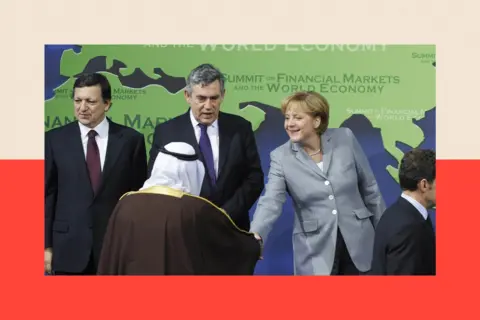
There's also the poor state of international relations. Amid the 2008 crisis, national leaders met at a series of emergency meetings, including a crucial one in Washington in November 2008, where they hammered out their plan to pour billions into banks; and another in London in April 2009.
Gordon Brown, the prime minister who helped to lead the international response, has said that strong international cooperation is what stopped the crisis from turning into a depression.
 AFP via Getty Images
All that could be more difficult today, amid significant disagreements between rich countries over trade policy, Nato, and even the status of Greenland.
Writing earlier this month about the dangers of a financial crisis, the IMF made a point of warning that "international cooperation is weaker" now than in previous years. The implication, perhaps, is that in an era of war in Europe, US-China trade wars, and US President Donald Trump's "America First" policy, it will prove more difficult for governments to put aside their differences and get around a crisis table in the way they did in 2008.
And Brown has repeatedly warned of the dangers of an isolationist, 'us versus them' approach to international affairs.
Financial fragilities
Sarah Breeden, however, gives a note of optimism, arguing that banks have more capacity to absorb shocks than they did in 2008.
She takes comfort from the fact that banks are "much more capitalised now" - in other words, they have higher reserves of cash, rather than relying on borrowed money.
"I don't think if we get stressed it will be on the same scale," she says.
Mohammed El Erian agrees - to an extent. "We're not exactly in 2008 territory because I do not believe that the banking system, and therefore depositors' money and the payments system, is at risk. But we are in a 2008 moment in that the financial system could aggravate economic fragilities that tip us into recession."
And if that does happen, he's in no doubt who will suffer most.
"Economic and financial fragilities tend to expose the most vulnerable segments of the population. They have the least resilience and tend to get [hit] particularly hard."
 PA Wire
Bobby Seagull, now a Maths teacher - says financial markets are even more complex now and you never quite know what nasty surprises are lurking under the surface.
"You're sort of passing on financial instruments from one person to the other, not sure what's inside it. And I think the worry is if things happen, they escalate very quickly in financial markets. And that's where you don't want to be the last person left holding that package."
Top picture credit: Getty Images
More from InDepthWhy cheap power could matter more than clean power in the push for net zero
Scammers are becoming ever more sophisticated - this is what the fightback looks like
Fairway or driveway? The furious debate over building houses on golf courses

BBC InDepth is the home on the website and app for the best analysis, with fresh perspectives that challenge assumptions and deep reporting on the biggest issues of the day. Emma Barnett and John Simpson bring their pick of the most thought-provoking deep reads and analysis, every Saturday. Sign up for the newsletter here
Financial crisis of 2007-08Bank of EnglandCanary WharfOilСхожі новини
Повітряні сили про нічну атаку РФ: зафіксовано влучання 12 дронів
На Сумщині через російський удар загинула жінка – ОВА
Харків вночі зазнав удару дронами, одна людина постраждала – влада