4 Measures EU Governments Can Deploy Now to Protect Drivers from the Oil Price Shock
 May 13, 20262 hours
Transport & Environment (T&E)
0 Comments
Support CleanTechnica's work through a Substack subscription or on Stripe.
May 13, 20262 hours
Transport & Environment (T&E)
0 Comments
Support CleanTechnica's work through a Substack subscription or on Stripe.
Four demand-side measures could save EU car drivers €30–74 billion per year.
The shock at the pump
The US-Israel war on Iran has sent oil prices to levels not seen since the 2022 energy crisis. With the Strait of Hormuz currently blocked — through which roughly 20% of global oil trade flows — markets are pricing in a sustained period of elevated prices. European drivers are already feeling the consequences. By mid-April, filling a 55-litre diesel tank cost almost €30 more than before the conflict began.
This is not simply a short-term spike. It is a reminder of Europe’s deep and costly dependence on imported oil for road transport. With the transition to electric vehicles still in progress, millions of households remain exposed to the full volatility of global oil markets.
But this is not inevitable — and the response should not fall on individual drivers alone. The IEA has identified a set of practical, low-cost behavioural and policy measures that governments can implement immediately to reduce fuel consumption and the household bills that come with it. T&E has quantified what these measures would mean in euros for EU car drivers.
These measures can ease the immediate burden — but they are not a structural fix. Only the transition to electric vehicles, which permanently removes drivers from oil market exposure, offers lasting protection from the next crisis. In the meantime, demand-side measures represent the fastest available policy response, and governments should act on them now.

Why this matters now
The US-Iran conflict has exposed the fragility of a transport system still overwhelmingly dependent on fossil fuels. While the long-term answer is electrification — which permanently insulates drivers from oil price volatility — that transition will take years to complete. In the meantime, demand-side measures offer the fastest available protection. Crucially, these are not measures that require major capital expenditure or long lead times. Three additional days of remote working per week, lower speed limits on motorways, or simply checking tyre pressure can be facilitated immediately by governments. In a political environment increasingly focused on the cost of living and energy security, these measures deserve attention. The oil price shock is happening now. The savings can begin immediately.
Four measures, real savings
The IEA’s 10-point plan for reducing oil demand in transport identifies five measures applicable to EU car drivers, four of which T&E assesses to be viable short term measures. T&E has translated each of these four measures into the corresponding annual consumer cost saving.
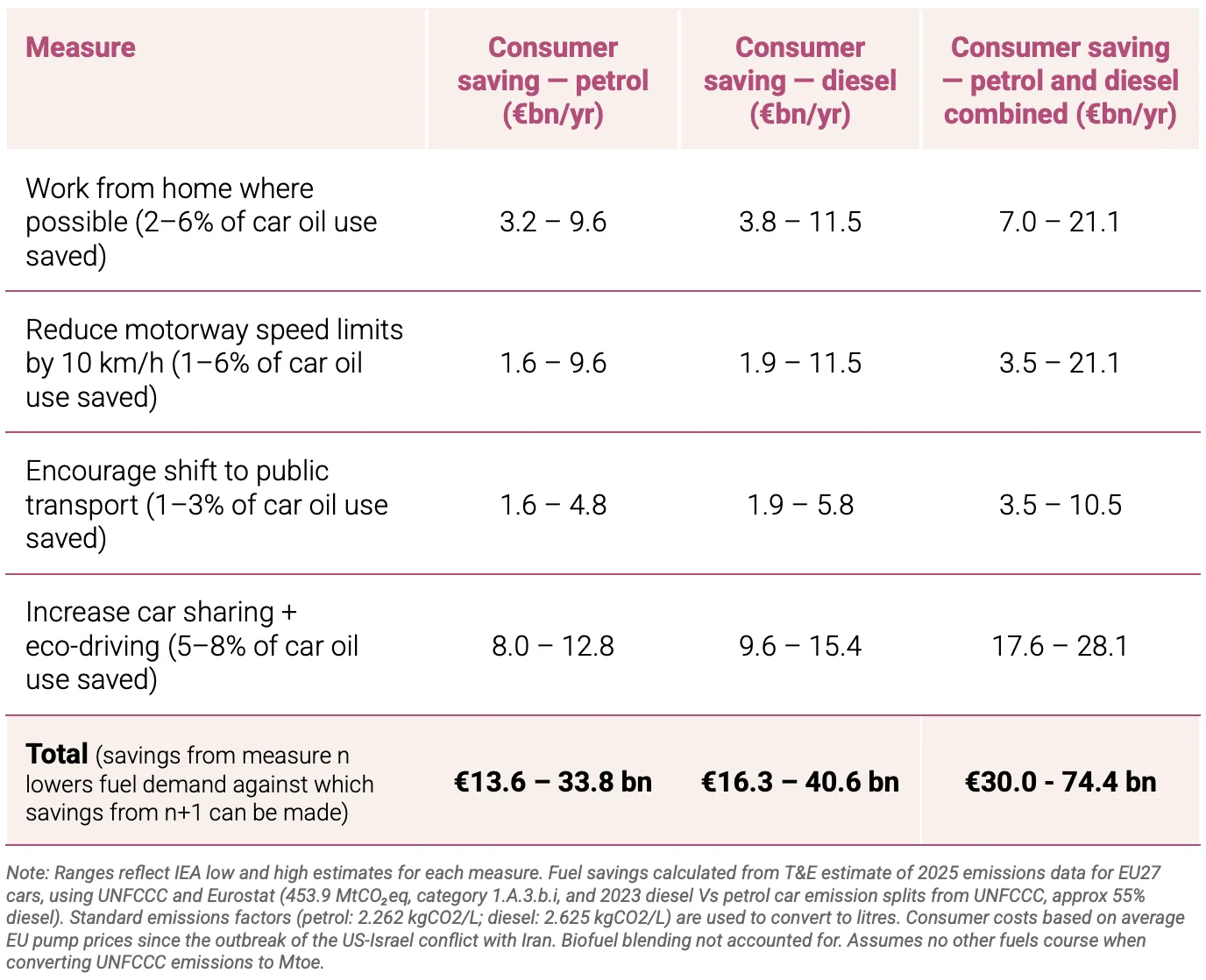
It should be noted that on the basis of equity we have excluded the IEA measure on alternate private car access to roads in large cities on different days. Further, the IEA measure on eco-driving (tyre pressures and air conditioning use) may be overstated, as drivers are likely to quickly revert to previous driving styles.

What policymakers should do now
- Encourage flexible working arrangements where feasible. Three additional remote working days per week could reduce individual driver fuel bills by up to 20%.
- Reinstate or strengthen motorway speed limit enforcement, with a minimum 10 km/h reduction on key corridors, as per the IEA emergency recommendation.
- Accelerate investment in public transport as an emergency energy security measure.
- Issue clear public guidance on eco-driving, tyre pressure maintenance and car-sharing to accompany any emergency communications on fuel prices.
- Pursue these short-term measures alongside the long-term structural solution: accelerated EV adoption, which permanently removes drivers from oil market exposure.
Briefing from T&E.
Sign up for CleanTechnica's Weekly Substack for Zach and Scott's in-depth analyses and high level summaries, sign up for our daily newsletter, and follow us on Google News! Advertisement Have a tip for CleanTechnica? Want to advertise? Want to suggest a guest for our CleanTech Talk podcast? Contact us here. Sign up for our daily newsletter for 15 new cleantech stories a day. Or sign up for our weekly one on top stories of the week if daily is too frequent. CleanTechnica uses affiliate links. See our policy here.CleanTechnica's Comment Policy
Share this story!
Схожі новини
Alien smuggling and ...: Iranian national pleads guilty in US court to two serious crimes
Trump becomes first U.S. leader to visit China since ’17 as high-stakes summit looms
Japan suspends Eddie Jones for verbally abusing officials