15-Year SAF Deal For UK’s Largest Regional Airline
 May 27, 202620 minutes
Tina Casey
0 Comments
Support CleanTechnica's work through a Substack subscription or on Stripe.
May 27, 202620 minutes
Tina Casey
0 Comments
Support CleanTechnica's work through a Substack subscription or on Stripe.
Last month, energy analysts warned that Europe had about six weeks of jet fuel left before the taps run dry, on account of the global energy crisis resulting from the Iran war. The juice is still flowing, but the war has prompted policy makers and private sector stakeholders to think more seriously about transitioning to SAF, aka sustainable aviation fuel, and the UK airline Loganair is among those who don’t need to be asked twice.
Loganair Hearts Next-Gen SAF
Loganair is pitching its hat into the SAF ring at a good time. The SAF industry is far more expansive now than it was in the early 2000’s, when innovation in the field has centered on bio-based versions of petroleum-based kerosene aviation fuel.
Jet fuel derived from cultivated algae earned itself a slot early on, based on its high oil content alongside the advantages of avoiding land use conflicts and food system competition, only to run into cost and scale-up issues. R&D work continues (here’s one example), but in the meantime other SAF has already gone into commercial production, mainly consisting of used cooking oil, animal fats, and other food wastes.
In recent years other SAF variants have entered the scene, supported by electrolysis systems, electric bioreactors, or both. Part of the appeal of these new systems is their scalability compared to conventional biofuel production. That explains why the US Air Force, for example, has been exploring e-fuels (short for electrofuels) of late.
On its part, Loganair has decided to embrace both biomass and e-fuel solutions. On May 26 the company announced a 15-year offtake agreement with the ClimaHtech Green Flight branch of the Belfast firm CATAGEN, covering both sides of the SAF coin.
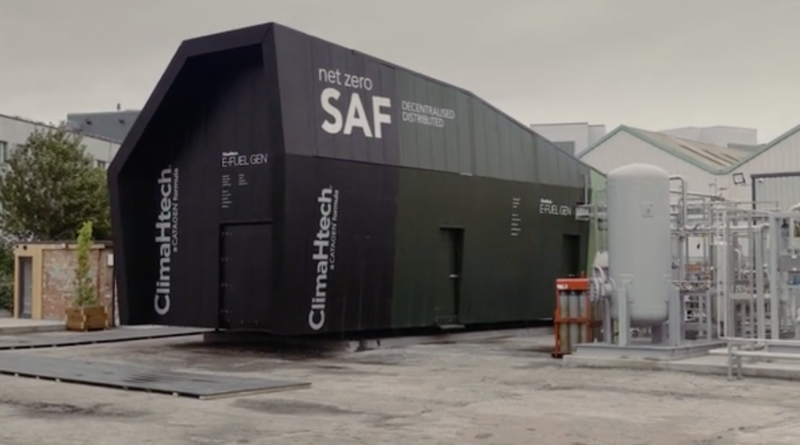
“The SAF will be produced using ClimaHtech Green Flight’s advanced technology pathways, including BioSAF (Power-Biomass-to-Liquid) and eSAF (Power-to-Liquid),” Loganair explains, adding that the technology provides new opportunities for decentralized SAF production alongside use of waste biomass and the deployment of intermittent renewable power sources, namely, wind and solar.
“This long-term agreement with ClimaHtech Green Flight is an important step in securing access to Sustainable Aviation Fuel that is produced closer to where we operate, supports UK supply chains, and reflects our commitment to lower our carbon footprint,” Loganiar CEO Luke Farajallah emphasized in a press statement.
Saving Excess Wind Power For SAF
ClimaHtech Green Flight describes the Loganair system as a first-of-its-kind project that centers the UK’s copious wind resources. “The ClimaHtech electrically driven platform is more tolerant to intermittent renewable power supply thus enabling direct connection to renewable electricity assets. By combining this with highly efficient energy and biomass utilisation, we are bringing a scalable and resilient approach to SAF deployment,” the company explains.
The aim is to harvest stranded wind resources that are curtailed during periods of low demand, or constrained by grid bottlenecks. The company is also focusing attention on wind farms that are too small to support large-scale, conventional biofuel operations and other large loads.
“As of April 2024, the UK had approximately 800 wind farms including nearly 10,000 onshore turbines with a total operational capacity of over 15.8GW,” ClimaHtech Green Flight observes. “Despite delivering around 29% of the country’s electricity, over half of these farms have capacities under 10 MW, making them incompatible with large-scale, centralised fuel plants.”
With that in mind, ClimaHtech Green Flight takes note of five advantages compared to conventional SAF facilities:
— Faster Deployment: Smaller, modular systems reduce installation time.
— Less grid strain: Built to operate alongside intermittent renewables, utilising energy that might otherwise be curtailed or lost through constraint.
— Local demand creation: The system can turn surplus renewable electricity into fuel, helping to maximise local resource use.
— Located near renewable generation allowing production sites to avoid costly grid upgrades and lengthy electricity transmission.
— Fabricated using industry-standard components, enabling rapid deployment without the need for extensive site groundwork or custom infrastructure.
The company also emphasizes the additional benefits of scaling down and decentralizing SAF production:
- Regional energy independence, reducing reliance on global fuel supply chains
- Greater energy security, especially important amid growing geopolitical tensions and fuel market volatility
- Economic resilience, as more value is retained locally through domestic fuel production
“While not a complete replacement for all fuel imports, it’s a critical step toward building a more secure, stable, and sustainable energy mix,” the company adds.
Meanwhile, Over In The USA
Activity in the bio-based SAF field has also been stirring in the US of late, partly due to the completion and commissioning of projects that were years in the planning. In a recap of events on May 6 of 2025, the US Energy Information Administration referred to the 10,000 barrels/day Phillips 66 Rodeo project and the 15,000 b/d Diamond Green Diesel Port Arthur project, both of which were nearing completion as of 2024.
By way of comparison, SAF production in the US totaled just 2,000 b/d at the beginning of 2024, split between two plants in California and Montana. The industry was easily outpaced by renewable heating oil and other renewable fuels in EIA’s “Other Biofuels” reporting category.
EIA also took note of two smaller projects under way in 2025, including New Rise Renewables in Nevada and Par Pacific in Hawaii, adding a total of 5,000 b/d to the pot.
All else being equal, last year’s burst of commissioning resulted in a doubling of the Other Biofuels category in just three months, from December 2024 to February 2025. “With SAF production capacity now around 30,000 b/d and growing in 2025, SAF will likely drive significant growth in Other Biofuels production,” EIA explained.
Don’t break out the pom-poms just yet. The amount of fuel that will actually make its way to a jet is still vanishingly small. “Despite strong growth in SAF on a percentage basis, the absolute volumes will remain relatively low, making up less than 2% of about 1.7 million b/d of U.S. jet fuel consumption in 2025 and about 2% in 2026,” EIA observed.
Not to worry. The emerging e-fuels industry is gearing up to help fill in the gap. Keep an eye on Texas, where the state’s renewable energy resources have been called upon to run electrolysis systems, producing green hydrogen to synthesize liquid fuels with captured carbon.
In the latest news on that score, in April the Sustainable Aviation Buyers Alliance and American Airlines selected the Project Atlas e-fuels facility for an aggregated off-take contract. The project, under the wing of the US firm Infinium Energy, will produce about 100,000 metric tons per year. Infinium submitted the proposal to SABA jointly with American Airlines.
Infinium also has two other e-fuels commercial scale projects in Texas, Project Pathfinder and Project Roadrunner.
Aviation stakeholders sign up for the SABA aggregation program on a voluntary basis, and Infinium also notes that the output from Atlas meets compulsory regulations in the EU. The system is based on book-and-claim accounting, meaning that the buyers don’t necessarily get their hands on the physical fuel. American Airlines will handle the fuel itself, and the other SABA members will share in the claim of emissions reduction.
Photo: The UK regional carrier Loganair has signed onto a modular, localized SAF (sustainable aviation fuel) system developed by the firm ClimaHtech Green Flight (courtesy of ClimatHtech Green Flight).
Sign up for CleanTechnica's Weekly Substack for Zach and Scott's in-depth analyses and high level summaries, sign up for our daily newsletter, and follow us on Google News! Advertisement Have a tip for CleanTechnica? Want to advertise? Want to suggest a guest for our CleanTech Talk podcast? Contact us here. Sign up for our daily newsletter for 15 new cleantech stories a day. Or sign up for our weekly one on top stories of the week if daily is too frequent. CleanTechnica uses affiliate links. See our policy here.CleanTechnica's Comment Policy
Share this story!
Схожі новини